Ho Foods


A compact Taiwanese kitchen on East 7th Street, Ho Foods has earned back-to-back spots on Opinionated About Dining's Cheap Eats list for 2024 and 2025. The short menu runs from radish cakes and fan tuan at breakfast through beef noodle soup at dinner, anchoring a consistent presence in the East Village's growing roster of serious Taiwanese cooking.
Pearl is the En Primeur Club membership app — saves, bookings, and concierge access live there. Same editors, same standards.
- Address
- 110 E 7th St, New York, NY 10009
- Phone
- (347) 788-0682
- Website
- hofoodsnyc.com
- Directions
- Get directions
 Saves & bookings on Pearl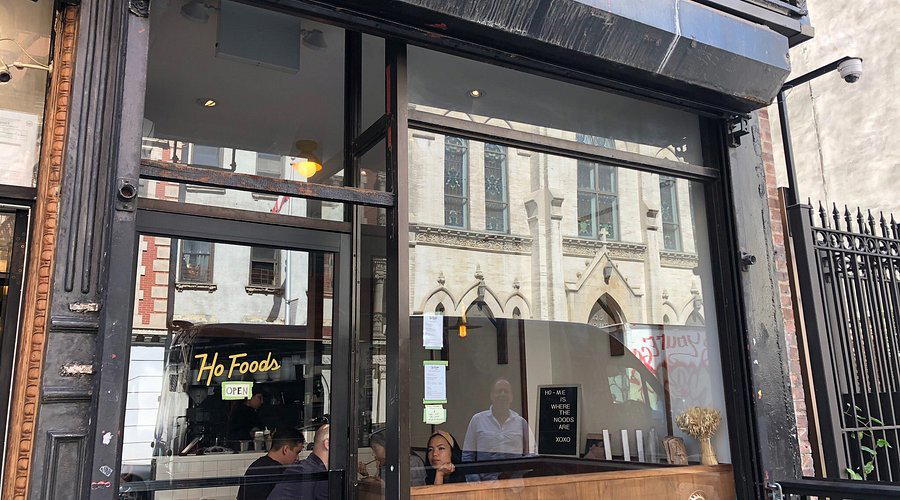
East Village, Taiwanese, and the Case for Doing a Little Extremely Well
East 7th Street between First and Avenue A holds a particular kind of credibility in New York's cheaper eating scene: small rooms, no reservations, lines that form before the door opens. Ho Foods, at 110 E 7th St, fits that physical grammar exactly. The East Village has always been the borough's pressure-release valve for serious food at non-serious prices, and Taiwanese cooking has found a sharper foothold there over the past decade, with 886 and Taiwanese Gourmet mapping the range from modern to traditional. Ho Foods sits at the disciplined, traditional end of that spectrum.
Taiwanese cuisine draws from a distinct set of regional influences that separates it from the mainland Chinese categories most New York diners know. Where Cantonese cooking prizes clarity of broth and restraint of seasoning, and Sichuan cuisine leans on numbing heat and fermented pastes, Taiwanese food carries a heavier debt to Fujianese settlers who crossed the Taiwan Strait over several centuries, mixed with Japanese colonial influence and the post-1949 influx of mainland Chinese regional styles. The result is a cuisine built around soy-braised proteins, rice-based breakfast formats, and slow-cooked beef soups with a depth that comes from time rather than complexity of ingredient. Ho Foods works squarely within that tradition.
The Format: Short Menu, High Return Rate
The menu at the restaurant is deliberately brief, which in this context functions as a quality signal rather than a limitation. Opinionated About Dining ranked the restaurant at #409 in its Cheap Eats in North America list in 2024 and moved it to #419 in 2025. That consistency across years matters more than a single-year placement; it suggests the kitchen is not coasting on early attention.
The morning menu follows Taiwanese breakfast logic, a category that New York has historically underserved despite the city's deep Cantonese dim sum tradition. Fan tuan, the rice roll format common at Taiwanese breakfast stalls, and housemade soy milk represent a style of eating that is grain-forward and light in protein, calibrated for early hours. Radish cake, with its contrast between a softened interior and crisped edge, belongs to the same Fujianese-derived canon that runs through Hong Kong cha chaan teng culture but reads differently in a Taiwanese kitchen, where the seasoning tends drier and the texture more compact.
Evening anchor is beef noodle soup, which occupies a specific place in Taiwanese culinary identity. The dish arrived via mainlanders who came to Taiwan after 1949, carrying Sichuan and Hunan techniques that gradually merged with local ingredient sourcing. In its Taiwanese form, the soup typically skews toward a deeply reduced, soy-heavy red-braised broth rather than the clear stocks of Cantonese cooking or the chili-saturated versions found in western Sichuan. It is a slow dish, requiring hours of reduction, and restaurants that do it well operate on a different timeline than kitchens chasing volume. For a place of the restaurant' scale in the East Village, maintaining that standard across a split daytime-evening schedule is operationally demanding.
Where Ho Foods Sits in New York's Taiwanese Scene
New York's Taiwanese restaurant tier has sharpened considerably. At the higher end of the price spectrum, Wenwen in Greenpoint has moved the conversation toward a more contemporary Taiwanese register, where technique is modernized and the setting deliberate. The restaurant operates at the opposite price point and with none of that formal register, and the two venues serve almost entirely different decision contexts. The comparison that matters for the restaurant is not with Wenwen or the high-contact service of a place like Atomix, but with the small-room, counter-or-table format that defines serious cheap eating in Manhattan.
That volume of responses, accumulated at a price point where customers are often more candid than at expensive restaurants, suggests consistent execution rather than occasional peaks. The OAD Cheap Eats placement in both 2024 and 2025 reinforces that reading. The OAD list is weighted toward professional and semi-professional critics rather than aggregated public opinion, which means the restaurant is clearing two different thresholds simultaneously.
For context on the wider range of New York dining, Le Bernardin anchors the formal French end of the city's reputation. Internationally, the Taiwanese kitchen tradition that restaurant works within can be traced through benchmark addresses in Taipei itself, including Fujin Tree Taiwanese Cuisine & Champagne (Songshan) and Golden Formosa, which represent the more formal end of the same culinary lineage.
And for comparison points across the American dining spectrum at the opposite end of the price scale, Alinea in Chicago, The French Laundry in Napa, Single Thread Farm in Healdsburg, Lazy Bear in San Francisco, Providence in Los Angeles, and Emeril's in New Orleans illustrate how differently serious cooking can be packaged across the country.
Planning Your Visit
The restaurant is at 110 E 7th St, New York, NY 10009, in the East Village. Hours: Monday 5 to 10 pm; Tuesday closed; Wednesday 5 to 10 pm; Thursday 9 am–3 pm and 5 to 10 pm; Friday 9 am–3 pm and 5 to 10 pm; Saturday 10:30 am–3:30 pm and 5 to 10 pm; Sunday 10:30 am–3:30 pm and 5 to 9 pm. Booking: No booking information confirmed; given the format and scale, walk-in is the standard approach, with Thursday and Friday mornings typically the least contested windows. Budget: OAD Cheap Eats classification implies pricing well below the New York casual mid-range; expect a full meal well under $30 per person. Dress: No code; the neighborhood norm is entirely casual.
Just the Basics
Comparable venues nearby, for context on price, style, and recognition.
| Venue | Cuisine | Price | Notes |
|---|---|---|---|
| Ho FoodsThis venue — the venue you are viewing | East Village, Taiwanese Beef Noodle Soup | $$ | Not listed |
| Cha Kee | Not listed | $$ | Chinatown-Two Bridges, Japanese-Influenced Cantonese |
| Nan Xiang xiao long bao | Not listed | $$ | Midtown South-Flatiron-Union Square, Shanghainese Soup Dumplings |
| Breeze | Greenpoint, Sichuan with Dim Sum | $$ | Not listed |
| Nuevo Jardín de China | Not listed | $$ | Astoria (Central), Cuban-Chinese Fusion |
| Joe's Steam Rice Roll | Not listed | $ | Upper West Side (Central), Cantonese Steamed Rice Rolls |
Recognition history
Dated appearances from independent guides and award organizations, with the underlying list record or original source where available.
New York Times Best Restaurants in New York City #89
New York Times
Opinionated About Dining Cheap Eats in North America Recommended
Opinionated About Dining
New York Times Best Restaurants in New York City
New York Times
Opinionated About Dining Cheap Eats in North America Ranked #419
Opinionated About Dining
Opinionated About Dining Cheap Eats in North America Ranked #409
Opinionated About Dining
Continue exploring
More in New York City
Restaurants in New York City
Browse all →
Bars in New York City
Browse all →
Hotels in New York City
Browse all →





At a Glance
- Minimalist
- Intimate
- Solo
- Casual Hangout
- Sake Program
Current opening hours
- Monday
- 5–10 PM
- Tuesday
- Closed
- Wednesday
- 5–10 PM
- Thursday
- 11 AM–3 PM, 5–10 PM
- Friday
- 9 AM–3 PM, 5–10 PM
- Saturday
- 9:30 AM–3:30 PM, 5–10 PM
- Sunday
- 9:30 AM–3:30 PM, 5–9 PM
Hours can change for holidays and private events. Last verified .
Casual and minimalist with quick turnover in a small dining area featuring just a few tables and a counter.