
HINATA-YA belongs to Tokyo’s serious daytime curry culture: compact, inexpensive by central Tokyo standards, and shaped around small parties rather than lingering groups. Its Tabelog Curry TOKYO 100 selections in 2023 and 2024 place it in the city’s competitive curry conversation, while the fourth-floor setting near Jimbocho gives the meal a sharper sense of place than the usual street-level lunch counter.
Pearl is the En Primeur Club membership app — saves, bookings, and concierge access live there. Same editors, same standards.
- Address
- Japan, 〒101-0052 Tokyo, Chiyoda City, Kanda Ogawamachi, 3 Chome−10−3 振 天堂 ビル 4F
- Phone
- +81 3-5848-7520
- Website
- hinata-ya.info
 Saves & bookings on Pearl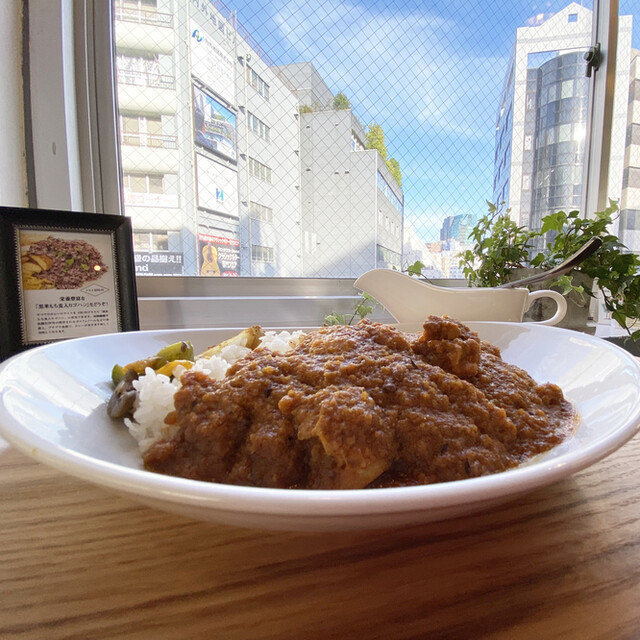
The approach is part of the point: an old triangular building in Kanda Ogawamachi, a manual elevator, then a fourth-floor room with windows rather than the basement murmur that defines so many Tokyo curry addresses. HINATA-YA sits in a district where lunch has always done serious work. Jimbocho and Ochanomizu pull in students, publishers, office workers, guitar-shop browsers, and book hunters, and curry here is not an afterthought between meetings. It is a fast, opinionated midday genre with its own hierarchies.
Tokyo curry is often discussed as comfort food, but that phrase flattens the category. Around Jimbocho, curry splits into several urban types: old-school European-style rice curry, spice-forward Japanese curry, soup curry, cafe curry, and specialist plates that borrow from South Asian and Southeast Asian formats without becoming strict replicas. The meaningful question is not whether a shop is grand. It is whether it can make a modest lunch feel deliberate.
A fourth-floor curry room in a neighbourhood built for lunch
The local comparison set is tight. Curry Rice Senmon Ten Ethiopia Honten, Soup Curry Ya Oodori Chiyoda kandasurugadai ten, and Curry Ya Banbi all operate in the same affordable lunch bracket, which matters in Tokyo: curry reputations are built through repeat use, not tasting-menu ceremony. The price band encourages regulars, short visits, and sharp preferences. Within that field, Tabelog’s Curry TOKYO 100 selection in both 2023 and 2024 gives HINATA-YA a public signal beyond neighbourhood loyalty.
The room’s scale shapes the meal. Fifteen seats, including three counter seats, make it better suited to solo diners and pairs than larger parties. That is not merely a practical footnote; it aligns with how much of Tokyo’s serious lunch culture works. The better small restaurants in business districts often read the city accurately: quick turnover, low ceremony, narrow focus, and enough personality in the room to justify choosing them over a chain.
Category listing, curry, Asian, ethnic, cafe, also says something about the city’s casual dining vocabulary. Tokyo uses “cafe” broadly, and not always to mean coffee-led dining. Here it signals an accessible format rather than fine-dining structure: curry as a daytime anchor, with vegetable-conscious options and take-out in the mix. The presence of vegetarian and gluten-free options puts it slightly apart from older curry counters, where choice can be narrower and assumptions more rigid.
Daytime curry has a different economy than dinner
Lunch-versus-dinner divide is unusually clear here because the restaurant’s identity belongs to the day. Tokyo has many restaurants that treat lunch as a discounted preview of dinner. Jimbocho curry reverses that logic. Lunch is the main event, the moment when value, speed, and neighbourhood demand converge. The absence of an evening posture keeps the format clean: no late-service drift, no bar-restaurant ambiguity, no attempt to stretch a concise idea across too many occasions.
That matters for travellers who tend to overplan dinner and underplan lunch. In Tokyo, the smarter dining day often begins before sunset. A curry lunch in Kanda Ogawamachi can say more about the working city than another formal evening reservation in a globally legible district. The meal is also easier to fold into a cultural itinerary: Jimbocho’s bookshops, Ochanomizu’s instrument stores, and Kanda’s office blocks create the foot traffic that sustains this kind of restaurant.
Among peers in the area, the value band is consistent. Ethiopia Honten, Oodori, Banbi, and Koseto Coffee Ten all sit in the same broad lunch economy, while Mikokoro Mutenka China 935 moves into a higher dinner bracket despite sharing a modest lunch range. That contrast is useful. HINATA-YA is not trying to convert curry into evening luxury; it belongs to the democratic, midday side of Tokyo dining, where recognition comes from precision inside a tight format.
The Tabelog score of 3.76 is a stronger signal in Japan than casual visitors may assume. On that platform, scores above the mid-threes can indicate meaningful local approval, particularly in categories where regulars have strong preferences and repeat visits shape reputation. The Curry TOKYO 100 inclusion is the cleaner badge, but the score reinforces the same point: this is a small-format curry address with recognition beyond its immediate block.
How to read it against Tokyo's wider dining map
Tokyo’s premium dining reputation often runs through sushi counters, kaiseki rooms, French-Japanese tasting menus, and high-spec cocktail bars. Curry is a different lens, less formal and often more revealing. It shows how the city handles everyday specialization: one dish family, limited seating, a narrow service window, and enough discipline to turn lunch into a destination without inflating the experience.
For a broader read on the city, pair this kind of address with the wider EP Club Tokyo map: Our full Tokyo restaurants guide, Our full Tokyo hotels guide, Our full Tokyo bars guide, Our full Tokyo wineries guide, and Our full Tokyo experiences guide. Nearby and citywide restaurant references stretch from. 鮪と炭火焼き うお炭 秋葉原店, 12/10 Shinjuku ten, 124. KAGURAZAKA (Yakitori), 2D Cafe, and 3 Chome no Curry Ya San to regional comparisons such as -Grilled beef Sukiyaki- KAMAKURA TANUKIAN 鎌倉 たぬき庵 in Kamakura.cafe in Osaka.know in Kumamoto, (Shoku) Vietnam in Kawasaki, [Curry Senmon Ten] Maruyama Kyoju. in Sapporo, [ki:] in Kyoto, Jōdo Saké Bar in Los Angeles, and Onigiri Time in Pasadena.
The editorial case is simple: choose it for a Tokyo lunch that belongs to its neighbourhood, not for spectacle. The fourth-floor room, small seating plan, vegetable-conscious curry format, and repeat Tabelog Curry TOKYO 100 recognition make it a precise example of how the city treats casual food seriously.
Reputation Context
Comparable venues at the same tier.
| Venue | Cuisine | Price | Notes |
|---|---|---|---|
| HINATA-YAThis venue — the venue you are viewing | Japanese curry café | $$ | Not listed |
| Coffee Tengoku | Retro Japanese Pancake Cafe | $$ | Asakusa |
| 花蝶 | Tonkatsu | Not listed | Chūō |
| アンディ | Japanese Izakaya Seafood | $$ | Shibuya |
| Senju Takeyabu | Traditional Soba Noodle Shop | $$ | Adachi |
| 海月 | japanese | Not listed | Shibuya |
Recognition history
Dated appearances from independent guides and award organizations, with the underlying list record or original source where available.
Tabelog 100 #42 · No. 42
Tabelog · Tabelog 100 - Curry - TOKYO - 2024







At a Glance
- Cozy
- Classic
- Scenic
- Solo
- Casual Hangout
- After Work
- Panoramic View
- Historic Building
- Standalone
- Street Scene
Current opening hours
- Monday
- 11:30 AM–3:30 PM
- Tuesday
- 11:30 AM–3:30 PM
- Wednesday
- 11:30 AM–3:30 PM
- Thursday
- 11:30 AM–3:30 PM
- Friday
- 11:30 AM–3:30 PM
- Saturday
- 11:30 AM–3:30 PM
- Sunday
- Closed
Hours can change for holidays and private events. Last verified .
Daylit, homey café space on the fourth floor of a vintage Showa-style building, reached by a manual elevator, with large windows and a relaxed, old-school Jinbocho atmosphere.