Haveli sits on Food Street opposite Badshahi Mosque in Lahore's Walled City, where centuries of Mughal culinary tradition meet the open-air theatre of one of Pakistan's most historically charged dining corridors. The address alone positions it inside a peer set defined by provenance and atmosphere rather than fine-dining formality. For visitors mapping Lahore's old city, this is the reference point on Fort Road.
 Discover on Pearl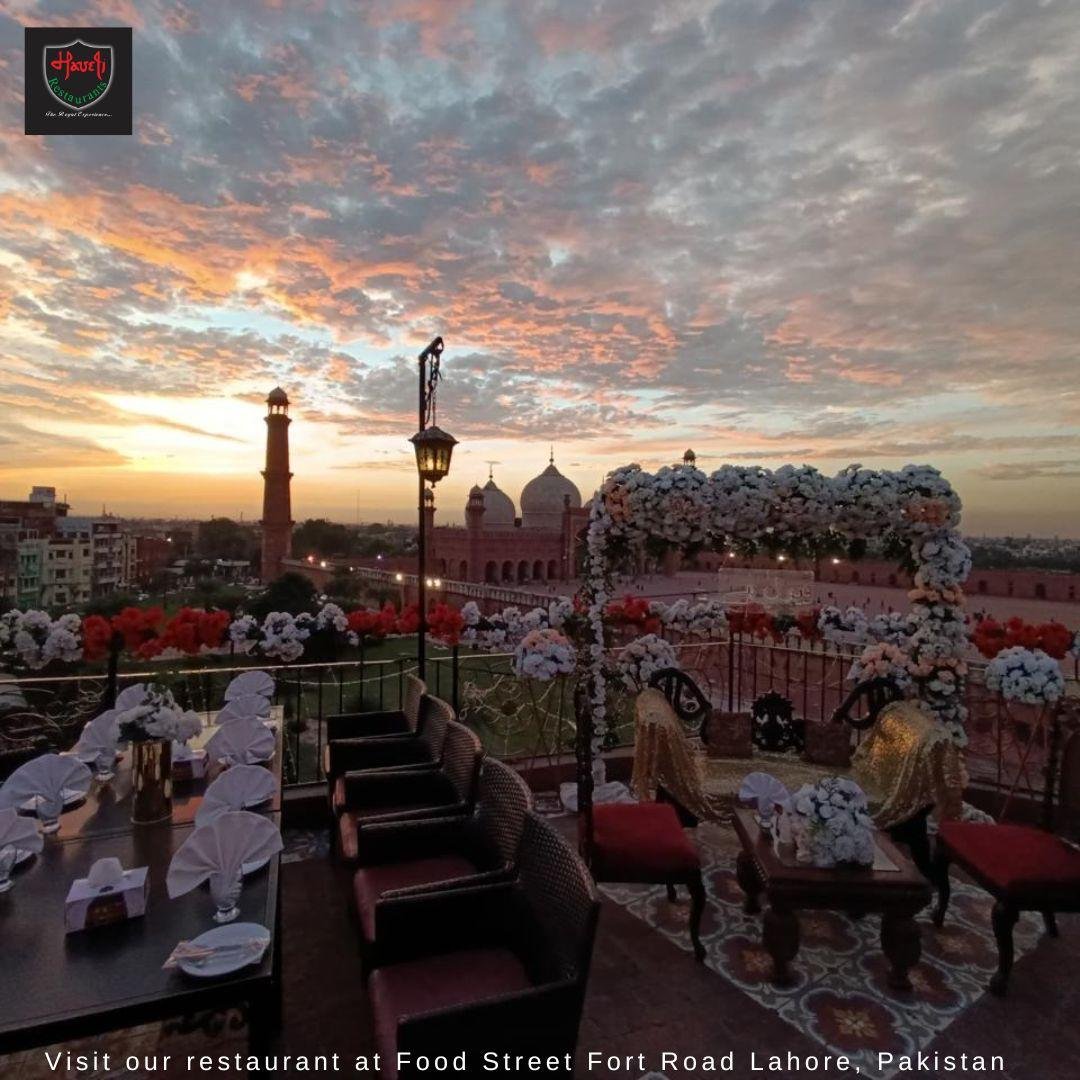
The Address That Does the Talking
Fort Road in the Walled City of Lahore is not simply a street. It runs between two of the subcontinent's most significant Mughal monuments — Lahore Fort and Badshahi Mosque — and the stretch known as Food Street has, over decades, become the physical anchor for the city's most visited open-air dining tradition. Arriving here at dusk, with the mosque's sandstone facade catching the last light and the smell of charcoal-fired karahi drifting across the road, is an experience that no interior room can replicate. Haveli occupies the address at 2170-A on that corridor, opposite the mosque itself, which places it at the most photographed and most footfall-heavy section of the strip.
In cities like Lahore, where the Walled City carries both living culture and UNESCO-adjacent heritage weight, the relationship between location and dining reputation is inseparable. Restaurants on Food Street are not competing on tasting-menu credentials or wine lists , they are competing on the ability to hold their own against one of the most atmospheric backdrops in South Asia. That is a different kind of pressure, and it shapes everything from the cooking format to the service pace.
The shortlist, unlocked.
Hard-to-book tables, cellar releases, and concierge-planned trips.
Get Exclusive Access →Lahori Cooking as a Culinary Tradition, Not a Menu Category
To understand what a restaurant like Haveli is offering, it helps to understand what Lahori cuisine actually represents within the broader canon of South Asian cooking. This is not a regional variation of a national template. Lahore sits at the crossroads of Mughal court tradition, Punjabi agricultural abundance, and Central Asian spice routes, and its food reflects all three. The city's cooking is defined by high-heat technique , the karahi, the tandoor, the tawa , and by a relative confidence with fat, spice, and char that distinguishes it from the more restrained profiles of Karachi or Islamabad's restaurant culture.
The Walled City, in particular, carries the oldest expressions of this tradition. Establishments like Khalifa Naan Shop Since 1869 represent the single-product specialist end of that spectrum , a shop that has refined one craft over more than 150 years. At the other end sit larger open-air venues where the format is communal, the servings generous, and the ambience is as much of the offering as the food itself. Haveli falls into the latter category: a venue where the physical setting and the cooking tradition are inseparable from each other.
For comparison, Butt Karahi represents the stripped-down, no-frills iteration of Lahori karahi culture , a format built around speed, heat, and a single dish done with precision. Food Street venues like Haveli operate on a different register, where the visual drama of the setting, the breadth of the menu, and the tourist-facing experience are all part of the proposition. Neither is a diluted version of the other; they serve different needs within the same culinary tradition.
The Food Street Format and How It Works
Food Street on Fort Road functions as an open-air dining district rather than a collection of independent restaurants in the conventional sense. Tables spill toward the road, rooftop terraces give direct sightlines to Badshahi Mosque, and the evenings , particularly on weekends , draw a mix of local families, domestic tourists, and international visitors navigating the Walled City. The format is walk-in and informal at most establishments, with menus that cover the Lahori canon: various karahi preparations, nihari, paye, seekh kebabs cooked over open charcoal, and breads from tandoors running continuously through service.
This kind of open-air communal dining has parallels in other cities , the street food corridors of Bangkok's old quarters, the night markets of Taipei, the barbecue lanes of Seoul's Mapo district , but Lahore's Food Street carries a specific density of historical meaning that those comparisons don't quite capture. The Mughal architectural backdrop is not decorative context; it is the reason this dining corridor exists where it does. Visitors eating here are participating in a geographical relationship between food and monument that goes back centuries.
For those mapping Pakistan's wider restaurant culture, the contrast with venues in other cities is instructive. Buqayvia Restaurant in Lahore represents a different tier of the city's dining offer, and further afield, Hunza Food Pavilion in Karimabad shows how regional Pakistani cuisine adapts to a completely different geographical and cultural context in the north. Lahore's Food Street occupies a specific niche: urban, historically embedded, and built for a volume of visitors that smaller specialist venues are not designed to handle.
Planning Your Visit
Food Street operates in the evenings, with the corridor coming to life after sunset when the mosque is illuminated and the ambient temperature drops enough to make outdoor dining comfortable. Weekend evenings draw the heaviest crowds, and the most atmospheric hour tends to be the period immediately after Maghrib prayer, when the mosque lights activate and foot traffic peaks. Arriving earlier in the week , Sunday through Wednesday , gives more space and shorter waits for rooftop tables with direct mosque views. The area is accessible by rickshaw from the city centre, and the fort-side entrance to the Walled City is the most direct approach from most central Lahore hotels. No booking infrastructure of the kind found at formal restaurants applies here; the format is walk-in, and table availability follows crowd patterns rather than reservation systems.
Visitors working through Lahore's wider dining offer alongside a Food Street evening might also consider our full Lahore restaurants guide for context across different neighbourhoods and formats. For those extending travel into other parts of Pakistan, Rafsal in Skardu, Sapna Shinwari Restaurant in Abbottabad, and Capital View Restaurant in Islamabad each represent distinct regional formats worth considering as the itinerary moves north or east.
Frequently Asked Questions
- What should I order at Haveli?
- The Lahori cooking tradition at Food Street centres on karahi preparations, seekh kebabs, nihari, and tandoor-baked breads , the same canon found across the Walled City's dining corridor. At a venue positioned on Fort Road opposite Badshahi Mosque, the karahi is the reference point: a high-heat, charcoal-influenced preparation that defines the street's culinary identity. Order to the table rather than individually, as the format is built for sharing.
- How hard is it to get a table at Haveli?
- Food Street operates without advance reservations, and table availability depends entirely on timing and day of the week. Weekend evenings from Friday through Saturday draw the densest crowds in Lahore's Walled City dining corridor, making rooftop spots with mosque views the most contested. Arriving on a weekday evening, particularly before 8pm, gives significantly better access to the better-positioned tables without the weekend volume.
- What's the defining dish or idea at Haveli?
- The defining idea at Food Street venues like Haveli is the relationship between the cooking and its setting. Lahori karahi , prepared over high heat with a confidence in spice and char that traces directly to the city's Mughal and Punjabi culinary roots , is the dish that anchors the menu and the tradition. The backdrop of Badshahi Mosque makes the meal a historically grounded one rather than a purely gastronomic act.
- Is Haveli on Food Street representative of Lahori home cooking, or is it tourist-facing?
- Food Street on Fort Road occupies a middle position in Lahore's culinary hierarchy: the cooking draws from the same tradition as neighbourhood karahi houses and old city specialists like Khalifa Naan Shop Since 1869, but the setting and scale are explicitly designed for a mixed local-and-visitor audience. The cuisine itself , karahi, nihari, seekh kebab , is not a tourist adaptation; these are the dishes Lahore actually eats. The theatrical setting amplifies the experience without distorting the food's authenticity.
Pricing, Compared
A fast peer set for context, pulled from similar venues in our database.
| Venue | Price | Awards | Notes |
|---|---|---|---|
| Haveli | This venue | ||
| Butt Karahi | |||
| Khalifa Naan Shop Since 1869 | |||
| Hunza Food Pavilion | |||
| China Hot Pot | |||
| Buqayvia Restaurant |
Need a table?
Our members enjoy priority alerts and concierge-led booking support for the world's most difficult tables.
Get Exclusive AccessThe shortlist, unlocked.
Hard-to-book tables, cellar releases, and concierge-planned trips.
Get Exclusive Access →