At Lakshmi Chowk in Lahore's Royal Park district, Butt Karahi represents the kind of no-frills karahi house that defines how the city actually eats. The format is simple: a wood-fire or gas-fired wok, fresh meat, tomatoes, and spice — cooked to order in front of you. For visitors and locals alike, this address is a direct line into Lahore's street-food tradition.
 Discover on Pearl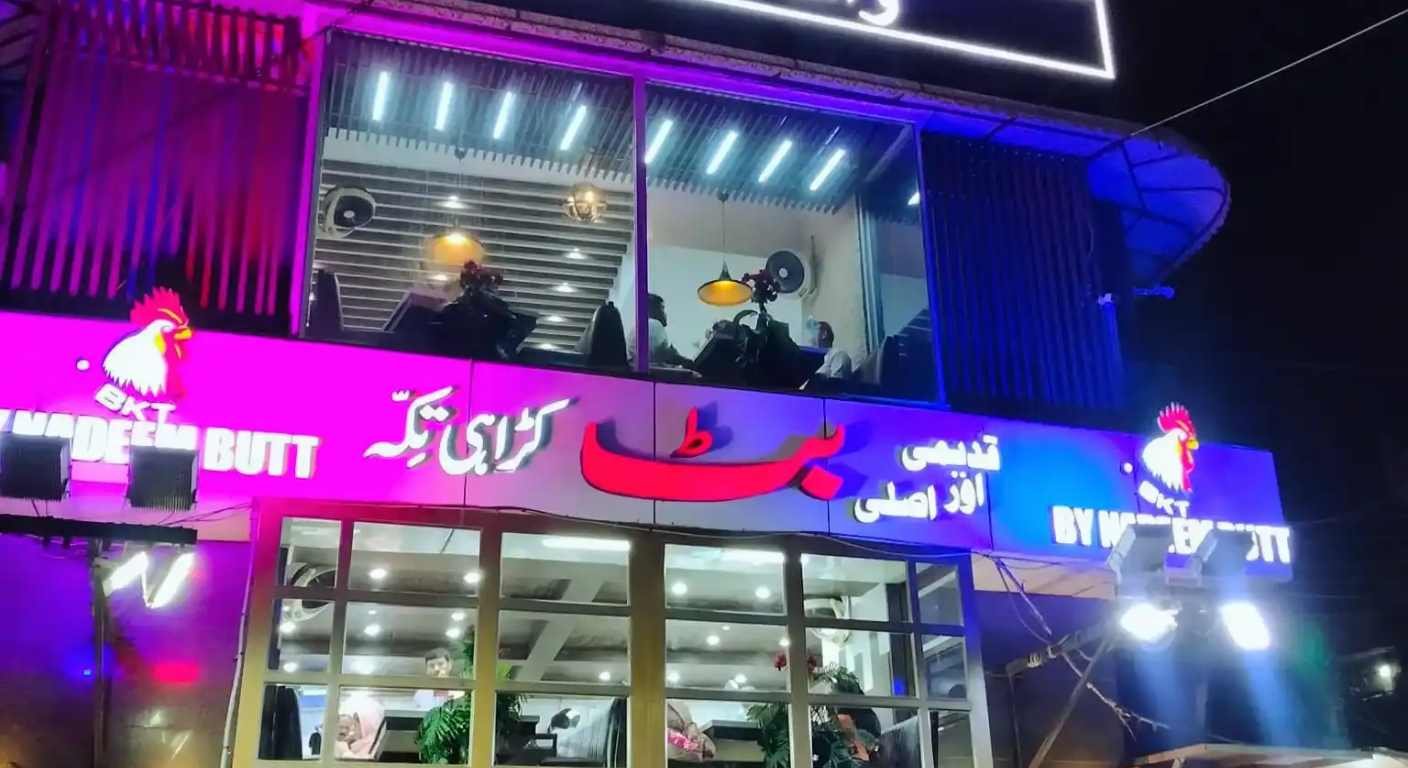
Lakshmi Chowk and the Grammar of Lahori Karahi
McLeod Road at night operates on a different register than Lahore's newer food districts. The Gita Bhavan Building sits at the edge of Lakshmi Chowk, one of the city's oldest commercial intersections, where the density of signage, the noise of traffic, and the smoke rising from open-flame cooking stations compress into something unmistakably Lahori. Butt Karahi occupies this environment not as an anomaly but as a continuation of it. The address in Royal Park places it within walking distance of the Walled City's fringe, a neighbourhood where food has been cooked and eaten on the street for well over a century.
The karahi format that defines venues like this one is worth understanding on its own terms before arriving. A karahi is both the dish and the vessel: a deep, two-handled wok in which meat, tomatoes, ginger, and a disciplined set of spices are cooked rapidly over high heat. There is no slow-braise logic here, no overnight stock, no layered sauce built from a roux. The cooking is fast, the heat is high, and the sourcing of the primary protein is what separates a credible karahi house from a mediocre one. In Lahore's most established karahi venues, mutton or chicken is typically purchased fresh that day from nearby wholesale markets, and the tomato base is adjusted seasonally depending on what local supply delivers. That seasonal responsiveness is not a philosophical statement — it is simply how the format works when done correctly.
The shortlist, unlocked.
Hard-to-book tables, cellar releases, and concierge-planned trips.
Get Exclusive Access →Where the Ingredients Come From
The ingredient logic of a Lahori karahi house is less about artisanal sourcing in any Western sense and more about proximity and freshness operating as the same thing. Lahore sits at the centre of Punjab's agricultural belt, a region that produces wheat, tomatoes, ginger, garlic, and green chillies in quantities that make daily-fresh procurement economically viable even at street-food price points. Venues operating in the Lakshmi Chowk corridor have historically drawn from nearby wholesale markets, particularly those around the older commercial districts of the inner city, where meat arrives from abattoirs serving the surrounding urban population.
Tomato is the ingredient that most directly expresses this supply chain. In a well-made karahi, tomatoes are cooked down to a point of near-dissolution, their acidity reduced and their sweetness concentrated, before the meat is added. The ratio of tomato to meat, the quantity of ginger julienned on leading, and the heat level at service are the variables that distinguish one karahi house from another in a city that takes these distinctions seriously. Lahore's food culture is not shy about comparative judgment — regulars at venues like Butt Karahi will tell you with specificity why they return to a particular spot rather than its neighbours, and those reasons almost always come back to the sourced quality of the meat and the cook's command of the wok temperature.
The Lakshmi Chowk Competitive Set
Butt Karahi operates in one of the more concentrated dining corridors in Lahore, where multiple karahi and traditional Pakistani restaurants compete for a clientele that ranges from working professionals eating quickly to families making a dedicated outing of a late-evening meal. Haveli represents the more formal, heritage-building end of Old Lahore dining, with a different format and price positioning. Khalifa Naan Shop Since 1869 occupies a complementary category, focused on bread rather than protein, and functions as part of the same meal ecosystem. Butt Karahi sits in the karahi-specialist tier, where the speed of service, the informality of seating, and the focus on a single cooking format define the experience.
Across Pakistan, the karahi format has spawned regional variations. The Peshawar-style karahi uses less tomato and more fat, often cooked in the rendered fat of the meat itself. The Karachi version tends toward more aromatics and sometimes cream. The Lahori version splits the difference with a tomato-forward base and a generous hand with ginger. Venues like Butt Karahi by Usman Tahir in Gujar Khan show how the format travels and adapts outside of Lahore, which makes the city's original karahi corridor worth comparing directly. For broader Pakistani dining context beyond Lahore, the Capital View Restaurant in Islamabad and Sapna Shinwari Restaurant in Abbottabad illustrate how different cities interpret the same culinary tradition with different emphases.
For those exploring Pakistan's northern regions alongside a Lahore visit, Hunza Food Pavilion in Karimabad and Rafsal in Skardu provide context for how dramatically the country's food culture shifts with geography and altitude. The contrast between a Lahori karahi house and a Gilgit-Baltistan restaurant is considerable, and worth understanding before building a Pakistan itinerary.
Planning a Visit
Lakshmi Chowk is most navigable by rickshaw or car from central Lahore; the address on McLeod Road in Royal Park is close enough to the Walled City that combining a visit with a walk through the older districts makes logistical sense, particularly in the evening when the area reaches its operational peak. Karahi houses in this corridor tend to run from early evening into the early hours of the morning, following the pattern of Lahore's late-night food culture. Arriving between 9pm and midnight places you in the middle of peak service, which is both the most atmospheric time to eat and the moment when the cooking is being done at its highest volume and freshest tempo. No booking infrastructure exists for venues of this type; the format is walk-in, and tables turn at the pace of the cooking rather than a reservation schedule.
Our full Lahore restaurants guide maps the city's dining options across formats and neighbourhoods, from the karahi corridor of Lakshmi Chowk to the newer restaurant districts further from the historic centre. For those cross-referencing international fine dining alongside this kind of street-level research, the gap in format and philosophy between a Lahori karahi house and a venue like Le Bernardin in New York City or HAJIME in Osaka is total , but the underlying commitment to ingredient quality at the leading of each respective format is, in principle, the same logic operating at different scales.
Frequently Asked Questions
- Is Butt Karahi child-friendly?
- Lahore's karahi houses are broadly family-oriented venues, and the Lakshmi Chowk corridor regularly draws multi-generational groups, particularly during late-evening weekend meals. The format is casual, the seating is communal, and the food arrives fast , conditions that tend to suit families with children better than longer tasting-menu formats. The area around McLeod Road is busy and loud at peak hours, which is part of the character of the experience rather than a drawback, and is worth factoring into expectations before bringing very young children.
- What should I expect atmosphere-wise at Butt Karahi?
- Lakshmi Chowk is one of Lahore's older commercial intersections, and the atmosphere at venues along this corridor is determined by the street rather than an interior design program. Expect open-fronted cooking, smoke from the woks, dense foot and vehicle traffic, and the compressed energy of a neighbourhood that has been doing this for decades. The experience is high-volume and unselfconscious, which is precisely what the city's regulars return for. Lahore's karahi culture does not produce quiet, contemplative dining rooms.
- What's the signature dish at Butt Karahi?
- The karahi is the format and the dish simultaneously , there is no separate menu logic to decode. In Lahore's karahi houses, the primary choice is typically between mutton and chicken, with the cooking method identical for both: high heat, tomato base, fresh ginger, green chilli, and a short finish with spice. The quality of the mutton karahi is generally the benchmark by which regulars assess a venue in this category, as the sourcing and freshness of the meat is more variable and more consequential than with chicken.
- How hard is it to get a table at Butt Karahi?
- Karahi houses in the Lakshmi Chowk corridor do not operate reservation systems, so access is determined by timing rather than advance booking. Peak hours on weekends, particularly after 10pm, will involve a wait at the most established venues. Arriving earlier in the evening or on weekdays reduces that variable considerably. There are no awards or formal recognition structures that create the kind of booking pressure seen at Michelin-tracked venues like Atomix in New York City or Lazy Bear in San Francisco , the demand here is purely local and driven by reputation within the city.
- Why do Lahore locals specifically travel to Lakshmi Chowk for karahi rather than eating closer to home?
- The Lakshmi Chowk corridor has accumulated a reputation over generations that functions independently of any single venue , it is the address that Lahoris reference when arguing about where the city's karahi tradition is most authentically expressed. The concentration of competing karahi specialists in a single area creates a self-reinforcing standard, where each venue is benchmarked against its immediate neighbours rather than against the city at large. For visitors, this means that a meal in this corridor delivers a data point about Lahori food culture that a venue in a newer district, however technically accomplished, does not replicate in the same way.
At-a-Glance Comparison
These are the closest comparables we have in our database for quick context.
Need a table?
Our members enjoy priority alerts and concierge-led booking support for the world's most difficult tables.
Get Exclusive AccessThe shortlist, unlocked.
Hard-to-book tables, cellar releases, and concierge-planned trips.
Get Exclusive Access →