Hangari Kalguksu

On Koreatown's busy 6th Street corridor, Hangari Kalguksu is one of Los Angeles's most consistently recognized casual Korean restaurants, ranked by Opinionated About Dining in both 2024 and 2025. The kitchen focuses on kalguksu, the hand-cut wheat noodle soups that anchor everyday Korean cooking, in a format that draws regulars from across the city and earns its standing on substance rather than spectacle.
Pearl is the En Primeur Club membership app — saves, bookings, and concierge access live there. Same editors, same standards.
- Address
- 3470 W 6th St Suite 9 and 10, Los Angeles, CA 90020
- Phone
- (213) 388-2326
- Website
- hangarikalguksu.com
- Directions
- Get directions
 Saves & bookings on Pearl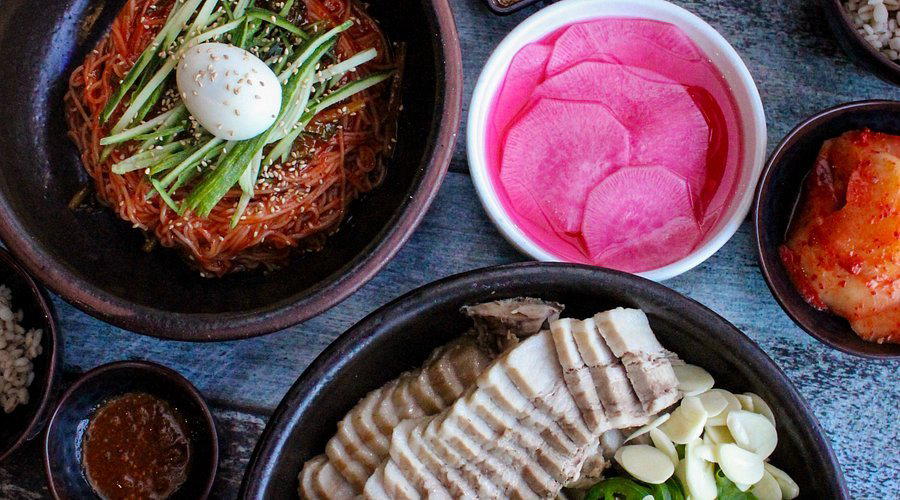
Koreatown's Noodle Tradition, Served Without Ceremony
Walk into the stretch of Koreatown along West 6th Street on any given weekday and the dynamic is immediately legible: small storefronts, shared plazas, the smell of simmering broth drifting from propped doors. This is the working core of one of the densest Korean communities outside the Korean peninsula, and the dining here operates on a different logic than the tasting-menu restaurants that draw wider critical attention. Value and repetition matter. So does provenance. The question is not whether a dish is innovative but whether it is correct.
Hangari Kalguksu occupies Suite 9 and 10 at 3470 W 6th Street, a low-key address in a plaza format that typifies how Koreatown's most-frequented kitchens are housed. There is no grand entrance, no valet queue. The signaling is internal: a dining room that fills quickly, a menu centered on specific preparations, and a reputation built over years of consistent execution.
The Street-Food Lineage Behind the Bowl
Kalguksu belongs to the broader family of Korean dishes rooted in utility and communal eating: foods that emerged from markets, night stalls, and home kitchens where hand labor substituted for expensive ingredients. The name translates directly as "knife-cut noodles," and the preparation is precisely that: wheat dough rolled and cut by hand, producing noodles with irregular edges that hold broth differently than machine-extruded pasta. Served in anchovy or chicken-based broths with clams, zucchini, or hand-made dumplings, kalguksu sits in the same heritage category as tteokbokki, hotteok, and kimbap, dishes that carry the texture and rhythm of Korean street food culture, adapted for restaurant service.
That lineage matters for understanding what Hangari is doing and why it has sustained critical attention. Opinionated About Dining, which ranks casual dining in North America with the same systematic rigour it applies to fine dining, placed Hangari at #629 in 2025 and #648 in 2024. Year-on-year improvement in a competitive casual Korean category is a signal worth noting: it suggests the kitchen has not stood still. OAD's casual rankings draw on frequent diner reporting rather than professional critic visits, which means this positioning reflects repeat patronage from people who eat across the full spectrum of the city's Korean options.
Where Hangari Sits in Los Angeles's Korean Dining Tier
Los Angeles Korean dining has stratified considerably over the past decade. At one end, there are grilled meat specialists, tofu houses, and banchan-heavy full-service restaurants that compete on value and portion. At the other, a smaller group of contemporary Korean kitchens, several of them chef-driven, have pushed toward a more global-facing format. Hangari occupies a specific position in the middle tier: casual in format and accessible in premise, but operating with enough consistency and craft that it appears on the same ranked lists as restaurants with more elaborate production values.
For reference on how the Korean dining conversation plays out at fine-dining level, Mingles in Seoul and Kwonsooksoo in Seoul represent what happens when Korean ingredients and technique are applied within a tasting-menu architecture. Hangari operates at the opposite register: the point is not to reimagine the dish but to execute it with fidelity to its origins. Within Los Angeles's Koreatown specifically, its closest OAD-ranked peers include Dha Rae Oak, Danbi, and Jeong Yuk Jeom, each anchored in a different Korean subcategory. BCD Tofu House occupies a parallel niche in sundubu-jjigae, while Myung Dong Kyoja (MDK Noodles) draws direct comparison for its focus on hand-made noodle preparations.
The broader LA fine-dining tier, venues like Kato, Hayato, Vespertine, Camphor, and Gwen, operates in an entirely different competitive frame, with Michelin recognition, lengthy tasting formats, and price points that remove any direct comparison. Hangari's recognition comes from a different axis: frequency, consistency, and the kind of satisfaction that generates 1,350-plus reviews without a publicist.
Planning Your Visit
The kitchen runs six days a week, closing Tuesdays. Thursday through Saturday evening hours extend later than the rest of the week, with Friday and Saturday running to 10:30 pm. The format suggests lunch and early dinner as the natural entry points for first visits; the 10 am opening on most days reflects the Korean dining culture of early service, when broth-based dishes function as morning meals as much as lunch.
| Venue | Cuisine Focus | Format | OAD / Awards | Hours |
|---|---|---|---|---|
| Hangari Kalguksu | Kalguksu, Korean noodles | Casual, walk-in | OAD Casual #629 (2025) | Mon, Wed–Sun 10am–9/10:30pm; Tue closed |
| MDK Noodles | Kalguksu, mandu | Casual, quick service | Koreatown staple | Varies |
| BCD Tofu House | Sundubu-jjigae | Casual, full service | Koreatown institution | 24-hour (main location) |
| Dha Rae Oak | Korean BBQ, traditional | Full service | OAD ranked | Varies |
For readers interested in high-end American dining contexts beyond Los Angeles, the reference tier includes Le Bernardin in New York City, The French Laundry in Napa, Lazy Bear in San Francisco, Single Thread Farm in Healdsburg, Alinea in Chicago, and Emeril's in New Orleans.
The Essentials
Comparable venues nearby, for context on price, style, and recognition.
| Venue | Cuisine | Price |
|---|---|---|
| Hangari KalguksuThis venue — the venue you are viewing | Korean | $$ |
| Kyochon Chicken | Wilshire Center, Korean Fried Chicken | $$ |
| Borit Gogae | Koreatown, Korean Home-Style Barley Rice | $$ |
| Yuchun Restaurant | Koreatown, Traditional Korean Naengmyun | $$ |
| Dong Il Jang | Koreatown, Traditional Korean BBQ | $$ |
| Surawon Tofu House | Koreatown, Korean Tofu House | $$ |
Recognition history
Dated appearances from independent guides and award organizations, with the underlying list record or original source where available.
Opinionated About Dining Casual in North America Recommended
Opinionated About Dining
Opinionated About Dining Casual in North America Ranked #629
Opinionated About Dining
Opinionated About Dining Casual in North America Ranked #648
Opinionated About Dining
Continue exploring
More in Los Angeles
Restaurants in Los Angeles
Browse all →
Bars in Los Angeles
Browse all →
Hotels in Los Angeles
Browse all →
Wineries in Los Angeles
Browse all →
At a Glance
- Cozy
- Lively
- Casual Hangout
- Group Dining
- Open Kitchen
Current opening hours
- Monday
- 10 AM–9 PM
- Tuesday
- Closed
- Wednesday
- 10 AM–9 PM
- Thursday
- 10 AM–10 PM
- Friday
- 10 AM–10:30 PM
- Saturday
- 10 AM–10:30 PM
- Sunday
- 10 AM–9 PM
Hours can change for holidays and private events. Last verified .