Tabelog 100 #96
Our verdict
Namba’s tachinomi culture rewards speed, low ceremony, and sharp value, and hadoromanchikka sits directly in that lane. The draw is the stand-up bar format: counter-led drinking, sake and shochu alongside wine, and a compact Osaka room recognised in the Tabelog 100 Tachinomi 2025 selection.

Pearl is the En Primeur Club membership app, where members save venues, book tables and use the concierge.
The menu
What to order
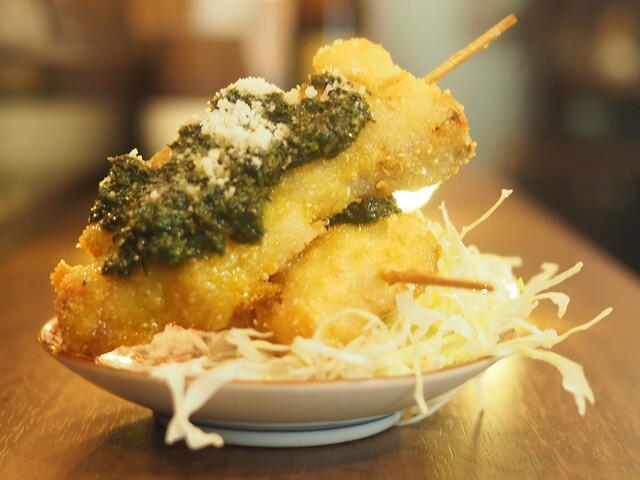
- Freshly fried skewers selected from the showcase
Approaching an Osaka stand-up bar means entering the city at street level: signs stacked over narrow fronts, station traffic still moving late, and a room built for short distances between customer, glass, and conversation. Tachinomi is not a consolation prize for diners priced out of formal restaurants. In Osaka, it is its own discipline, measured by turnover, drink fluency, and how much pleasure a small room can deliver without the machinery of a full dining room.
That is the useful frame for hadoromanchikka. The category matters before the name does. Osaka has long been one of Japan’s pressure points for casual eating and drinking, from everyday queues to late-night counters, and the stand-up bar format compresses that energy into a leaner proposition. A 2025 Tabelog Hyakumeiten tachinomi selection gives it a public signal inside a category where outside visitors often struggle to separate serious drinking rooms from generic quick stops.
Osaka tachinomi with a value equation that makes sense
Osaka’s value conversation is often reduced to portion size, but tachinomi works differently. The argument is not abundance; it is access. Standing service lowers ceremony, keeps the room moving, and places drinking closer to the centre of the experience. Here, the format points to a stand-up bar rather than a restaurant trying to be everything at once. That matters in Osaka, where visitors can easily spend more on a seated dinner and come away with less insight into how locals actually drink.
Compared with nearby dining benchmarks, the distinction is clear. Ajinoya Honten and Daikoku sit in approachable Osaka dining territory, while Hari Ju Doutonbori honten and Nikushou Nakata Honten represent a different, more restaurant-shaped rhythm. A tachinomi room such as hadoromanchikka is playing another game: lower ceremony, narrower footprint, and a stand-up structure that rewards a focused stop rather than a long reservation-led evening.
The Tabelog Hyakumeiten tachinomi 2025 inclusion is useful because this is not a category where Michelin-style signals do much work for travellers. Stand-up bars are judged by local habits: whether the room feels natural for a quick drink, whether the experience justifies staying for another round, and whether the place can absorb regulars without shutting out newcomers. Recognition in a tachinomi-specific list is more relevant here than a generic restaurant accolade would be.
The counter is the point, not a compromise
The stand-up format changes the social contract. Visits do not unfold with the pacing of a formal counter or the plushness of a hotel bar; they move in short, precise increments. The room’s appeal sits in casual overlap, where drink, conversation, and the evening’s momentum matter as much as any single order. For solo visitors, that can be an advantage rather than a limitation.
Osaka’s better casual rooms understand that value comes from fit. A visitor looking for a polished tasting menu should look elsewhere. A visitor trying to understand Osaka after dark should pay attention to places that remove the distance between customer and room. That is where tachinomi has cultural force: it lets the city’s dining life stay porous. People drop in, drink with intent, and move on without turning every meal into an occasion.
The absence of private-room formality also shapes expectations. This is not the mode for a hushed business dinner or a family meal with space to spread out. It is closer to a compact drinking stop that makes sense before or after another plan in Osaka. The format also explains why flexibility matters more here than dress or ceremony.
Where it fits in an Osaka eating day
Osaka is dense enough that a single evening can move through several versions of the city’s dining without requiring a rigid plan. A casual snack, a specialist counter, a quick meal, and a late drink can sit within the same itinerary if the pacing is disciplined. For broader planning, Our full Osaka restaurants guide maps the restaurant side, while Our full Osaka bars guide is the cleaner route for drink-led nights. Travellers building a wider stay can pair that with Our full Osaka hotels guide, Our full Osaka experiences guide, and Our full Osaka wineries guide.
Within the city’s casual spectrum, useful contrasts include other Osaka dining rooms for takeout-and-snack logic, low-ceremony morning rhythms, daytime pacing, casual range, and more restaurant-shaped evenings. The point is not to rank them against one another; it is to see how Osaka supports radically different levels of formality without forcing every good meal into the same mould.
For readers extending the same value-minded lens beyond Osaka, useful cross-city comparisons can be made with other Japanese cities and with overseas venues that translate Japanese drinking and snack formats abroad. Those rooms often require more explanation and less compression than Osaka demands. Hadoromanchikka, by contrast, works through the local shorthand of standing, ordering, drinking, and moving through the night without overproducing the experience.
The editorial call is simple: hadoromanchikka belongs on an Osaka night when the aim is not luxury, but signal. The award marker, stand-up format, accessible Tabelog price band, and compact mode all point in the same direction. This is Osaka value as an operating system: less furniture, fewer rituals, more immediacy.
Frequently asked questions
Can I bring kids to hadoromanchikka?
Hadoromanchikka is listed as a stand-up bar, so it reads as a drink-led, adult-leaning stop rather than a conventional family outing.
What should I expect atmosphere-wise at hadoromanchikka?
Expect a tachinomi setup rather than a lingering sit-down meal. The 2025 Tabelog Hyakumeiten tachinomi selection and the JPY 1,000–1,999 price range point to a casual, fast-moving stand-up bar in Osaka.
What should I budget for a meal at hadoromanchikka?
Pricing at hadoromanchikka is listed as JPY 1,000 - JPY 1,999.
How do I find hadoromanchikka?
Osaka.
Comparable Options
Side-by-side context: comparable cuisine and price.
| Venue | Cuisine | Price | Awards | Notes |
|---|---|---|---|---|
| hadoromanchikkaThis venue (the venue you are viewing) | Japanese stand-up bar with fried skewers and sake | $10–20 | Tabelog 100 #96 | Not listed |
| Nikushou Nakata Honten | High-End Wagyu Yakiniku & Steak | $100–150 | Tabelog 100 #67 | JPY 15,000 - JPY 19,999 |
| Ajinoya Honten | Traditional Osaka Okonomiyaki & Yakisoba | $20–30 | Tabelog 100 #29 | JPY 3,000 - JPY 3,999 JPY 1,000 - JPY 1,999 |
| Harijyu Dotombori Grill Western Food | Traditional Yoshoku (Japanese Western) Grill | $30–50 | Not listed | Not listed |
| Hari Ju Doutonbori honten | Traditional Wagyu Sukiyaki & Shabu-shabu | $50–100 | Tabelog 100 #9 | JPY 8,000 - JPY 9,999 JPY 6,000 - JPY 7,999 |
| Daikoku | Traditional Osaka cafeteria (teishoku & obanzai) | $10–20 | Tabelog 100 #65 | JPY 1,000 - JPY 1,999 JPY 1,000 - JPY 1,999 View spending breakdown |
Recognition history
Dated appearances from independent guides and award organizations, with the underlying list record or original source where available.
Tabelog 100 #96 · No. 96
Tabelog · Tabelog 100 - Tachinomi - 2025