
Wine Spectator Best of Award of Excellence
Our verdict
Glass Brasserie occupies the second floor of the Hilton Sydney on George Street, positioning itself within the city's mid-to-upper brasserie tier rather than the tasting-menu circuit. The room's scale and CBD address make it a natural anchor for business dining and pre-theatre meals. It sits alongside contemporaries such as Rockpool and Bennelong in Sydney's broader Australian modern dining conversation.

Pearl is the En Primeur Club membership app — saves, bookings, and concierge access live there. Same editors, same standards.
- Address
- level 2/488 George St, Sydney NSW 2000, Australia
- Phone
- +61292656068
- Hours
- Mon–Fri 6:30–10 AM, 12–3 PM, 5:30–9:30 PMSat–Sun 6:30–10:30 AM, 2–4:30 PM, 5:30–9:30 PM
- Website
- glassbrasserie.com.au
- Directions
- Get directions
- Booking
- Book on SevenRooms
The menu
What to order
- Steak tartare
- Organic egg omelette with blue swimmer crab
George Street at Table Height
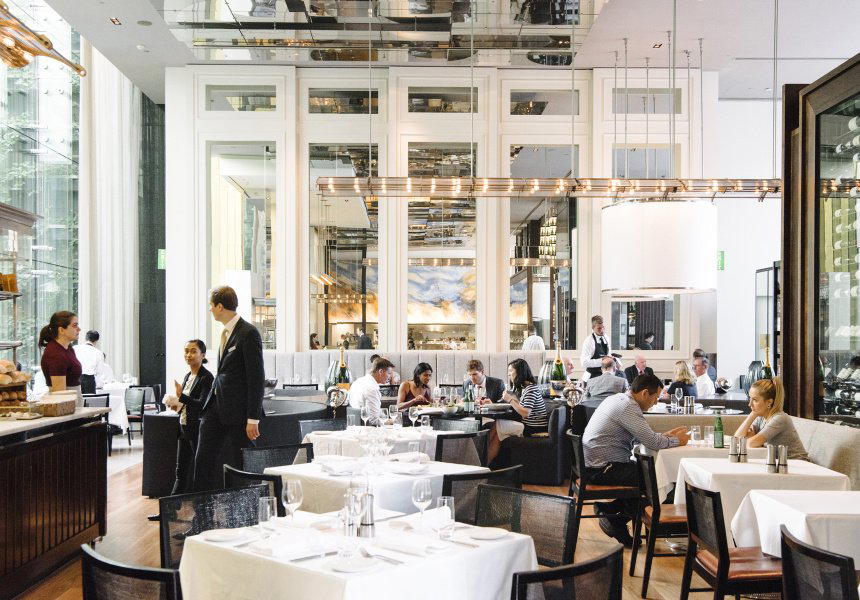
The second floor of a George Street hotel is not where you expect a room to hold its own against Sydney's standalone dining scene, yet that tension is precisely what makes Glass Brasserie worth reading carefully. Level 2 of the Hilton Sydney places the restaurant above the noise of the CBD pavement but below the abstracted remove of a rooftop concept, a positioning that is as much editorial as architectural. The room is large by Sydney standards, the kind of scale that allows a brasserie to function simultaneously as a power-lunch address, a pre-theatre destination, and a Saturday-night booking for visitors who want something credible without committing to a twelve-course progression. That range of function is a deliberate design choice, and it shapes everything from the menu format to the room's ambient register.
Sydney's hotel dining has followed a pattern visible across most major Australian cities: a first wave of ambitious signature restaurants attached to international brands, a contraction during the years when standalone operators took critical attention, and a current moment of selective re-investment. Glass Brasserie sits inside that arc. The address at 488 George Street keeps it anchored to the business and tourism corridor that feeds the Hilton's core clientele, which means the restaurant must speak to a wider audience than, say, Saint Peter, whose narrowly focused seafood program attracts a specifically committed diner. That breadth is both the brasserie's commercial logic and its primary creative challenge.
The Brasserie Format and How Sydney Reads It
The word "brasserie" carries particular weight in Australian dining. It signals something between a bistro's informality and a fine-dining room's technical ambition, a format that gained traction in Sydney during the early 2000s as a middle register between casual all-day cafes and full-occasion tasting menus. At that tier, the comparison set for Glass Brasserie includes Rockpool on the Australian modern side and a range of hotel restaurants that have cycled through various identities over the same period.
What distinguishes the brasserie tier from tasting-menu-led dining is the expectation of choice: a printed menu with recognisable categories, the ability to eat lightly or substantially depending on appetite and occasion, and a wine list that functions as a supporting document rather than a primary event. This format demands consistency across a broader output than a counter-seated omakase or a set-progression kitchen, and consistency at scale is where hotel restaurants have historically separated into two groups: those that treat the dining room as a revenue centre servicing room guests, and those that attempt genuine critical relevance to the city's dining conversation. The evolution of Glass Brasserie tracks that distinction.
Evolution at a CBD Address
Hotel dining programs at CBD properties tend to reinvent on a slower cycle than standalone restaurants, constrained by the operational requirements of a full-service hotel and the expectations of an international brand's food and beverage standards. The Hilton Sydney's George Street location has seen Glass Brasserie adapt across different phases of Sydney's dining development, from a period when hotel restaurants commanded significant critical attention to a more recent environment in which the conversation has shifted toward specialist operators. That shift is visible across Australia: Brae in Birregurra, Attica in Melbourne, and Botanic in Adelaide have each defined a different model of destination dining that draws critical attention away from hotel rooms and toward standalone formats.
Within that context, Glass Brasserie's continued presence on the Sydney dining map reflects an understanding of what the brasserie format can do that a tasting-menu restaurant cannot: absorb walk-ins, accommodate a table of eight with mixed dietary requirements, and serve a two-course lunch at a pace that respects a one-hour meeting window. These are not lesser functions. They represent a specific service contract with a specific audience, and the restaurants that have maintained relevance in this tier are those that have leaned into that contract rather than reaching for critical validation through formats that don't suit their operational context. Compare the trajectory here with regional properties like Hentley Farm in Seppeltsfield or Laura at Pt Leo Estate in Merricks, where destination dining and a controlled, set-format experience are inseparable from the proposition.
Internationally, the distinction maps onto similar conversations at hotel-anchored rooms in other cities. Le Bernardin in New York City demonstrates what a hotel-adjacent fine-dining room can achieve when format discipline is absolute, while Lazy Bear in San Francisco represents the opposite model: a fixed-format, high-commitment experience that trades accessibility for singular focus. Glass Brasserie operates in neither extreme, which is precisely where a well-run brasserie should sit.
Where It Sits in Sydney's Current Scene
Sydney's restaurant geography has become more differentiated over the past decade. The CBD corridor remains dominated by business dining and hotel-attached restaurants, while creative energy has concentrated in Surry Hills, Paddington, and along the harbour foreshore. Within the CBD tier, Glass Brasserie competes on consistency and accessibility rather than on novelty or critical ambition. This places it in a different conversation than 10 William St or 1021 Mediterranean, both of which operate with a tighter editorial identity. For the full range of what Sydney's dining scene offers across neighbourhoods and price points, our full Sydney restaurants guide maps the broader picture.
Other Sydney-adjacent options for comparison include Ormeggio at The Spit in Mosman, which occupies a similar mid-to-upper register but with a harbour setting and Italian-led focus, and 10 Pounds, which operates at a different format and price point within the broader Sydney dining conversation. Further afield, Pipit in Pottsville, Provenance in Beechworth, and Salt Water Restaurant in Cairns each demonstrate how Australian dining outside major cities has developed its own critical vocabulary, distinct from the hotel-brasserie model that Glass occupies.
Planning a Visit
| Detail | Glass Brasserie | Rockpool | Saint Peter |
|---|---|---|---|
| Address | Level 2, 488 George St, Sydney CBD | 66 Hunter St, Sydney CBD | 362 Oxford St, Paddington |
| Format | Hotel brasserie, à la carte | Australian modern, à la carte | Seafood-focused, à la carte |
| Setting | Hotel dining room, CBD | Heritage building, CBD | Standalone, inner suburb |
| Leading for | Business dining, hotel guests, mixed groups | Occasion dining, wine focus | Seafood commitment, regular diners |
Frequently asked questions
What's the address for Glass Brasserie?
Glass Brasserie is located at level 2/488 George St, Sydney NSW 2000, Australia, Sydney.
Is Glass Brasserie a good option for a group dinner in Sydney's CBD?
Glass Brasserie's second-floor position within a George Street hotel makes it a practical choice for group dining in the core Sydney CBD, with the infrastructure of a hotel property behind it. Brasserie-format rooms at this scale typically accommodate shared tables and set menus more readily than smaller standalone restaurants. For groups requiring private dining or specific configurations, contacting the venue at 488 George St directly will confirm what arrangements are available.
What's the must-try dish at Glass Brasserie?
The brasserie format at a CBD George Street address typically anchors around a core of reliable, protein-led mains suited to both business and leisure dining. Checking directly with the restaurant at 488 George St for the current menu is the most reliable approach.
Do I need a reservation for Glass Brasserie?
For a hotel brasserie positioned on level 2 of 488 George St in Sydney's core CBD, advance booking is advisable, particularly for dinner service and peak midweek lunch periods when business dining demand is highest. Walk-ins may find space during quieter periods, but the room's hotel setting means occupancy can shift quickly around events and conferences. Contacting the venue directly will confirm current availability.
Where the Accolades Land
Comparable venues nearby, for context on price, style, and recognition.
| Venue | Cuisine | Price | Awards | Notes |
|---|---|---|---|---|
| Glass BrasserieThis venue — the venue you are viewing | Modern French Brasserie with Asian Influences | $50–100 | Wine Spectator Best of Award of Excellence | Not listed |
| Le Petit Flot | Contemporary French Bistro with Japanese Twist | $50–100 | Not listed | Sydney |
| The Ambassador Training Restaurant | Modern Australian with French Technique | $30–50 | Not listed | Ryde |
| Gavroche Brasserie | Classic French Brasserie | $50–100 | Not listed | Ultimo |
| Wunderbar | French Brasserie with Tasmanian Ingredients | Not listed | Not listed | North Hobart |
| Cafe Loulou | All-day French café & bistro | $20–30 | Not listed | North Sydney |
Recognition history
Dated appearances from independent guides and award organizations, with the underlying list record or original source where available.
Wine Spectator Best of Award of Excellence
Wine Spectator
Continue exploring
More in Sydney
Restaurants in Sydney
Browse all →
Bars in Sydney
Browse all →
Hotels in Sydney
Browse all →

Details
- Elegant
- Sophisticated
- Lively
- Modern
- Date Night
- Business Dinner
- Celebration
- Brunch
- Hotel Restaurant
- Open Kitchen
- Wine Cellar
- Extensive Wine List
- Sommelier Led
- Local Sourcing
- Street Scene
- A La Carte
- Small Plates
- Wine
- Vegetarian Friendly
- Vegan Options
- Gluten Free Options
Current opening hours
- Monday
- 6:30–10 AM, 12–3 PM, 5:30–9:30 PM
- Tuesday
- 6:30–10 AM, 12–3 PM, 5:30–9:30 PM
- Wednesday
- 6:30–10 AM, 12–3 PM, 5:30–9:30 PM
- Thursday
- 6:30–10 AM, 12–3 PM, 5:30–9:30 PM
- Friday
- 6:30–10 AM, 12–3 PM, 5:30–9:30 PM
- Saturday
- 6:30–10:30 AM, 2–4:30 PM, 5:30–9:30 PM
- Sunday
- 6:30–10:30 AM, 2–4:30 PM, 5:30–9:30 PM
Hours can change for holidays and private events. Last verified .
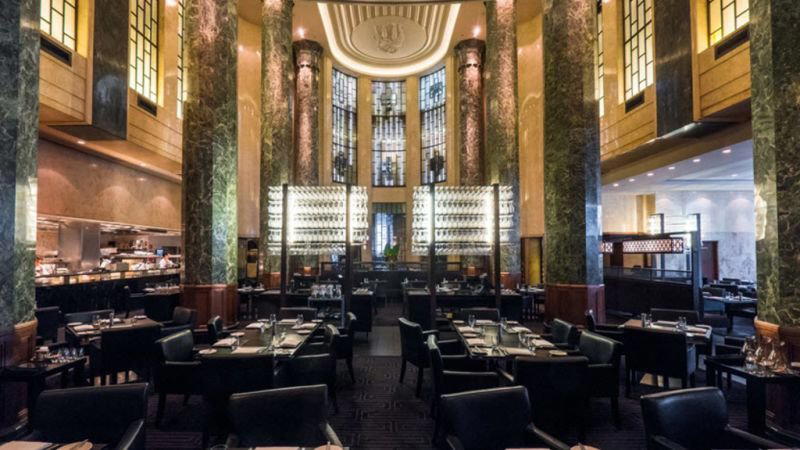
Sophisticated brasserie atmosphere with dramatic floor-to-ceiling wine wall, sweeping city views, and elegant lighting fostering lively conversation.