
Tabelog 100 #89
Our verdict
Osaka’s Chinese dining scene is broader than quick gyoza counters and department-store banquet rooms, and Fukushima Koto belongs to the small-format end of that spectrum. The restaurant is selected for Tabelog 100 Chinese WEST 2026, works in a reservation-only chef’s-choice format, and keeps the room compact enough that planning matters as much as appetite.

Pearl is the En Primeur Club membership app, where members save venues, book tables and use the concierge.
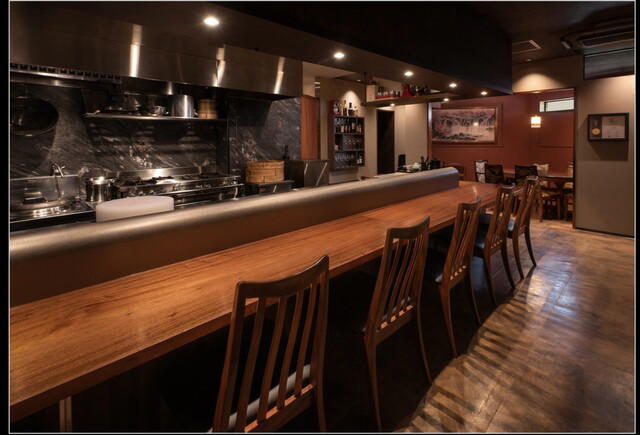
Osaka sits in a dining culture where the evening can change register quickly. The towers and rail lines are part of the city’s geography, but the mood at more serious restaurants is often quieter: meals are chosen with more intention, and diners tend to plan rather than drift. In that context, Fukushima Koto reads less like a generic stop and more like a clearly identified Osaka Chinese restaurant: a place where the category, budget, and recognition give the meal a defined purpose before anyone starts comparing options.
That matters because Chinese cuisine in Osaka is not a single category. At street level, the city often treats it as comfort food, from pork buns and takeaway counters to late-night stir-fry rooms. At the higher end, the model becomes more deliberate, with diners paying closer attention to where a restaurant sits within the city’s serious dining map. Fukushima Koto sits in that more focused lane, with Tabelog 100 Chinese WEST 2026 recognition giving it a clear signal inside western Japan’s competitive Chinese category.
A Chinese dining choice in a city built on appetite
The restaurant is best understood as a Chinese dining room to plan for rather than a casual fallback address. That distinction is useful because it places the experience closer to an intentional restaurant choice than a standard everyday meal. Osaka diners know abundance well; the distinction here is clarity. A recognised Chinese restaurant shifts attention from simple convenience to category, budget, and how Chinese cooking can be positioned within a more deliberate Osaka dining context.
The planning idea is not a decorative detail. In Osaka, high-demand restaurants often reward diners who decide early, check details directly, and avoid treating every meal as interchangeable. A serious restaurant cannot always be approached in the same way as a casual dining hall. The reward is focus: fewer assumptions, a clearer sense of occasion, and a format that gives Chinese cuisine the same close-range seriousness that Osaka has long granted to other specialist restaurants.
The appeal is also in how the category is framed. Chinese dining in Japan extends well beyond a simple split between banquet rooms and casual shared plates, and the more ambitious addresses are often judged by diners with close attention to pacing, texture, and overall balance. Fukushima Koto belongs in that more considered conversation, not in the broader, louder Chinese restaurant tradition built around volume alone.
Why the recognition matters for planning, not bragging rights
Tabelog’s Hyakumeiten lists are useful in Japan because they capture a local dining culture that often moves faster than international guidebooks. Selection for Chinese WEST 2026 does not simply decorate the name; it identifies the restaurant as part of a regional field that includes Kansai’s serious Chinese kitchens, many of them highly local in audience. For a traveller, that kind of recognition is practical intelligence. It tells you that this is not a fallback dinner in Osaka. It is a meal to plan around.
Fukushima Koto also reflects a broader Osaka pattern: ambitious dining can be found across the city rather than relying only on the densest nightlife blocks. Osaka has the advantage of access without requiring every serious restaurant to present itself as a spectacle. That balance is increasingly common in the city’s stronger dining rooms, where the experience can feel intentionally contained even when the wider city remains busy and informal.
Compared with the nearby field, the positioning is clear. Fukushima Koufukuya operates in a different bracket, while Sweet Basil occupies a more casual place in the local dining mix. Korean Ryori Mugunfa sits in another cuisine, and Yonemasu belongs to Osaka’s Japanese dining conversation rather than its Chinese one. Those comparisons matter because they prevent a common mistake: treating every notable restaurant in Osaka as the same kind of occasion.
How it fits into a wider Osaka itinerary
Osaka rewards diners who separate categories rather than chase a single grand meal. A serious Chinese dinner in Osaka can sit alongside bakery stops, casual counters, and bars without trying to replace them. For broader mapping, EP Club’s full Osaka restaurants guide is the natural starting point, with city planning supported by the Osaka hotels guide, Osaka bars guide, Osaka wineries guide, and Osaka experiences guide.
The city’s range is visible in the contrast between specialist restaurants and everyday addresses: casual cafes, bakeries, takeaway counters, pizza rooms, and Italian restaurants all point to different Osaka appetites. Wider Japan comparisons can also be useful in a general sense, because specialist formats differ by city and by audience. Across other markets, the same lesson often holds: tightly defined concepts travel better than generic luxury, and the best dining plans are built by understanding what each room is trying to do.
The editorial call is simple. Choose this restaurant when the goal is Chinese dining in Osaka, not a spontaneous night of unspecified shared plates. Its value is in specificity: Chinese cooking, a defined budget, and recent regional recognition. In a city famous for appetite, that clarity is the point.
Frequently asked questions
Is Fukushima Koto expensive?
Pricing at Fukushima Koto is listed as Dinner: JPY 15,000 - JPY 19,999; Lunch: JPY 8,000 - JPY 9,999.
What are Fukushima Koto's hours?
Publicly provided details here do not confirm Fukushima Koto's current hours. Check the venue's official channels before planning a visit.
Where do I go for Fukushima Koto?
Osaka.
What is Fukushima Koto known for?
Fukushima Koto is known for Chinese dining in Osaka. It was selected for Tabelog Chinese WEST “Tabelog 100” in 2026, which gives it clear local standing.
Can Fukushima Koto adjust for dietary needs?
The public record provided here does not list specific dietary accommodations. For any restrictions, the restaurant provides a phone number, +81-6-6476-8668. Check the venue's official channels for the latest details.
Is Fukushima Koto good for families?
The public record provided here does not confirm family-specific facilities or policies.
Compact Comparison
Comparable venues by price and recognition.
| Venue | Cuisine | Price | Awards | Notes |
|---|---|---|---|---|
| Fukushima KotoThis venue (the venue you are viewing) | Cantonese Chinese | Not listed | Tabelog 100 #89 | Not listed |
| Fukushima Koufukuya | Japanese standing bar (tachinomi izakaya) | Not listed | Tabelog 100 #14 | JPY 2,000 - JPY 2,999 |
| Korean Ryori Mugunfa | High-end Korean | $100–150 | Tabelog 100 #9 | JPY 15,000 - JPY 19,999 |
| Yonemasu | Traditional Japanese Kaiseki | $30–50 | 1 Michelin Star · Tabelog Bronze #522 | Japanese |
| Sweet Basil | Authentic Thai Restaurant | $30–50 | Tabelog 100 #96 | JPY 4,000 - JPY 4,999 JPY 1,000 - JPY 1,999 |
Recognition history
Dated appearances from independent guides and award organizations, with the underlying list record or original source where available.
Tabelog 100 #89 · No. 89
Tabelog · Tabelog 100 - Chinese cuisine - WEST - 2026















