Our verdict
Fratelli Pastabar on Könneritzstraße brings the logic of the Italian pasta bar format to Leipzig's Plagwitz district: a focused menu built around fresh pasta, executed without ceremony. In a city where the dining scene ranges from Michelin-level creative cooking to neighbourhood staples, this is a room that earns its following through repetition and craft rather than occasion or spectacle.

Pearl is the En Primeur Club membership app — saves, bookings, and concierge access live there. Same editors, same standards.
- Address
- Könneritzstraße 59, 04229 Leipzig, Germany
- Phone
- +49 341 9746849
- Hours
- Mon–Sat 5–10 PMSun Closed
- Directions
- Get directions
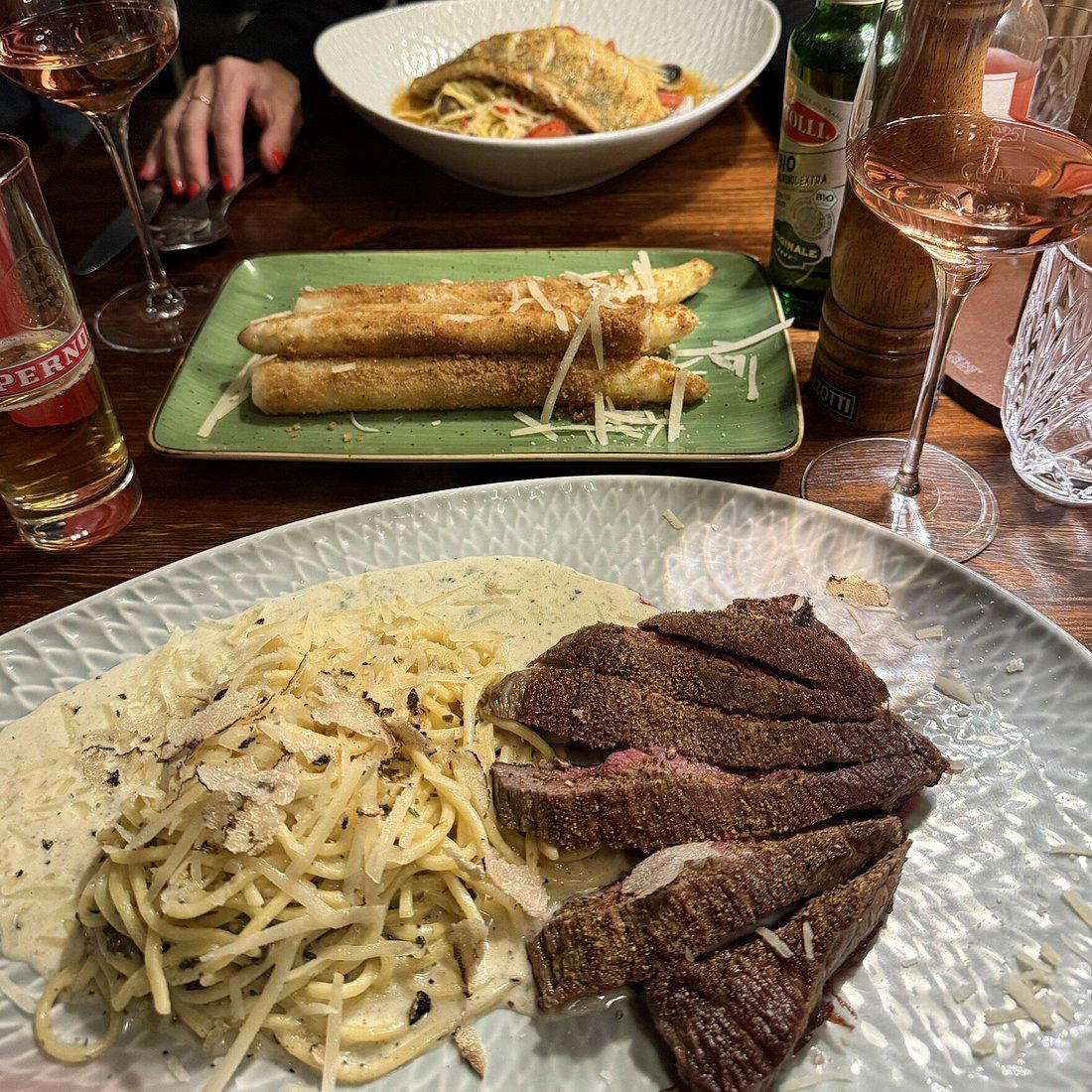
The menu
What to order
- Handmade truffle pasta
- Gnocchi
The Pasta Bar Format and What It Means in a German City
The pasta bar as a format has a specific logic: narrow the menu, maximise the craft on a single product category, price accessibly, and fill the room with regulars. That model, perfected across northern Italy from Bologna to Torino, has taken longer to migrate convincingly into Germany than one might expect. Leipzig's Plagwitz district, home to Fratelli Pastabar at Könneritzstraße 59, is an instructive place for it to land. Plagwitz spent the post-reunification decades cycling through industrial vacancy and creative reoccupation, and it now carries a neighbourhood character that rewards small, specific operators over large, generalist ones. A focused pasta bar fits that environment more naturally than it might in a larger, more formally stratified dining city.
Across Germany, the restaurant conversation tends to concentrate on the upper tier: destinations like Schwarzwaldstube in Baiersbronn, Aqua in Wolfsburg, or Vendôme in Bergisch Gladbach represent the country's Michelin-level ambition, and Berlin's CODA Dessert Dining shows how format innovation operates at the awarded end. But the more durable story in any city's food culture is usually the mid-tier: the places that function on a Tuesday as readily as a Saturday, that serve the same neighbourhood for years, and that build a reputation on a particular product done consistently. Fratelli Pastabar operates in that register.
Fresh Pasta as a Cultural Proposition
Italian pasta culture is worth taking seriously as a craft tradition, because the range of what falls under the category is enormous. Fresh egg pasta cut by hand in Emilia-Romagna operates under a completely different set of standards than extruded dried pasta from a box. The distinction matters in the context of a venue that calls itself a pasta bar: the implicit claim is that pasta is the subject, not just the vehicle. In Italian trattorias and pasta bars that have earned their followings, the kitchen is typically organised around the pasta station, with sauces, fillings, and accompaniments built to support the pasta itself rather than compete with it.
Germany has historically consumed Italian food at scale, but not always with that specificity. The trattoria model, which spread broadly across German cities from the 1970s onwards, frequently genericised the menu to serve every guest's idea of Italian food simultaneously. The pasta bar format is a correction to that: fewer dishes, clearer sourcing claims, and a room that communicates through its narrowness that the kitchen knows what it is doing. Leipzig's dining scene, which includes technically serious operators like Kuultivo at the modern cuisine end and the creative cooking at Stadtpfeiffer, also contains a range of international neighbourhood formats: Addis Café for Ethiopian, 997 Sushi Restaurant for Japanese, and Alfa Restaurant among others. In that pluralist environment, Italian pasta, done with genuine focus, occupies a clear and defensible niche.
Plagwitz and the Neighbourhood Dynamic
The address on Könneritzstraße places Fratelli Pastabar in a part of Leipzig that has developed a recognisable dining and cultural identity over the past fifteen years. The Karl-Heine-Kanal runs through the district, and the former factory buildings along the waterway have been converted into studios, galleries, and small commercial spaces. It is the kind of neighbourhood where a small operator with a specific concept can build a loyal local following without competing on the terms of the city centre. The foot traffic is more residential and creative-class than tourist-heavy, which rewards repeat-visit formats over destination dining.
For the pasta bar model, this is an advantage. The format is not designed for the once-a-year occasion diner; it is designed for the person who returns fortnightly because the kitchen is consistent and the experience requires no particular planning or occasion. That is a harder thing to build than a special-occasion following, and it reflects a different kind of hospitality ambition. Places like JAN in Munich, Victor's Fine Dining by Christian Bau in Perl, or ES:SENZ in Grassau are built for the deliberate, planned visit. Fratelli Pastabar is built for the opposite: the spontaneous weeknight decision, the walk-in that becomes a regular habit.
Where It Sits Among Leipzig's Options
Leipzig's restaurant tier structure is still developing relative to cities like Munich, Hamburg, or Berlin. The city has awarded-level cooking at Stadtpfeiffer and the modern cuisine ambition of Kuultivo, but the mid-market is less densely populated with operators of clear culinary identity than in western German counterparts. That creates space for a focused single-category operator to accumulate a following without facing the kind of competition that would exist in Frankfurt or Düsseldorf. Pasta bars remain uncommon enough in German cities that a well-executed one occupies an identifiable slot in the local dining map rather than blending into a crowded category.
For readers comparing Leipzig options, the relevant frame is not whether Fratelli Pastabar competes with Stadtpfeiffer's tasting menu or with the technical ambition visible at destinations like Schanz in Piesport or Waldhotel Sonnora in Dreis. The relevant comparison is within the neighbourhood casual tier, where the question is whether the kitchen has a genuine point of view on its chosen product. Fresh pasta, made with care and served without ceremony, is a legitimate answer to that question. Internationally, the standard for this format is set by places that commit entirely to the discipline: consider how Le Bernardin in New York City built its entire identity around fish, or how Lazy Bear in San Francisco committed to a single format and format logic. The pasta bar applies the same principle at a neighbourhood scale. See our full Leipzig restaurants guide for broader context across price points and cuisine types.
Planning Your Visit
Könneritzstraße 59 is a walkable address from the Plagwitz S-Bahn stop, and the surrounding streets have enough adjacent interest, including bars and design shops in converted industrial spaces, to make the area worth an evening rather than just a meal. For a format like this, advance booking is less of a structural requirement than at destination restaurants, though weekend evenings in a small room can fill quickly. The restaurant does not carry a phone number or website in EP Club's records at the time of writing; on-the-ground confirmation, or a stop past the address, remains the most reliable approach. For readers familiar with Restaurant Haerlin in Hamburg or other destinations where planning months ahead is required, the contrast here is significant: this is a room that rewards the city-dweller who builds it into rotation rather than the long-haul visitor who plans a single trip around it.
Frequently asked questions
How do I find Fratelli Pastabar Leipzig?
Fratelli Pastabar Leipzig is located at Könneritzstraße 59, 04229 Leipzig, Germany, Leipzig.
Is Fratelli Pastabar Leipzig a good option for a casual weeknight dinner in Plagwitz?
The pasta bar format is specifically designed for accessible, weeknight-friendly dining: a focused menu, reasonable throughput, and pricing that does not require occasion-level commitment. Plagwitz as a neighbourhood adds further convenience, with bars and adjacent venues on and around Könneritzstraße that make it straightforward to combine dinner with a broader evening out in Leipzig.
What do regulars order at Fratelli Pastabar Leipzig?
The pasta bar format at Könneritzstraße 59 is built around a focused menu rather than a broad Italian spread, which means regulars tend to return for specific pasta preparations rather than rotating through many categories. Because the concept narrows to fresh pasta as its primary offering, repeat visitors typically anchor their orders to the house shapes and sauces rather than supplementary dishes.
How far ahead should I plan for Fratelli Pastabar Leipzig?
Fratelli Pastabar sits in Plagwitz, one of Leipzig's more active dining and cultural neighbourhoods, where smaller format restaurants with focused menus tend to fill quickly on evenings and weekends. Booking a few days ahead for weekday visits and at least a week ahead for Friday or Saturday evenings is a reasonable baseline for this type of venue in the district.
What has Fratelli Pastabar Leipzig built its reputation on?
The venue's positioning in Leipzig's Plagwitz district is built around a pasta bar format that treats fresh pasta as a primary craft rather than one item among many on a broad menu. That kind of category focus is still relatively uncommon in Leipzig's restaurant tier, which gives Fratelli Pastabar a clear identity in a city whose dining scene is still developing its speciality food positioning relative to Hamburg or Berlin.
Is Fratelli Pastabar Leipzig allergy-friendly?
Fresh egg pasta is a core component of the pasta bar format, which means gluten and egg are structural ingredients across much of the menu by default. The Könneritzstraße 59 address is the best starting point for any direct allergy enquiry.
A Pricing-First Comparison
| Venue | Cuisine | Price | Awards | Notes |
|---|---|---|---|---|
| Fratelli Pastabar LeipzigThis venue — the venue you are viewing | Classic Italian Pasta Bar | $20–30 | Not listed | Not listed |
| Kuultivo | Modern Creative Cuisine | $100–150 | 1 Michelin Star | Modern Cuisine |
| Stadtpfeiffer | Modern European Fine Dining | $150–200 | 1 Michelin Star · La Liste Top Restaurants | Creative |
| Falco | Modern European Fine Dining | $100–150 | Falstaff Bar - 92 Falstaff Points | Modern European |
| C'est la vie | Modern French Fine Dining | $100–150 | Michelin Plate | French |
| Michaelis | Seasonal German Fine Dining | $50–100 | Michelin Plate | International |
Continue exploring
More in Leipzig
Restaurants in Leipzig
Browse all →
Bars in Leipzig
Browse all →
Hotels in Leipzig
Browse all →

Details
- Romantic
- Cozy
- Intimate
- Date Night
- Special Occasion
- Open Kitchen
- Garden
- A La Carte
- Vegetarian Friendly
- Vegan Options
Current opening hours
- Monday
- 5–10 PM
- Tuesday
- 5–10 PM
- Wednesday
- 5–10 PM
- Thursday
- 5–10 PM
- Friday
- 5–10 PM
- Saturday
- 5–10 PM
- Sunday
- Closed
Hours can change for holidays and private events. Last verified .
Cozy and tranquil with dim lighting, candlelight, and a marvelous romantic atmosphere between grapevines.