.png)


étude is a contemporary French restaurant in the 16th arrondissement, where chef Keisuke Yamagishi works within a format of tight seatings and market-driven menus. Ranked #526 in Opinionated About Dining's 2025 European list and holding a Michelin Plate, it operates as a focused, counter-style proposition that sits well outside the grand-room tradition of Paris fine dining.
 Discover on Pearl
A Small Room With a Specific Argument
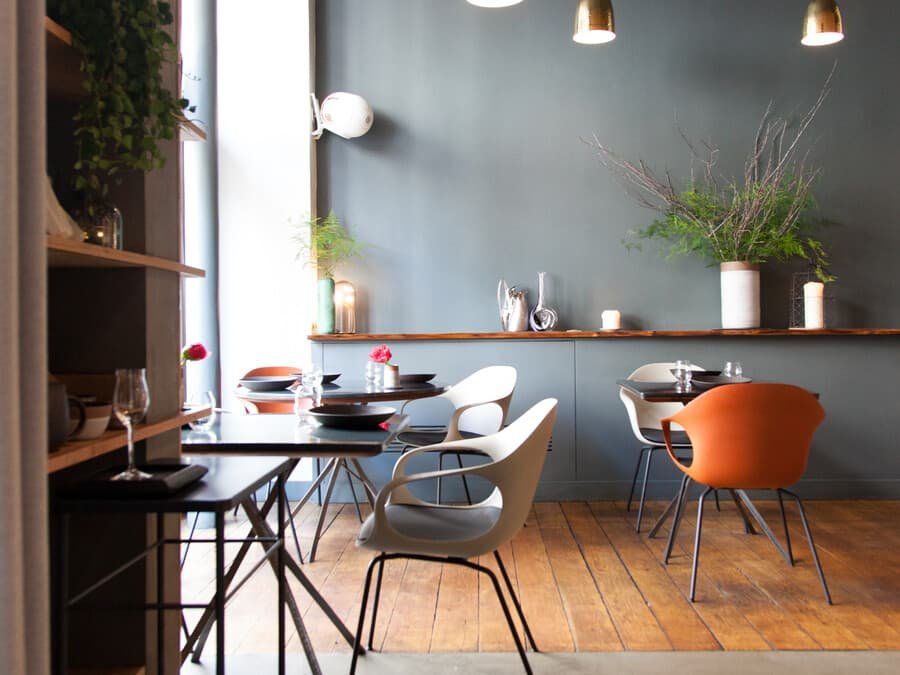
The 16th arrondissement has long been associated with a particular register of Parisian dining: large rooms, established names, and the kind of formality that feels inherited rather than chosen. The address at 14 Rue du Bouquet de Longchamp places étude at the quieter, more residential end of that neighbourhood, away from the trophy tables along Avenue Iéna and the Arc de Triomphe corridor. Arriving in the evening, the scale is immediately apparent. This is not a room that signals ambition through grandeur. It signals it through compression.
That compression is deliberate. Paris has seen a steady growth in chef-driven, small-format restaurants that operate on tightly controlled seatings rather than the continuous-service model of brasserie culture. étude sits clearly in this category, with evening sittings that begin at 20:00 and close by 21:00, and a mid-week lunch window of 12:30 to 13:30. Saturday and Sunday are dark. The rhythm says something about how the kitchen approaches the work: specific hours, specific guests, a specific sequence. It is a format common to high-commitment omakase or dégustation operations, where the chef's control over timing is as much a quality signal as anything on the plate.
The Market-Driven Logic of Contemporary French Cooking
Contemporary French cuisine in Paris operates along a wide spectrum, from the grand architectural gestures of Plénitude and Le Grand Restaurant to the lighter, vegetable-forward approach associated with restaurants like Neige d'Eté. The thread running through the more interesting end of the category is a commitment to sourcing that functions as a creative constraint rather than a marketing claim. When the menu moves with the market, the kitchen cannot rely on fixed signature dishes; it must build a new argument each service.
Chef Keisuke Yamagishi trained within the French tradition and brings a background that places étude inside the Japan-meets-France subgenre that has become one of the more distinctive voices in contemporary Parisian cooking. This is not unusual territory: the French kitchen has absorbed Japanese precision in technique for decades, producing a hybrid sensibility that appears at several addresses across the city, including at Maison Sota Atsumi. At étude, the editorial interest is less the biography of the chef and more what the format demands of the cooking: with a kitchen operating across tight daily windows, seasonal and market responsiveness is structural, not optional.
This approach contrasts sharply with the fixed-menu architecture of the grands restaurants. Alain Ducasse au Plaza Athénée operates from a defined aesthetic framework that changes incrementally across seasons. At étude, the scale enforces a different logic. Producer relationships, market availability, and the specific quality of ingredients on a given week become the actual menu. That is a different kind of discipline, and one that places the kitchen closer to the traditions of the French countryside than to the grande maison model of the capital.
The French regional canon has long been sustained by exactly this relationship with local supply. Restaurants like Flocons de Sel in Megève, Bras in Laguiole, and Auberge de l'Ill in Illhaeusern built their reputations in part through the depth of their relationships with local producers and the particularity of their regional terroir. Transplanted to Paris, and onto a smaller stage, that philosophy finds a different expression: not a region's larder, but a city chef's access to Rungis and the smaller specialist networks that feed the leading kitchens in the capital.
Recognition Signals and Peer Positioning
The awards record for étude traces a clear upward line. Opinionated About Dining listed it among recommended new restaurants in Europe in 2023, moved it to a ranked position at #431 on its European list in 2024, and placed it at #526 in 2025 as the list expanded and competition deepened. A Michelin Plate in 2025 confirms inspector interest without yet translating to star recognition. Taken together, the signals position étude as a restaurant that specialist audiences have noticed and tracked, while remaining below the tier occupied by three-star addresses like Troisgros or the legacy institution of Paul Bocuse.
OAD ranking movement from 2023 to 2025 is the kind of trajectory that typically reflects consistent kitchen performance rather than a single breakout moment. OAD rankings are driven by the dining logs of frequent, well-travelled diners rather than by a small panel, which makes them a useful proxy for the restaurant's reputation among repeat visitors to Paris rather than among casual tourists. The Google rating of 4.6 across 158 reviews points in the same direction: a satisfied, engaged audience, not a mass-market crowd.
For comparative positioning: the three-Michelin-star tier in Paris (Alléno, Kei, L'Ambroisie, Le Cinq, Pierre Gagnaire) operates at price points that price out many otherwise committed diners. étude exists in a space below that tier but above the bistrot, where a Michelin Plate and OAD recognition provide meaningful external validation without the premium that a full star rating commands. It is a position occupied by a significant number of the most interesting rooms in the city.
The French contemporary dining tradition also plays out across Mirazur in Menton and Abbaye de la Celle in Provence, where the relationship between kitchen and immediate landscape is the central narrative. étude operates in the Paris register of that same conversation, where the landscape is the city's supply chain rather than a kitchen garden.
Planning Your Visit
The compressed operating hours at étude require more advance planning than the typical Paris restaurant. Lunches run Wednesday through Friday only, dinners Monday through Friday, with no weekend service. Building a visit around a mid-week lunch or early-week dinner will require coordinating with other Paris plans accordingly.
| Detail | étude | Comparable Tier (Paris) |
|---|---|---|
| Michelin Recognition | Michelin Plate (2025) | Plate to 1 Star typical |
| OAD European Rank | #526 (2025) | Specialist-audience tracked |
| Service Days | Mon–Fri only | Varies; many close Mon |
| Lunch Availability | Wed–Fri, 12:30–13:30 | Often Fri–Sat only at this tier |
| Evening Sitting | 20:00–21:00 | Typically 19:30–21:00 |
| Google Rating | 4.6 / 5 (158 reviews) | 4.4–4.7 typical range |
For broader planning, see our full Paris restaurants guide, our full Paris hotels guide, our full Paris bars guide, our full Paris wineries guide, and our full Paris experiences guide. For those travelling beyond the capital, Auberge du Père Bise in Talloires-Montmin represents the kind of regional French table that étude's market-driven sensibility echoes in a very different setting.
Cost and Credentials
Comparable venues for orientation, based on our database fields.
| Venue | Price | Awards | Notes |
|---|---|---|---|
| étude | Category: Remarkable; Opinionated About Dining Top Restaurants in Europe Ranked… | This venue | |
| Alléno Paris au Pavillon Ledoyen | €€€€ | Michelin 3 Star | Creative, €€€€ |
| Kei | €€€€ | Michelin 3 Star | Contemporary French, Modern Cuisine, €€€€ |
| L'Ambroisie | €€€€ | Michelin 3 Star | French, Classic Cuisine, €€€€ |
| Le Cinq - Four Seasons Hôtel George V | €€€€ | Michelin 3 Star | French, Modern Cuisine, €€€€ |
| Plénitude | €€€€ | Michelin 3 Star | Contemporary French, €€€€ |
Continue exploring