Michelin Plate
Our verdict
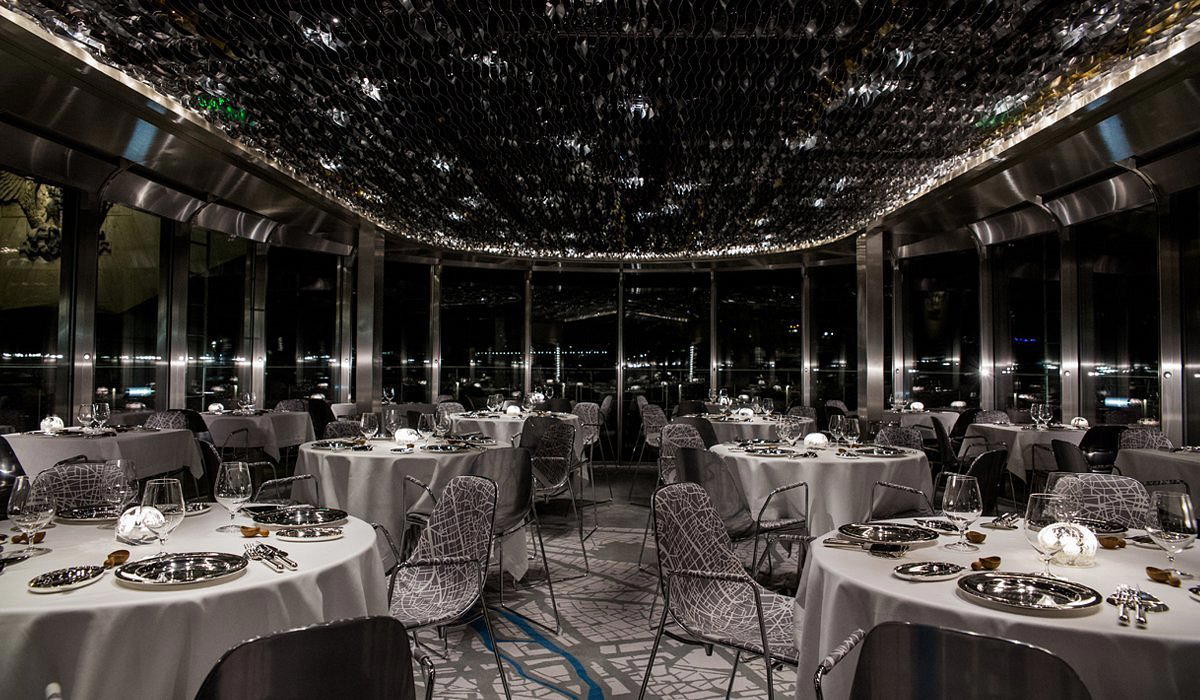
Ducasse sur Seine brings Alain Ducasse's kitchen discipline to the Seine itself, operating as a working restaurant aboard a vessel moving through Paris's most recognisable stretches of river. Chef Pierre Marty leads a menu positioned at the top of the €€€€ tier, with Michelin Plate recognition in both 2024 and 2025 confirming sustained kitchen consistency. The format is rare in Paris: fine dining in motion, with the city's monuments serving as the backdrop rather than the destination.

Pearl is the En Primeur Club membership app, where members save venues, book tables and use the concierge.
The menu
What to order
- Petit pâté chaud de pintade et foie gras de canard
- Cookpot d'orge perlé, légumes et fruits de saison
- Paris tout chocolat, caviar de vanille
Dining on the Move: Paris's River as Context
Paris has always treated its waterways as scenery rather than infrastructure, and the dining scene has largely followed suit, anchoring its serious kitchens in fixed addresses from Saint-Germain to the 8th arrondissement. The emergence of high-specification restaurant vessels on the Seine represents a different logic: the city itself becomes the dining room, and the kitchen must perform at a level that justifies the premium without the shelter of a celebrated postal address. Michelin's Plate recognition, awarded in both 2024 and 2025, marks it as a kitchen that meets a standard, not merely a novelty that trades on the view.
The broader context matters here. Paris's top tier of modern cuisine restaurants, including houses like Alléno Paris au Pavillon Ledoyen, Amâlia, and Accents Table Bourse, are rooted in fixed architectural settings where the room itself contributes to the experience. Ducasse sur Seine inverts that equation. The room moves. The kitchen aboard a vessel has none of the spatial advantages of a grand dining room, which makes the consistent Michelin recognition more instructive than it might first appear.
The Seine as Both Setting and Editorial Statement
Approaching Port Debilly in the early evening, the Eiffel Tower rises to the southeast and the Trocadéro gardens frame the embankment. The vessel itself sits low on the water, and boarding at this stretch of the Seine places guests at river level rather than above it, which is a different relationship with the city than any rooftop terrace offers. The movement is slow and deliberate, designed to hold guests in view of the city's most recognisable landmarks through the duration of a meal.
What makes this format editorially interesting in 2025 is what it says about how Paris's dining scene thinks about environment and efficiency. The vessel architecture imposes constraints that a conventional restaurant never faces: limited storage, restricted energy systems, the challenge of service on a moving platform. Kitchens operating under those constraints, and doing so at a Michelin-recognised level, are making an implicit argument about prioritising quality over convenience. That argument aligns naturally with a broader movement in French fine dining toward reduced-footprint operations, careful sourcing, and material accountability.
Sustainability and the Logic of a River Kitchen
The environmental dimension of cooking on water is more complex than it appears. River vessels in France operate under strict regulatory frameworks covering fuel consumption, waste management, and water-adjacent food handling. For a kitchen aiming at the €€€€ price tier with Michelin oversight, those constraints tend to push toward sourcing discipline: smaller ingredient volumes, tighter rotation, and a preference for producers whose supply chains can adapt to a floating kitchen's logistics. Chef Pierre Marty operates within those parameters, and the Plate recognition in consecutive years suggests the kitchen has found a working rhythm rather than struggling against its own format.
This connects to a wider pattern in French fine dining, where sustainability has moved from a marketing posture to an operational reality. Houses like Bras in Laguiole built their reputation in part on a relationship with the terrain of the Aubrac plateau. Flocons de Sel in Megève draws its identity from alpine proximity and seasonal constraint. Ducasse sur Seine operates on a different register but faces an analogous pressure: the environment is not incidental, and the kitchen's relationship to it is visible to every guest. A vessel moving through Paris at dusk, with the lights of the Pont Alexandre III reflected on the water, is not an anonymous room. What the kitchen sends out of it carries that context.
Alain Ducasse as a name is associated with a global network of restaurants spanning Monaco, London, Tokyo, and New York, as well as multiple Michelin-starred Paris addresses. The house has a documented record of applying consistent kitchen philosophy across very different formats. Ducasse sur Seine sits at the accessible end of that network in terms of concept novelty, but the sourcing and kitchen discipline that define the broader organisation carry over. The Plate recognition, rather than a star, places it accurately: this is serious cooking within a format that does not yet compete directly with fixed addresses like Anona or 114, Faubourg in the same tier.
Where Ducasse sur Seine Sits in Paris's Modern Cuisine Tier
The €€€€ bracket in Paris covers a wide range. At the leading sit three-Michelin-starred addresses like L'Ambroisie, Le Cinq at the Four Seasons George V, Pierre Gagnaire, and Kei, where the price per head reflects decades of institutional recognition and kitchen depth. Ducasse sur Seine occupies the same price bracket by tariff but a different position by critical standing. The Plate, in Michelin's framework, signals that the kitchen merits attention without yet meeting the threshold for a star. For the category of river dining in Paris, that standing is meaningful: there is no direct peer in the city operating a fixed-route dinner vessel at this level of consistency.
Internationally, the fixed-concept fine dining vessel is a format with scattered precedents. Restaurants like Frantzén in Stockholm and FZN by Björn Frantzén in Dubai operate in fixed locations but share the logic of high-specification dining within an unusual physical framework. The vessel format adds a layer of logistical complexity that those kitchens avoid, which makes the Ducasse operation's sustained recognition a genuine data point rather than a house-name dividend.
For the broader Paris scene, the restaurant also functions as a pressure test for what modern cuisine means outside a traditional room. The city's most celebrated addresses, from Troisgros in Ouches to Auberge de l'Ill in Alsace or Paul Bocuse outside Lyon, built their authority in rooms with deep architectural identity. Ducasse sur Seine asks whether that identity can be generated by movement and landscape rather than walls and history.
Planning Your Visit
Ducasse sur Seine departs from Port Debilly in the 16th arrondissement. The address places it within reach of the Trocadéro (Métro line 6 or 9) and accessible from central Paris in under twenty minutes by taxi from the 8th. Timing matters: an evening departure positions guests to see the Eiffel Tower's light sequence, which runs on the hour after dark. Lunch departures offer a different read of the city, with stronger natural light on the stone embankments and fewer crowds on the water.
| Venue | Format | Price Tier | Michelin Status | Setting |
|---|---|---|---|---|
| Ducasse sur Seine | Moving vessel, set dinner/lunch | €€€€ | Plate (2024, 2025) | Seine river, Paris |
| Alléno Paris au Pavillon Ledoyen | Fixed grand restaurant | €€€€ | 3 Stars | Champs-Élysées gardens |
| Le Cinq, Four Seasons George V | Fixed hotel dining room | €€€€ | 3 Stars | 8th arrondissement |
| Auberge de Montfleury | Fixed country-inn format | €€€€ | See EP Club listing | Greater Paris region |
For further context on dining in the French capital. If you are building a wider itinerary, Paris bars guide, Paris wineries guide, and Paris experiences guide cover the broader range. For reference outside the capital, Mirazur in Menton offers a comparable argument about environment-led fine dining, with the Mediterranean replacing the Seine as the defining geographic frame.
Frequently asked questions
What's the cuisine at Ducasse sur Seine?
Does Ducasse sur Seine have a Michelin star or similar recognition?
Ducasse sur Seine has received recognition including: Michelin Plate (2025); Michelin Plate (2024).
What's the must-try dish at Ducasse sur Seine?
The menu at Ducasse sur Seine shifts with season and supply, as is standard for a moving-vessel kitchen operating under Pierre Marty. The Michelin Plate recognition in both 2024 and 2025 points to consistent cooking quality across the board rather than a single signature dish. On a €€€€ tasting format, the stronger strategy is to follow the kitchen's current direction on the night rather than targeting one course.
How much does it cost to eat at Ducasse sur Seine?
Pricing at Ducasse sur Seine is listed as €€€€.
Cuisine-First Comparison
| Venue | Cuisine | Price | Awards | Notes |
|---|---|---|---|---|
| Ducasse sur SeineThis venue (the venue you are viewing) | Modern French Fine Dining | $150–200 | Michelin Plate | Not listed |
| Alléno Paris au Pavillon Ledoyen | Modern French Fine Dining | $150–200 | 3 Michelin Stars · World's 50 Best #79 | Creative |
| Kei | Modern French with Japanese Influences | $300–500 | 3 Michelin Stars · World's 50 Best #93 | Contemporary French, Modern Cuisine |
| L'Ambroisie | Classic French Haute Cuisine | $300–500 | 2 Michelin Stars · World's 50 Best #23 | French, Classic Cuisine |
| Le Cinq - Four Seasons Hôtel George V | Modern French Fine Dining | $300–500 | 3 Michelin Stars · World's 50 Best #24 | French, Modern Cuisine |
| Plénitude | Modern French Sauce-Led Fine Dining | $300–500 | 3 Michelin Stars · World's 50 Best #14 | Contemporary French |
Recognition history
Dated appearances from independent guides and award organizations, with the underlying list record or original source where available.
Michelin Plate
Michelin
Full recognition history (2 entries)
Michelin Plate
Michelin