Double Knot
Our verdict
Double Knot occupies a distinct position in New York City's Japanese-influenced dining scene, drawing on the multi-course tradition where seafood and global technique intersect. For visitors serious about precision cooking, it warrants a place on the itinerary alongside the city's top-tier Japanese and seafood houses.

Pearl is the En Primeur Club membership app, where members save venues, book tables and use the concierge.

The menu
What to order
- Edamame and truffle dumplings
Where the Multi-Course Tradition Meets the Global Seafood Counter
New York's upper tier of Japanese-influenced dining has split into two recognizable camps over the past decade. One is the purist omakase counter, where the chef's lineage, rice temperature, and fish provenance are the entire conversation. The other is a more hybrid format: multi-course structures that draw on kaiseki principles of sequence, seasonality, and visual discipline, but apply them to global ingredients and techniques. Double Knot, with its Japanese and seafood foundations set against a broader global approach, sits in that second camp alongside a growing number of New York addresses that treat the kaiseki framework as a philosophy rather than a strict geographic tradition.
Kaiseki, as a formal tradition, organizes a meal around seasonal rhythm and aesthetic contrast. Each course is calibrated not just for flavor but for texture, temperature, color, and proportion relative to what comes before and after. When that logic is applied outside its Kyoto origins, the results tend either to feel diluted or genuinely inventive, depending on how seriously the kitchen commits to the underlying discipline. The more credible examples in New York treat it as a structural constraint rather than a decorative reference, letting the sequence do editorial work that a single dish cannot accomplish alone.
Double Knot in the Context of New York's Japanese and Seafood Scene
New York hosts a concentrated range of Japanese and seafood-focused dining at high price points. At one end sits Masa, the city's most expensive sushi counter, where the omakase format is total and uncompromising. At the other end of the formality spectrum, the city's seafood institutions offer à la carte precision in a different register, with Le Bernardin representing the French-trained, product-led approach to seafood that has defined fine dining in this city for decades. Double Knot's Japanese and global hybrid positioning places it between those poles, in a bracket that rewards guests who come for sequence and contrast rather than a single-ingredient showcase.
The comparison with Atomix is instructive. Atomix applies Korean culinary tradition through a tasting-counter format with deep aesthetic rigour, and has earned significant critical attention for doing so with consistency. The challenge any Japanese-influenced multi-course restaurant faces in New York is how to differentiate within a category that already includes serious practitioners. Eleven Madison Park and Per Se occupy the French-inflected tasting-menu tier and demonstrate how a clear philosophical commitment, sustained over years, builds the kind of institutional credibility that separates a restaurant from its peers.
Across the United States, the multi-course format with strong regional or philosophical anchors has produced some of the most discussed restaurant openings of the past decade. Single Thread Farm in Healdsburg applies a Japanese-influenced kaiseki framework to Northern California ingredients with notable rigour. Lazy Bear in San Francisco treats the communal tasting-counter format as its defining structure. Smyth in Chicago and Blue Hill at Stone Barns in Tarrytown both ground their multi-course logic in agricultural sourcing. Providence in Los Angeles and Addison in San Diego show how a California seafood sensibility can anchor a formal tasting structure. In each case, the restaurant's identity comes from how clearly it can articulate what its sequence is for. Double Knot's Japanese and global synthesis is the frame through which that same question must be answered.
The Kaiseki Logic Applied Globally
The strength of the kaiseki influence in contemporary fine dining lies in what it demands of a kitchen beyond technique. It requires a theory of sequence: why does course three exist in relation to course two, and what is course five setting up? That question is harder to answer when the tradition is global rather than rooted, because the seasonal and regional anchors that kaiseki draws on in Japan are replaced by something the kitchen must consciously construct. The restaurants that handle this most credibly tend to anchor their sequence in a clear sourcing philosophy, a specific geography, or a defined technique family. Diffuseness is the main risk in a globally-framed format.
Internationally, this challenge is visible in restaurants like Atelier Moessmer Norbert Niederkofler in Brunico, where strict Alpine ingredient sourcing gives the multi-course format a clear editorial spine. Dal Pescatore in Runate grounds a long-form Italian tasting structure in a specific regional tradition. The lesson in both cases is that a multi-course format earns its length through discipline about what it includes and what it refuses. That discipline is the most transferable insight from kaiseki for any restaurant operating outside the tradition's geographic home.
Planning Your Visit
Double Knot is located in New York City. For the broader New York dining context, including comparable tasting-counter and seafood experiences, see our full New York City restaurants guide. Guests looking to benchmark Double Knot against other multi-course formats in the region might also consider The Inn at Little Washington in Washington, Emeril's in New Orleans, or Frasca Food & Wine in Boulder for a sense of how the tasting-format tradition plays across different American cities and ingredient cultures. The French Laundry in Napa remains the reference point for how a long-form American tasting menu builds and sustains an institutional reputation over decades.
Reservations: Book as far in advance as possible; tasting-counter formats in this price tier in New York typically require several weeks' notice. Dress: Smart casual is the baseline at comparable venues in this tier; business casual is never wrong. Format: Japanese-influenced multi-course with seafood and global technique; confirm current menu length and dietary options directly with the venue.
Frequently asked questions
How does Double Knot's Japanese-seafood-global format differ from a traditional omakase counter in New York?
A traditional omakase counter in New York, such as those operating in the purist Edomae tradition, is built around a single chef's editorial control over a fixed sequence of nigiri or sashimi with minimal outside reference points. Double Knot's cuisine type spans Japanese, seafood, and global influences, which positions it closer to the kaiseki-informed multi-course model than the counter-driven omakase format. That distinction matters for a diner deciding between provenance-specific precision and a kitchen that applies Japanese sequencing logic to a broader sourcing and technique vocabulary in New York City.
What should I order at Double Knot?
At a Japanese-influenced multi-course venue like Double Knot, committing to the full sequence is the more coherent choice than ordering selectively. The kaiseki-adjacent format is built on progression, where each course gains meaning from what precedes and follows it. Ordering à la carte from that structure tends to flatten the logic the kitchen is working from.
What's the best way to book Double Knot?
For restaurants in New York City's premium Japanese and seafood tier, the standard approach is to book through the venue's website or a reservation platform such as Resy or OpenTable, checking both channels since availability sometimes differs. Booking midweek typically opens more options.
What do critics highlight about Double Knot?
In New York's Japanese and global seafood category, critical attention tends to focus on sequence integrity, sourcing credibility, and how closely the kitchen's global references hold up against the precision demanded by a kaiseki-influenced structure. For a venue combining Japanese and seafood with broader global influences, the question critics most consistently press is whether that range narrows focus or extends it productively.
Is a meal at Double Knot worth the investment?
In a city where the premium Japanese and seafood tier includes addresses like Masa at the highest price point in the country and Le Bernardin as the reference for seafood technique, value is always relative to what the kitchen is attempting. Double Knot's Japanese-seafood-global format sits in a tier where the full multi-course commitment is the clearest test of whether the kitchen's ambition and execution are aligned.
When should I go to Double Knot?
If Double Knot operates on a seasonal menu rotation, the transitions between seasons are typically when Japanese-influenced multi-course formats show the most range, as sourcing shifts and the kitchen recalibrates its sequence. In New York City, autumn and spring represent the periods when seasonal seafood supply is most varied, which tends to reward the kaiseki-style logic this format draws from.
A short peer table to compare basics side-by-side.
| Venue | Cuisine | Price | Awards | Notes |
|---|---|---|---|---|
| Double KnotThis venue (the venue you are viewing) | Japanese Sushi & Robatayaki Izakaya | $50–100 | Not listed | Not listed |
| Le Bernardin | French Seafood Fine Dining | $300–500 | 3 Michelin Stars · World's 50 Best #13 | French, Seafood |
| Atomix | Modern Korean Tasting Menu | $300–500 | 2 Michelin Stars · World's 50 Best #7 | Modern Korean, Korean |
| Per Se | French Fine Dining Tasting Menu | $300–500 | 3 Michelin Stars · World's 50 Best #40 | French, Contemporary |
| Masa | Traditional Japanese Omakase | $500+ | 2 Michelin Stars · World's 50 Best #27 | Sushi, Japanese |
| Eleven Madison Park | Contemporary Plant-Based Fine Dining | $300–500 | 3 Michelin Stars · World's 50 Best #4 | French, Vegan |
Continue exploring
More in New York City
Restaurants in New York City
All restaurants in New York City →
Bars in New York City
All bars in New York City →





Details
- Trendy
- Modern
- Lively
- Group Dining
- Casual Hangout
- Late Night
- Open Kitchen
- Craft Cocktails
- Sake Program
- A La Carte
- Small Plates
- Cocktails
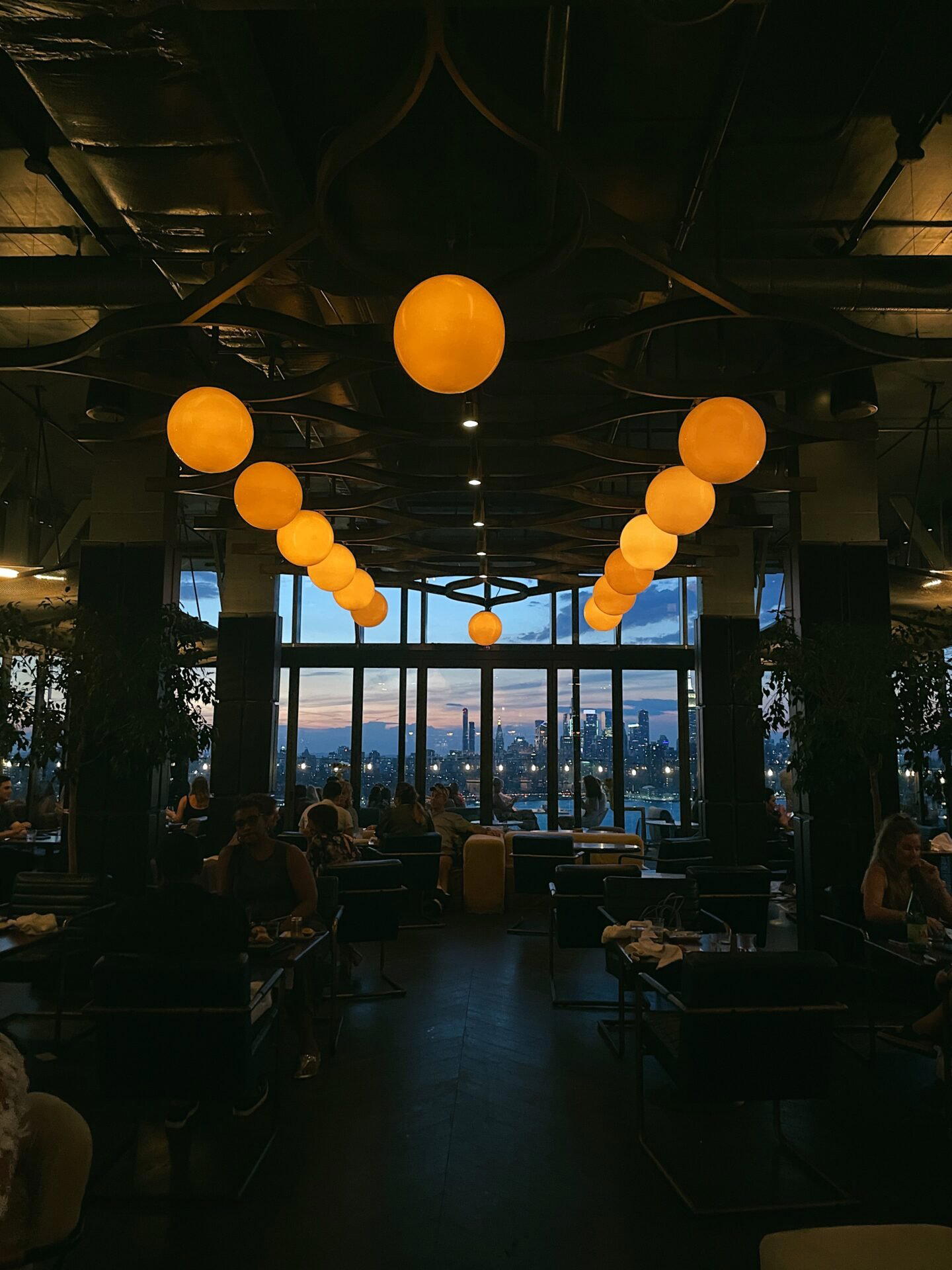
Swank and sprawling space with a playful, accommodating atmosphere suitable for groups.