
Michelin Bib Gourmand
Our verdict
The basement-level Taipei 101 outpost of Din Tai Fung sits inside one of Asia's most recognisable retail destinations, ranking #11 on Opinionated About Dining's Casual Asia list in 2025. It represents xiao long bao at a volume and consistency that few operations in the world have matched, and remains a useful benchmark for understanding Taiwan's most exported culinary format.

Pearl is the En Primeur Club membership app, where members save venues, book tables and use the concierge.
The menu
What to order
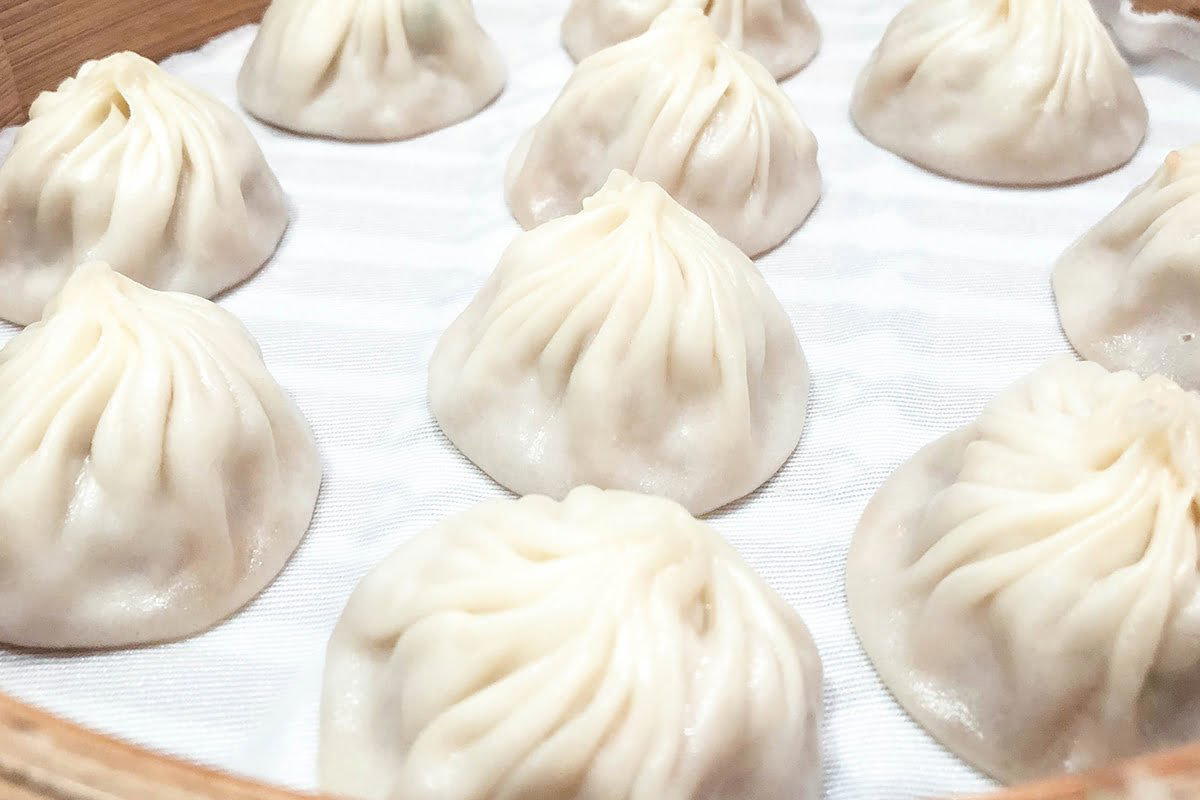
- Pork Xiao Long Bao
- Spicy Vegetable and Ground Pork Wonton
- Pork Fried Rice
The Glass Kitchen and the Queue: What Xiao Long Bao Looks Like at Scale
There is a particular kind of theatre inside the Taipei 101 location of Din Tai Fung that has nothing to do with the building's observation deck. In the basement of one of Asia's most photographed skyscrapers, behind panels of glass, a kitchen team folds dumplings at a pace that functions almost like a performance installation. The wrapping stations are visible from the dining floor, and watching the rhythm of production, the precise pleating, the bamboo steamers cycling in and out, the controlled assembly-line logic, is its own form of education about what it takes to deliver xiao long bao at consistent volume without losing the texture and soup concentration that define the format.
The broader dining scene in Taipei has split dramatically between counter-format fine dining and high-volume casual. On the fine-dining side, places like logy and Taïrroir operate at the intimate, tasting-menu end of the spectrum, with tight seat counts and months-long waits. Din Tai Fung's Taipei 101 location occupies the other pole entirely: high throughput, broad accessibility, and a pricing structure that keeps xiao long bao within reach of tourists, local families, and visiting food professionals alike. Both tiers matter to understanding how Taipei has built its dining reputation.
Ranked and Referenced: The 2025 OAD Position in Context
In 2025, Opinionated About Dining ranked the Taipei 101 branch #11 in its Casual Asia list, a category that rewards consistency and dining value over ambition or provocation. That ranking is worth reading carefully: OAD's casual tier is not a consolation category. It tends to capture places that have sustained quality at a price and format accessible to a wide audience, which is a harder operational discipline than it sounds.
Within the xiao long bao category specifically, Din Tai Fung's Taipei 101 branch functions as a reference point rather than just a restaurant. For visitors arriving from cities where the chain has an international presence, this address represents the original operational context. The comparison works in both directions: Din Tai Fung in Hong Kong and independent interpretations of the format at places like Bao, The in New York City and dan Modern Chinese in Los Angeles all trace a lineage that leads back to Taiwan.
Soup Dumplings and the Question of Waste-Conscious Production
The sustainability conversation around high-volume Chinese dumpling operations is more nuanced than most editorial coverage acknowledges. At the scale Din Tai Fung's Taipei 101 branch operates, ingredient sourcing and food-waste management have practical consequences that a ten-seat counter never faces. The xiao long bao format itself, pork and gelatin-rich broth encased in thin wheat dough, involves few ingredients, which limits sourcing complexity but amplifies the impact of any variance in protein quality. Maintaining a consistent soup concentration across hundreds of portions daily requires either tight supplier relationships or frequent quality corrections, neither of which is invisible to the kitchen's waste profile.
In Taiwan more broadly, food culture has long operated with a lower-waste philosophy at the casual end of the market, partly because of tight kitchen economics and partly because the format of Chinese dim sum and dumpling cuisine was historically built around full-animal and full-ingredient utilisation. The broth that gives xiao long bao its defining characteristic is itself a product of that tradition: collagen-rich, gelatin-set, using parts of the animal that coarser cooking would discard. That lineage does not make the modern chain operation inherently sustainable, but it does mean the format has a structural logic that aligns with waste reduction in a way that protein-heavy Western fine dining typically does not.
For context on how other Taiwanese restaurants approach sourcing at the premium end, Akame in Wutai Township has built an entire identity around indigenous ingredients and local procurement, a different tier and format, but an instructive counterpoint to the high-volume model.
The Taipei 101 Address: Location Logic and What Surrounds It
The Xinyi District location, in the basement of Taipei 101 at City Hall Road, places the restaurant inside one of the highest-footfall retail environments in Taiwan. That context shapes the experience in ways that a standalone restaurant address would not. The surrounding floor hosts international retail and food stalls, which means the path to the restaurant involves navigating a commercial environment before arriving at the dining room. The operational payoff is convenience: the address sits on the Taipei Metro's Xinyi line, making it one of the more accessible dining destinations in the city for visitors without local transport.
For visitors building a broader Taipei itinerary, the Xinyi District position makes this an efficient pairing with other parts of the city. The full Taipei restaurants guide covers the wider dining map, from Michelin-level Cantonese at Le Palais to Spanish contemporary cooking at Molino de Urdániz and French technique at L'Atelier de Joël Robuchon. For those extending beyond Taipei, comparable precision at a different scale appears at JL Studio in Taichung and GEN in Kaohsiung. The Taipei hotels guide, bars guide, and experiences guide round out the city planning picture, while the wineries guide is relevant for those pairing the visit with Taiwan's growing wine culture.
Visits to southern Taiwan can include a stop at A Cun Beef Soup in Tainan or the mountain setting of Volando Urai Spring Spa and Resort in Wulai District for a contrast in pace and format.
Planning the Visit
The Taipei 101 branch is located at B1, No. 45, City Hall Road, Xinyi District, Taipei, accessible directly from the Taipei 101/World Trade Center MRT station on the red line. Given its position inside one of the city's busiest commercial buildings, queue times at peak hours (weekend lunches in particular) can extend considerably. Arriving before the midday service peak or after the main lunch rush reduces wait time materially. The branch operates at high volume, so turnover is fast once you are seated, but the wait before seating is the variable most worth managing. Specific opening hours and booking availability should be confirmed directly with the venue or via its current listings, as both are subject to change.
Frequently asked questions
Is Din Tai Fung Chinese Taipei 101 Restaurant child-friendly?
The Taipei 101 branch handles one of the highest-volume dining crowds in the Xinyi District, which means the format is well-suited to families: casual seating, fast pacing, and a menu built around dumplings and noodles that children tend to eat without negotiation. The basement-level location within the mall also removes the logistical friction of street-level access with strollers.
What should I expect atmosphere-wise at Din Tai Fung Chinese Taipei 101 Restaurant?
The Taipei 101 branch operates as a glass-walled kitchen theatre: diners can watch the dumpling team work at close range, each wrapper weighed and pleated to a fixed specification. Ranked #11 on the 2025 Opinionated About Dining Casual Asia list, the room rewards consistency over ceremony, this is a high-footfall operation in a major retail tower, so the energy is efficient and purposeful rather than hushed.
What distinctions does Din Tai Fung Chinese Taipei 101 Restaurant have?
Din Tai Fung Chinese Taipei 101 Restaurant has received recognition including: Opinionated About Dining Casual in Asia Ranked #11 (2025).
What should I eat at Din Tai Fung Chinese Taipei 101 Restaurant?
The xiao long bao is the reference point, the kitchen's signature soup dumpling is the dish that earned Din Tai Fung its international reputation and the 2025 OAD Casual Asia #11 ranking across its Taiwan operations.
How would you describe the cuisine at Din Tai Fung Chinese Taipei 101 Restaurant?
In Context: Similar Options
Comparable venues nearby, for context on price, style, and recognition.
| Venue | Cuisine | Price | Awards | Notes |
|---|---|---|---|---|
| Din Tai Fung Chinese Taipei 101 RestaurantThis venue (the venue you are viewing) | Taiwanese Dim Sum | $10–20 | Michelin Bib Gourmand | Not listed |
| 小李子清粥小菜 | Taiwanese Congee and Small Dishes | $10–20 | Not listed | Da'an |
| 一甲子餐飲 | Small eats | Not listed | Michelin Bib Gourmand | Xinqi |
| 京星港式飲茶二 | Hong Kong-style Dim Sum | $10–20 | Not listed | Da_an |
| 吉品海鮮餐廳 Ji Pin Restaurant | Cantonese Seafood & Dim Sum | $50–100 | Not listed | Da'an District (Xinyi/Zhongshan areas) |
| æ³ ç±³é£å | Modern Taiwanese | $30–50 | Not listed | Longyuan |
Recognition history
Dated appearances from independent guides and award organizations, with the underlying list record or original source where available.
Michelin Bib Gourmand
Michelin
Opinionated About Dining Casual in Asia Ranked #17
Opinionated About Dining
Full recognition history (4 entries)
Opinionated About Dining Casual in Asia Ranked #11
Opinionated About Dining
Michelin Bib Gourmand
Michelin