
Tabelog 100 #46
Our verdict
Hatagaya’s compact curry counter gives Tokyo’s spice scene a different scale: 10 seats, vegetable-led cooking, and a Tabelog 100 selection for Asian and ethnic cuisine in Tokyo. Curry & Spice Aoi Tori sits between Indian curry, Sri Lankan influence, and izakaya drinking culture, with prices in the JPY 1,000–1,999 range and a room built for close-range, low-friction dining.

Pearl is the En Primeur Club membership app, where members save venues, book tables and use the concierge.
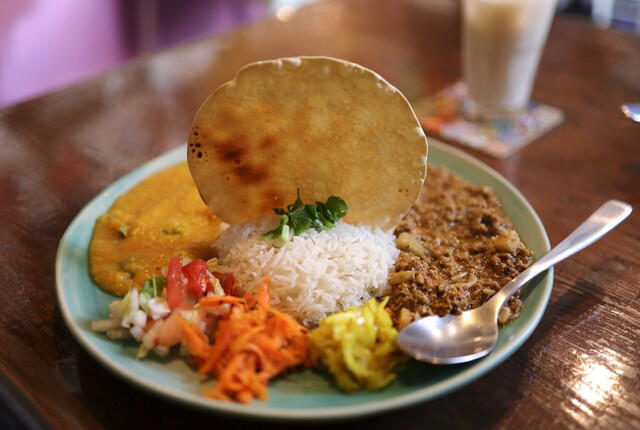
Tokyo moves through many dining tempos: dense station-area corridors, quieter local streets, and restaurants where the cooking has to carry the evening without theatrical architecture. Curry & Spice Aoi Tori fits that Tokyo pattern: a venue whose public profile is built around curry, spice, and an informal category mix rather than spectacle. The useful facts are modest but clear: it is in Tokyo, it is listed in Asian, ethnic, Indian curry, and izakaya categories, and it has third-party recognition in the city’s crowded dining field.
Tokyo’s curry culture is not one cuisine. It runs from Japanese curry rice and South Asian-influenced counters to spice-curry specialists and casual restaurants where curry sits alongside drinking-food habits. Curry & Spice Aoi Tori belongs to that broad ecosystem without needing a grand-format description. Its listed categories read Asian, ethnic, Indian curry, and izakaya, which matters: the meal is not framed only as a quick curry stop, but as part of Tokyo’s casual dining grammar.
A Tokyo curry stop that makes the category feel close-range
Tokyo restaurants often use focus as an editorial decision. Even when the public record does not require a diner to know the exact layout, the point is still legible: a curry-led restaurant depends on pacing, menu clarity, and a kitchen point of view. In curry restaurants, that focus changes the experience. The kitchen is not just a distant idea, and the plate becomes the centre of the visit. Curry & Spice Aoi Tori sits apart from broader casual dining formats in Tokyo, where long menus can dilute the point of view.
The design signal is not luxury; it is focus. The restaurant’s profile places it closer to an approachable Tokyo curry address than a special-occasion dining room. In Tokyo, that distinction matters. A restaurant can be serious without tasting-menu choreography, and recognised without entering the high-spend bracket. The listed JPY 1,000 - JPY 1,999 range for both lunch and dinner places it in the city’s rare zone of credible, recognised dining that remains casual in cost.
That position sharpens against Tokyo’s wider restaurant map. The city can ask diners to choose between precision-led counters, broad izakaya menus, and higher-spend international formats. Compared with a Japanese dining room such as Shigeyuki or an international-format entry such as UNE IMMERSION, this is a different proposition: shorter, more informal, and more dependent on curry and spice than luxury cues. Within the wider Asian and ethnic field, Thai Miaomiao and Nihao show the category’s breadth; Curry & Spice Aoi Tori gives that map a curry-focused lane.
Categories, balance, and Tokyo's spice-curry language
The most reliable culinary description is the one carried by the venue’s own category data: Asian, ethnic, Indian curry, and izakaya. That combination is specific enough to be useful without overclaiming a chef’s philosophy, a house technique, or a single regional lineage. It points to curry as the core reason to visit, while leaving room for the casual, evening-friendly frame implied by the izakaya listing.
Tokyo’s curry scene is especially good at absorbing references without making every restaurant fit a single template. Some rooms lean toward speed and comfort; others toward spice structure, rice-and-curry formats, or drinking-friendly plates. Curry & Spice Aoi Tori should be read within that flexible city language. The important thing is not to force an invented backstory onto the restaurant, but to understand it as a Tokyo curry address with enough local traction to stand out.
That makes it useful for travellers and locals who want an approachable meal rather than a long formal commitment. The budget range is low by Tokyo dining-guide standards, and the categories suggest an easygoing restaurant rather than a luxury room. In a city where curry can be a lunch staple, a specialist pursuit, or part of a casual night out, Curry & Spice Aoi Tori sits in the overlap.
Recognition gives the format weight. Curry & Spice Aoi Tori is listed with 2024 Tabelog Hyakumeiten recognition, and its Tabelog score is 3.60. In Tokyo, where user scoring can be conservative and category-specific, that number is a useful signal rather than a final verdict. Awards do not make curry better by themselves, but a 2024 Hyakumeiten listing gives the restaurant clear third-party visibility.
Where it fits in a Tokyo itinerary
Tokyo suits diners who want to move between different levels of formality in a single trip. Curry & Spice Aoi Tori is better read as a focused curry meal than as a long, multi-stop night built around ceremony. The appeal is the tight format: Tokyo location, curry-led categories, approachable pricing, and enough recognition to justify seeking it out.
For travellers building a broader Tokyo dining plan, contrast is the point. A curry-focused stop here reads differently after other Tokyo dining rooms, casual counters, or higher-spend international formats. For comparison inside the allowed Tokyo set, Shigeyuki, UNE IMMERSION, Thai Miaomiao, Nihao, and パヴォーネ・インディアーノ show how wide the city’s restaurant map can feel even before narrowing the focus to curry. Curry & Spice Aoi Tori is quieter in editorial terms; its story is category focus, price accessibility, and recognition rather than spectacle.
Readers mapping Japan more widely can place the address within the broader national appetite for curry, casual Asian dining, and focused restaurants without needing to anchor it to unrelated named venues. Tokyo alone provides enough context: other dining rooms, hotels, bars, and experiences can frame the trip, while Curry & Spice Aoi Tori supplies a concise, affordable curry stop. For planning across the city, use broader Tokyo restaurant resources and compare it with other unnamed Tokyo dining options according to budget, category, and pace.
Frequently asked questions
What part of town is Curry & Spice Aoi Tori in?
Tokyo.
What price level is Curry & Spice Aoi Tori?
Pricing at Curry & Spice Aoi Tori is listed as JPY 1,000 - JPY 1,999 JPY 1,000 - JPY 1,999.
What are the opening hours for Curry & Spice Aoi Tori?
The supplied public record for Curry & Spice Aoi Tori does not provide confirmed opening hours. Check the venue's official channels for the latest details in Tokyo.
What makes Curry & Spice Aoi Tori worth seeking out?
Curry & Spice Aoi Tori has 2024 Tabelog Hyakumeiten recognition, a listed Tabelog score of 3.60, and categories including Asian, ethnic, Indian curry, and izakaya. Its listed budget is Dinner: JPY 1,000 - JPY 1,999; Lunch: JPY 1,000 - JPY 1,000 - JPY 1,999.
Do they accommodate allergies at Curry & Spice Aoi Tori?
The supplied public record does not list a formal allergy protocol. The safest approach is to use the listed contact number, +81-90-8502-3656, and check the venue's official channels for the latest details before ordering in Tokyo.
Peers You’d Cross-Shop
Comparable venues to calibrate price, style, and recognition.
| Venue | Cuisine | Price | Awards | Notes |
|---|---|---|---|---|
| Curry & Spice Aoi ToriThis venue (the venue you are viewing) | Creative Indian & Sri Lankan spice curry | $10–20 | Tabelog 100 #46 | Not listed |
| Thai Miaomiao | Thai Restaurant | Not listed | Tabelog 100 #49 | JPY 4,000 - JPY 4,999 JPY 1,000 - JPY 1,999 |
| UNE IMMERSION | Modern French | $100–150 | Michelin Plate | French |
| パヴォーネ・インディアーノ | Italian-Indian Fusion | $20–30 | Not listed | Not listed |
| Nihao | Chinese dumpling house (gyoza specialist) | $20–30 | Tabelog 100 #14 | JPY 2,000 - JPY 2,999 |
| Shigeyuki | Seasonal Japanese Kaiseki | $200–300 | 1 Michelin Star · Tabelog 100 #7 | Japanese |
Recognition history
Dated appearances from independent guides and award organizations, with the underlying list record or original source where available.
Tabelog 100 #46 · No. 46
Tabelog · Tabelog 100 - Asian cuisine / Ethnic cuisine - TOKYO - 2024
Continue exploring
More in Tokyo
Restaurants in Tokyo
All restaurants in Tokyo →




Bars in Tokyo
All bars in Tokyo →






Details
- Cozy
- Intimate
- Solo
- Casual Hangout
- After Work
- Standalone
- A La Carte
Current opening hours
- Monday
- Closed
- Tuesday
- 11:30 AM–2:15 PM, 5:30–9:45 PM
- Wednesday
- 11:30 AM–2:15 PM, 5:30–9:45 PM
- Thursday
- 11:30 AM–2:15 PM, 5:30–9:45 PM
- Friday
- 11:30 AM–2:15 PM, 5:30–9:45 PM
- Saturday
- 11:30 AM–2:15 PM, 5:30–9:45 PM
- Sunday
- 11:30 AM–3:15 PM
Hours can change for holidays and private events. Hours as of .
A small, warm, and cozy curry shop with only ten seats, giving it an intimate, hidden-gem feel typical of a neighborhood spice curry restaurant in Shibuya’s Hatagaya area.