
Censu brings Japanese-European fusion into Hong Kong’s casual drinking-and-eating register rather than the hushed tasting-menu lane. Chef Shun Sato’s restaurant on Gough Street has 2026 Opinionated About Dining Recommended recognition, placing it in a city scene where informal formats increasingly carry serious culinary ambition.
Pearl is the En Primeur Club membership app — saves, bookings, and concierge access live there. Same editors, same standards.
- Address
- 28-30 Gough St, Hong Kong, Hong Kong, China
- Phone
- +852 2997 7009
- Website
- censu.net
 Saves & bookings on Pearl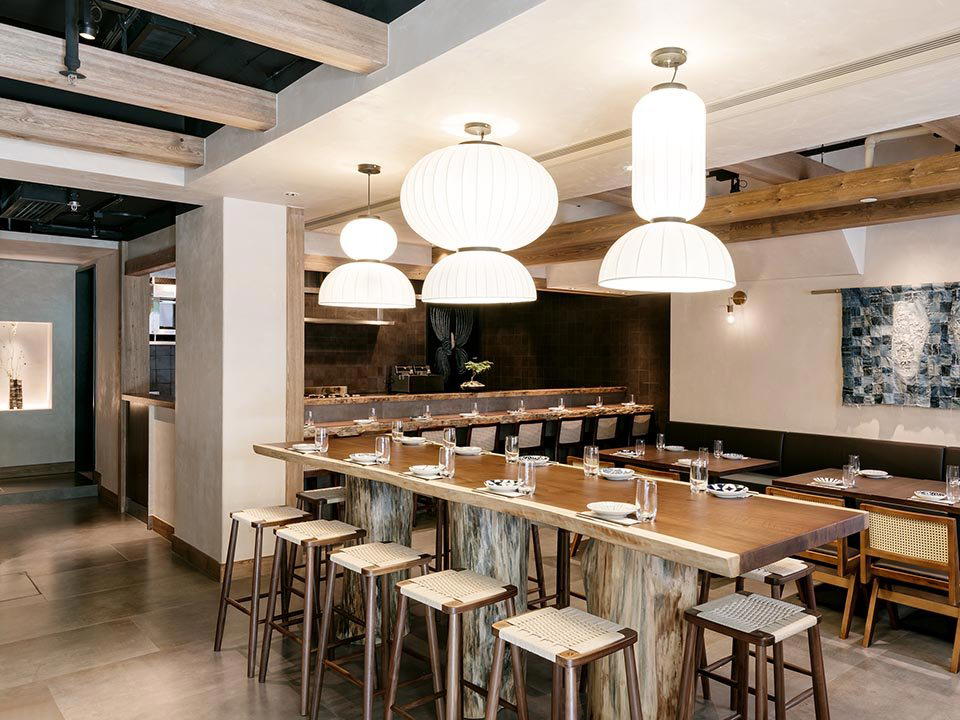
Gough Street has the right kind of Hong Kong compression: shopfronts, slope, spillover conversation, and the sense that dinner can move from a glass to several plates without ceremony. Censu fits that social rhythm. Its Japanese-European fusion reads less as a tasting-menu manifesto than as a contemporary izakaya-adjacent idea, where drinking, sharing, and sharp technique can sit at the same table.
That matters in Hong Kong because the city has long treated Japanese dining through multiple registers at once: sushi counters with formal pacing, ramen shops built for speed, kappo rooms for controlled intimacy, and izakaya formats where the table decides the tempo. The interesting middle now sits between precision and informality. A restaurant can borrow the communal energy of izakaya culture without copying it wholesale, then layer in European technique, richer sauces, wine-friendly structure, and a more global pantry.
Japanese-European cooking with an izakaya social code
The defining idea here is not fusion as novelty. It is fusion as service rhythm. Japanese-European cooking works in Hong Kong when it understands that the city’s diners are fluent in contrast: raw and grilled, sake and wine, rice and bread, soy depth and dairy richness. Censu operates in that cross-current, with chef Shun Sato attached to a format that signals craft but not stiff formality.
Opinionated About Dining included Censu in its 2026 Top Restaurants in Asia Recommended list, a useful marker because OAD tends to reward restaurants that generate strong diner opinion rather than merely polished luxury cues. In Hong Kong, that recognition places the restaurant in a broad but competitive band: not the banquet tradition, not the hotel fine-dining room, and not the bare-bones noodle shop, but the smaller independent dining room where identity is built through format and repeatability.
The izakaya reference should be read culturally, not literally. The classic izakaya is built around drinking first, eating alongside it, and ordering in waves rather than committing to a single linear progression. Contemporary Hong Kong has adapted that model for a denser, more international dining public. Plates can be composed with European logic, but the table still behaves socially: multiple dishes, shared pacing, conversation over sequence. That is the lane Censu occupies.
Where Gough Street changes the meal
Central and Sheung Wan reward restaurants that can absorb different kinds of nights. Office diners, design-world regulars, visitors staying nearby, and local groups all move through the same streets. Gough Street’s dining character is narrower and more intimate than the hotel-heavy rooms closer to the harbour, and that scale changes expectations. A restaurant here has to justify itself through personality and execution, not size or spectacle.
For readers mapping a wider Hong Kong itinerary, the surrounding city shows how fragmented the dining conversation has become. Central’s polished Italian register appears in places such as 8 1/2 Otto e Mezzo Bombana (Hong Kong) (Italian) and 8½ Otto e Mezzo BOMBANA in Central And Western, while neighbourhood-specific eating runs from Block 18 Doggie's Noodle in Yau Tsim Mong to Chin Sik in Tsuen Wan. That spread explains why a compact Japanese-European room has to be understood as part of a citywide pattern rather than an isolated address.
Hong Kong’s better casual restaurants often succeed by resisting the old split between “serious” and “fun.” The cooking may be technical, but the room does not need to behave like a temple. That distinction is useful for travellers: Censu is better read as a social dinner with culinary intent than as a destination built around silence, ceremony, or a long scripted menu.
How to place it within a Hong Kong dining day
The restaurant makes the strongest sense at dinner, when the izakaya logic of shared plates and drinks has room to stretch. Lunch, if offered, would change the rhythm; the core appeal is the evening grammar of ordering, drinking, and letting the table build momentum. Without published pricing or a fixed format to anchor expectations, the smarter approach is to treat it as a flexible contemporary restaurant rather than a bargain stop or a trophy reservation.
It also pairs well with a broader Central-and-western-side itinerary. Dining-led travellers can use Our full Hong Kong restaurants guide to plan nearby meals, then place drinks through Our full Hong Kong bars guide. Visitors building a fuller trip can cross-check stays through Our full Hong Kong hotels guide, cultural programming through Our full Hong Kong experiences guide, and bottle-focused detours through Our full Hong Kong wineries guide.
Other Hong Kong listings show how different the city’s dining modes can be within a single trip: 15-27 Cannon St, 208 Hollywood Rd, 22 Ships (Spanish-Tapas), and 7 Paintings each point to a different format logic, from address-led neighbourhood dining to tapas structure and immersive programming. Farther out, Enchanted Garden Restaurant in Islands, Former Jumbo Floating Restaurant in Aberdeen, and Habib's Indian & Middle Eastern Food in Kwun Tong underline the point: Hong Kong dining is not a single hierarchy, but a set of formats competing for different occasions.
For Japanese-leaning context beyond Hong Kong, Jōdo Saké Bar in Los Angeles and Onigiri Time in Pasadena show how Japanese food culture travels through bar, snack, and casual-specialist formats rather than only through omakase. Censu belongs to that broader international shift, where Japanese technique becomes a framework for social dining instead of a closed script.
The practical reading is simple: choose it when the night calls for conversation, shared plates, and a kitchen with a defined Japanese-European angle. Hong Kong has plenty of rooms built for ceremony. This one is more useful when the goal is a meal that can carry drinking, pacing, and serious cooking without turning dinner into a performance.
Reputation & Price
Comparable venues nearby, for context on price, style, and recognition.
| Venue | Cuisine | Price | Notes |
|---|---|---|---|
| CensuThis venue — the venue you are viewing | Central, Modern Japanese Izakaya | $$$ | Not listed |
| fukuro | Central, Modern Japanese Izakaya | $$$ | Not listed |
| Thomas & T’s | Central, Japanese-French Omakase | $$$$ | Not listed |
| Hanabi | Yau Tsim Mong South, Omakase Sushi | $$$ | Not listed |
| Sushi Zinc | Not listed | $$$ | Shau Kei Wan, Contemporary Japanese–Italian Omakase |
| Tempura Tenkai | Central, Tempura Omakase | $$$ | Not listed |
Recognition history
Dated appearances from independent guides and award organizations, with the underlying list record or original source where available.
Opinionated About Dining Top Restaurants in Asia Recommended
Opinionated About Dining
Continue exploring
More in Hong Kong
Restaurants in Hong Kong
Browse all →
Bars in Hong Kong
Browse all →
At a Glance
- Modern
- Sophisticated
- Cozy
- Intimate
- Trendy
- Date Night
- Business Dinner
- Group Dining
- Special Occasion
- Late Night
- Standalone
- Design Destination
- Open Kitchen
- Craft Cocktails
Comfortable and home-like, with interiors inspired by the chef’s grandmother’s house and a Wabi-sabi sensibility; guests describe the space as pleasantly decorated with good ambient music.