Celestia
Celestia occupies a Georgian address at 18 Eyre Place in Edinburgh's New Town, positioning itself within the city's upper tier of modern dining rooms. The format and team composition align it with Edinburgh's serious tasting-menu circuit, where collaboration between kitchen and floor defines the experience as much as the food itself. Visitors should check current booking availability directly before planning a visit.
Pearl is the En Primeur Club membership app — saves, bookings, and concierge access live there. Same editors, same standards.
- Address
- 18 Eyre Pl, Edinburgh EH3 5EP, United Kingdom
- Phone
- +441312872914
- Website
- celestiarestaurant.co.uk
- Directions
- Get directions
 Saves & bookings on Pearl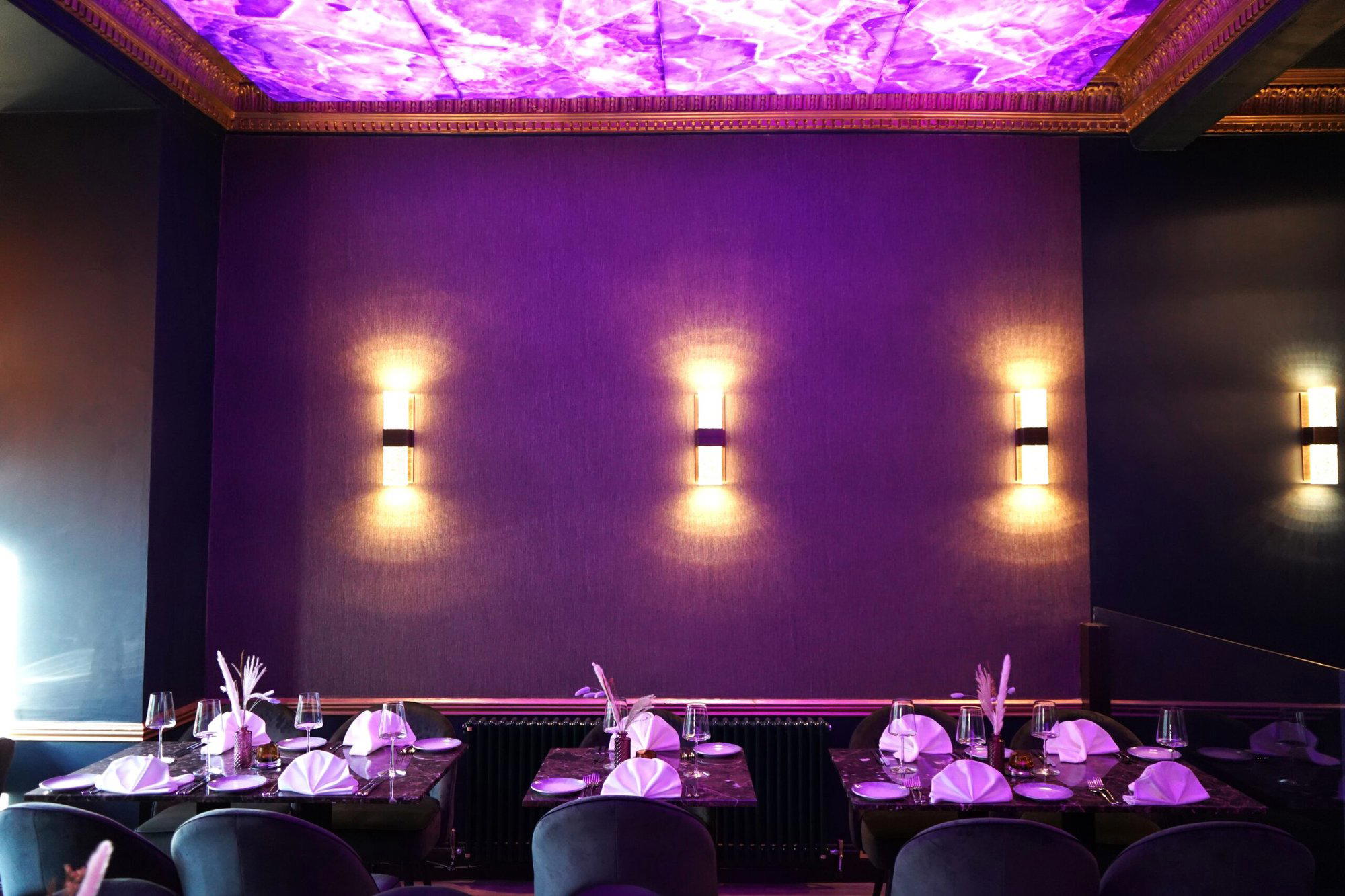
Where Edinburgh's New Town Meets Considered Modern Dining
Celestia is a restaurant in Edinburgh serving modern Indian fine dining at 18 Eyre Pl, Edinburgh EH3 5EP, United Kingdom. The Georgian grid, built for merchants and lawyers rather than restaurateurs, has long been overshadowed by Leith's waterfront concentration of ambitious kitchens and the Royal Mile's tourist-facing trade. Yet the neighbourhood around Eyre Place sits at a particular intersection: close enough to the city centre to draw destination diners, residential enough to retain a quieter register than the festival-season crowds further south. Celestia, at 18 Eyre Place, occupies that position deliberately. The address itself signals a certain intent, not the conspicuous footfall of Princes Street, and not the pilgrimage-destination isolation of a rural retreat, but a considered urban placement that rewards those who already know to look.
This matters because Edinburgh's upper dining tier has consolidated around a recognisable set of coordinates over the past decade. Martin Wishart and The Kitchin have anchored Leith's ambitions at the ££££ level for years, while Timberyard brought a Nordic-inflected sustainability argument to the West End. More recently, AVERY and Condita have reinforced the case that Edinburgh can sustain a genuinely diverse field of serious modern dining rooms, each with a distinct position rather than a generic fine-dining formula. Celestia enters this field as a New Town proposition, a slightly different geography, a slightly different context, and therefore a slightly different kind of evening.
The Collaborative Architecture of a Modern Dining Room
One interesting development in high-end British restaurants over the past decade is not what arrives on the plate. It is the increasingly deliberate choreography between kitchen, sommelier programme, and front-of-house, the way that a tasting menu at this level is engineered as a sequence of decisions made jointly by people who rarely share the same job title. The leading rooms at this tier function less like restaurants in the traditional sense and more like ensemble performances, where the floor team is as fluent in the logic of the menu as the kitchen is in the logic of the room. This is where Celestia's editorial interest lies: in what it represents about Edinburgh's maturation as a city where hospitality craft, in its widest sense, is taken seriously.
The progression from dish to dish in a modern tasting-menu context depends on the sommelier reading the table, adjusting pace, reading whether guests want education or atmosphere, knowing when to step back. It depends equally on front-of-house staff who understand the menu's internal logic well enough to narrate it without a script. Restaurants like CORE by Clare Smyth in London and L'Enclume in Cartmel have made this kind of integrated team approach a benchmark that provincial British dining rooms are increasingly measured against. In Edinburgh, the question for any serious new entry is whether kitchen ambition is matched by equivalent depth on the floor, and whether the wine programme has enough range and intelligence to function as a genuine third voice in the room rather than an afterthought.
Wider British context is relevant here. Properties like Waterside Inn in Bray, Le Manoir aux Quat'Saisons in Oxford, and Moor Hall in Aughton have each built reputations where the service and sommelier components are as cited in critical writing as the food itself. Gidleigh Park in Chagford and Midsummer House in Cambridge have similarly made the case that the full-evening experience, as opposed to the individual dish, is where premium British dining now competes. Edinburgh has historically punched slightly below London's weight on this front, strong on kitchen talent, occasionally thinner on floor depth, but the current generation of openings is closing that gap.
Edinburgh's Fine Dining comparable set in 2024
At the ££££ level in Edinburgh, the competitive field is genuinely competitive. Martin Wishart holds Michelin recognition and a Modern European position built over more than two decades. The Kitchin has anchored its identity in Scottish produce interpreted through a French classical framework. Timberyard occupies a distinct position with its Nordic-influenced approach and provenance-led sourcing. Against these established benchmarks, newer rooms like Celestia enter a market that knows what considered dining looks like and applies that expectation consistently. Internationally, the comparison rooms would include Opheem in Birmingham, another city-based modern room operating outside the London gravitational pull, and, at stronger examples from the register, places like Atomix in New York City and Le Bernardin in New York City, where team integration and multi-year consistency define what a mature fine-dining operation looks like.
For the Edinburgh diner specifically, the question is not whether Celestia competes with New York or London on paper, but whether it adds a distinct perspective to the city's existing offer. The New Town geography alone suggests a different audience rhythm: less destination-only, more embedded in the city's daily professional life, more attuned to the kind of evening that does not require a taxi to Leith or a pre-booked itinerary built around a single address.
Planning Your Visit
Celestia is located at 18 Eyre Place, Edinburgh EH3 5EP, within the New Town's northern section, walkable from the city centre in approximately fifteen minutes and well-served by bus routes along Dundas Street. Celestia is priced at about $40 per person, with reservations recommended and opening hours of Mon: 1–10 PM; Tue: 1–10 PM; Wed: 1–10 PM; Thu: 1–10 PM; Fri: 1–10:30 PM; Sat: 1–10:30 PM; Sun: 1–10 PM.
For those building a multi-day Edinburgh itinerary around food, the city's dining geography divides usefully into Leith (established, award-anchored), the Old Town and Royal Mile (mixed registers), and the New Town (quieter, more residential, increasingly interesting). Celestia's Eyre Place address sits in that third zone, which for many visitors is reason enough to approach it as a complement to, rather than a substitute for, the Leith circuit. Rooms like hide and fox in Saltwood and Hand and Flowers in Marlow offer a useful analogy: the leading rooms outside a city's primary dining district often work precisely because they are not trying to compete on the same terms as the flagship addresses.
A Pricing-First Comparison
Comparable venues nearby, for context on price, style, and recognition.
| Venue | Cuisine | Price | Notes |
|---|---|---|---|
| CelestiaThis venue — the venue you are viewing | Warriston, Modern Indian Fine Dining | $$$ | Not listed |
| Bonoful Restaurant | Portobello, Bangladeshi and Indian | $$ | Not listed |
| Twenty Princes Street | Not listed | $$$ | Greenside, Modern Scottish Grill & Smokehouse |
| One Square | West End, Modern Scottish Brasserie | $$$ | Not listed |
| No.35 at The Bonham | Dean, Scottish Contemporary European | $$$ | Not listed |
| Port of Leith Distillery | Leith Docks, Modern Scottish Gastropub | $$$ | Not listed |
Continue exploring
More in Edinburgh
Restaurants in Edinburgh
Browse all →
Bars in Edinburgh
Browse all →
At a Glance
- Elegant
- Modern
- Sophisticated
- Date Night
- Special Occasion
- Business Dinner
- Design Destination
Current opening hours
- Monday
- 1–10 PM
- Tuesday
- 1–10 PM
- Wednesday
- 1–10 PM
- Thursday
- 1–10 PM
- Friday
- 1–10:30 PM
- Saturday
- 1–10:30 PM
- Sunday
- 1–10 PM
Hours can change for holidays and private events. Last verified .
Sleek interiors with emerald banquettes, purple and amber lighting, sculptural chandelier, and spicy-brown marbled tables creating a warm glow.