Café des Arts
Our verdict
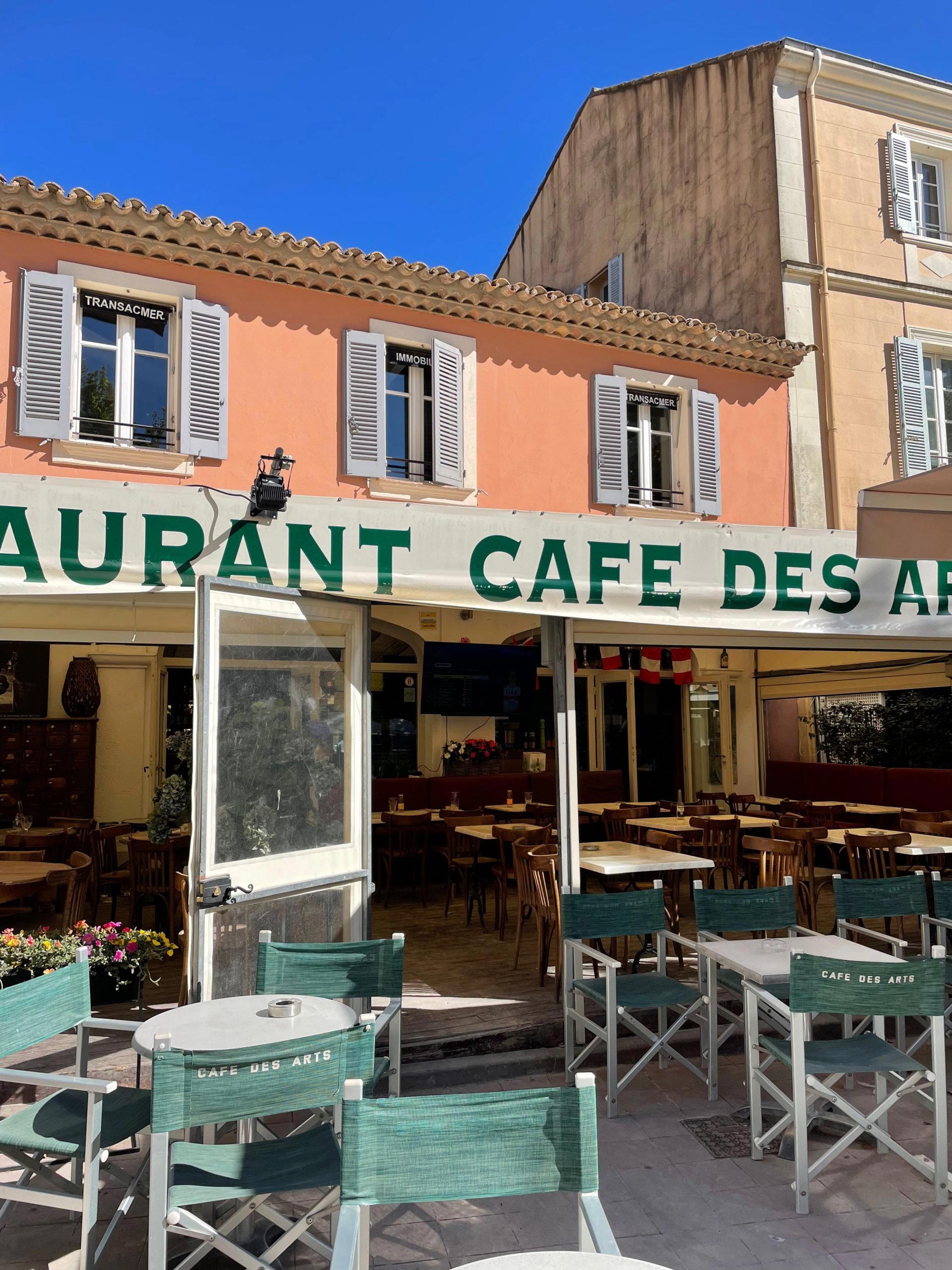
Café des Arts occupies one of Saint-Tropez's most storied addresses on the Place des Lices, where the town's famous pétanque players have gathered for generations. The café sits within a café-terrasse tradition that defined Riviera social life long before the marina crowd arrived. Visit for the square's atmosphere and its role in the social fabric of the old town.

Pearl is the En Primeur Club membership app — saves, bookings, and concierge access live there. Same editors, same standards.
- Address
- Place des Lices, 83990 Saint-Tropez, France
- Phone
- +33494970225
- Hours
- Daily 8 AM–7 PM
- Directions
- Get directions
The Square That Precedes the Season
Before the yachts fill the port and the lanes around the Vieux-Port thicken with summer traffic, Place des Lices functions as a town square in the oldest sense: morning market stalls on Tuesdays and Saturdays, pétanque boules clicking on packed gravel, and a ring of café terrasses where the rhythm is set not by restaurant timetables but by the light. Café des Arts is among the establishments that have defined this square's particular social character, occupying a position on one of the most recognisable open spaces in the French Riviera.
The cultural context matters here. Saint-Tropez became a reference point for a certain style of Côte d'Azur life precisely because its old-town core retained a working-market square at its centre rather than converting entirely to luxury retail. Place des Lices is the counterbalance to the port's theatre. The café terrasse format it sustains belongs to a long French tradition in which the act of sitting, watching, and being present in a public square constitutes the activity itself, not a prelude to something else.
Place des Lices and the Café-Terrasse Tradition
France's café-terrasse culture has a documented social function that precedes its tourism associations by centuries. In southern towns especially, the square café serves as a kind of public drawing room: a place where local residents mix with visitors, where market vendors wind down, and where the divisions between a late breakfast and a long aperitif hour become largely theoretical. Café des Arts on Place des Lices operates within this tradition rather than alongside it.
Saint-Tropez's Place des Lices is categorically different from the port terrasses that line the Vieux-Port quay. The port-side addresses price their sightlines toward the boats and collect a clientele largely composed of visitors. The Lices square has always drawn a broader mix, partly because of the market, partly because the pétanque tradition brings an older, local constituency that has little interest in the marina spectacle. A café positioned here is embedded in the social geography of the town in ways that a port address cannot replicate. Comparable squares in Provence — the café-rimmed cours in Aix-en-Provence, or the market squares in Apt and Vaison-la-Romaine — function similarly, but few have acquired the specific cultural visibility that Place des Lices carries internationally.
The comparison with other Saint-Tropez dining options is instructive. Dior Des Lices, also on the square, represents the fashion-house intervention in Riviera hospitality, designed, brand-driven, and aimed at an international luxury consumer. Chez Madeleine operates in a more intimate register, closer to the neighbourhood bistro tradition. Le Girelier anchors the port-side fish restaurant category. Café des Arts sits in a different tier from all of these, the civic café, defined more by its address and its social role than by a culinary program.
What to Eat and How to Approach the Menu
The café-terrasse format in southern France rarely requires the kind of advance research that a tasting-menu counter demands. The kitchen at a square café like Café des Arts typically operates in the register of Provençal brasserie cooking: salades composées, grilled fish, simple pasta preparations, and the kind of rosé-adjacent food that assumes the wine will arrive first and the food will follow at its own pace. Socca, pissaladière, and tomatoes prepared with local olive oil are the idiom of this cooking tradition on the Côte d'Azur, and a café on Place des Lices in July is not the place to look for technical ambition.
That is not a criticism. The café terrasse format serves a specific function, and judging it against the cooking at Flocons de Sel in Megève or the architectural discipline of Mirazur in Menton misunderstands what is on offer. The reference point is not the multi-star houses, not Alléno Paris au Pavillon Ledoyen, not Troisgros, not Paul Bocuse, not Bras in Laguiole, not Auberge de l'Ill, not Les Prés d'Eugénie. The reference is the square itself. The food at Café des Arts is the occasion's supporting structure, not its subject.
For dining that leans more heavily on cuisine as the primary draw elsewhere in the region, La Table du Castellet in Le Castellet or the sustained institutional cooking at Georges Blanc in Vonnas represent a different category of commitment. For those after a more curated experience in Saint-Tropez itself, Gandhi and Le Bistro de la Bastide operate in distinct registers worth comparing. The full Saint-Tropez restaurants guide maps the town's dining options by category and intent.
Planning a Visit: Timing and Logistics
Place des Lices runs at its most atmospheric during the twice-weekly market, on Tuesday and Saturday mornings, when the square fills with produce, clothing, and antique vendors from early morning until roughly 12:30. Arriving at Café des Arts on a market morning, settling at a terrasse table after the stalls begin winding down, captures the square at a moment that has little to do with high-season tourism and a great deal to do with how Provençal towns actually function. Mid-July to late August brings peak visitor density to Saint-Tropez, and the square is correspondingly full; earlier in June or after the first week of September the pace is measurably different.
Saint-Tropez has no train station; the nearest rail access is Les Arcs-Draguignan or Saint-Raphaël, both requiring onward transfer by bus or car. In peak season, road access to the peninsula is subject to serious delays, and the town is leading reached by boat from Sainte-Maxime or Saint-Raphaël where schedules permit. Place des Lices is a short walk from the Vieux-Port, well within the old town's pedestrian core.
For comparative context on what the Riviera café format looks like at different price points and formats, from the counter-service end through to the hotel-terrace model, the dining scenes in Nice, Antibes, and Cassis offer useful reference. Within Saint-Tropez, though, Place des Lices remains the square that most directly connects contemporary visitors to the town's pre-celebrity-era social life. Café des Arts holds that address.
Frequently asked questions
Where is Café des Arts in Saint Tropez?
Café des Arts is located at Place des Lices, 83990 Saint-Tropez, France, Saint Tropez.
When is the best time to visit Café des Arts on Place des Lices?
Tuesday and Saturday mornings are the clearest answer: those are market days on Place des Lices, when the square fills with produce, clothing, and local vendors in a format that predates the town's association with summer tourism. Outside of high season, the square runs at a pace closer to its original social function as a town centre in Saint Tropez, Var.
What should I eat at Café des Arts?
Café des Arts sits on Place des Lices, where the café-terrasse format in southern France centres on approachable, market-driven fare rather than tasting menus. On Tuesday and Saturday mornings, the square hosts a produce market that shapes the rhythm of eating here — coffee and something simple early, then a longer sit as the market winds down.
Is Café des Arts reservation-only?
Café-terrasse venues on Place des Lices generally operate on a walk-in basis, with peak competition for outdoor tables on market mornings (Tuesday and Saturday) and during the high summer season when Saint Tropez draws its largest crowds. Arriving early on market days is the practical approach.
What's the signature at Café des Arts?
The signature is positional as much as culinary: a terrace seat on Place des Lices, one of the most documented public squares in the French Riviera. The square itself — boules, plane trees, market stalls twice weekly — is the draw that has defined this address for decades.
What if I have allergies at Café des Arts?
No menu data or allergen policy is publicly documented for Café des Arts. In France, EU allergen labelling regulations require restaurants to identify the 14 major allergens on request. Speaking directly with staff at the venue on Place des Lices, Saint Tropez, is the reliable method — standard practice at café-terrasse operations across the Var.
Is Café des Arts worth it?
That depends on what you're after. Café des Arts has no recorded Michelin distinction or formal critical rating, so it is not competing on gastronomy. Its case rests on Place des Lices itself — a square with a documented role in Saint Tropez life long before the port became a summer fixture. If the goal is to sit where the town actually functions, the address is well placed for that.
Cost Snapshot
| Venue | Cuisine | Price |
|---|---|---|
| Café des ArtsThis venue — the venue you are viewing | Provençal Brasserie | $20–30 |
| Sénéquier | Classic French Riviera Brasserie & Patisserie | $50–100 |
| Chez Madeleine | Fresh Seafood & Oyster Bar | $30–50 |
| Dior Des Lices | Modern French Mediterranean | $150–200 |
| Gandhi | Traditional Indian Tandoori and Curry | $30–50 |
| Le Bistro de la Bastide | Italian Mediterranean Bistro | $100–150 |
Continue exploring
More in Saint-Tropez
Restaurants in Saint-Tropez
Browse all →
Bars in Saint-Tropez
Browse all →
Hotels in Saint-Tropez
Browse all →

Details
- Classic
- Cozy
- Casual Hangout
- Terrace
- Street Scene
- A La Carte
- Vegetarian Friendly
- Gluten Free Options
Current opening hours
- Monday
- 8 AM–7 PM
- Tuesday
- 8 AM–7 PM
- Wednesday
- 8 AM–7 PM
- Thursday
- 8 AM–7 PM
- Friday
- 8 AM–7 PM
- Saturday
- 8 AM–7 PM
- Sunday
- 8 AM–7 PM
Hours can change for holidays and private events. Last verified .
Charming typically Mediterranean setting with terrace seating on a lively square.