Our verdict
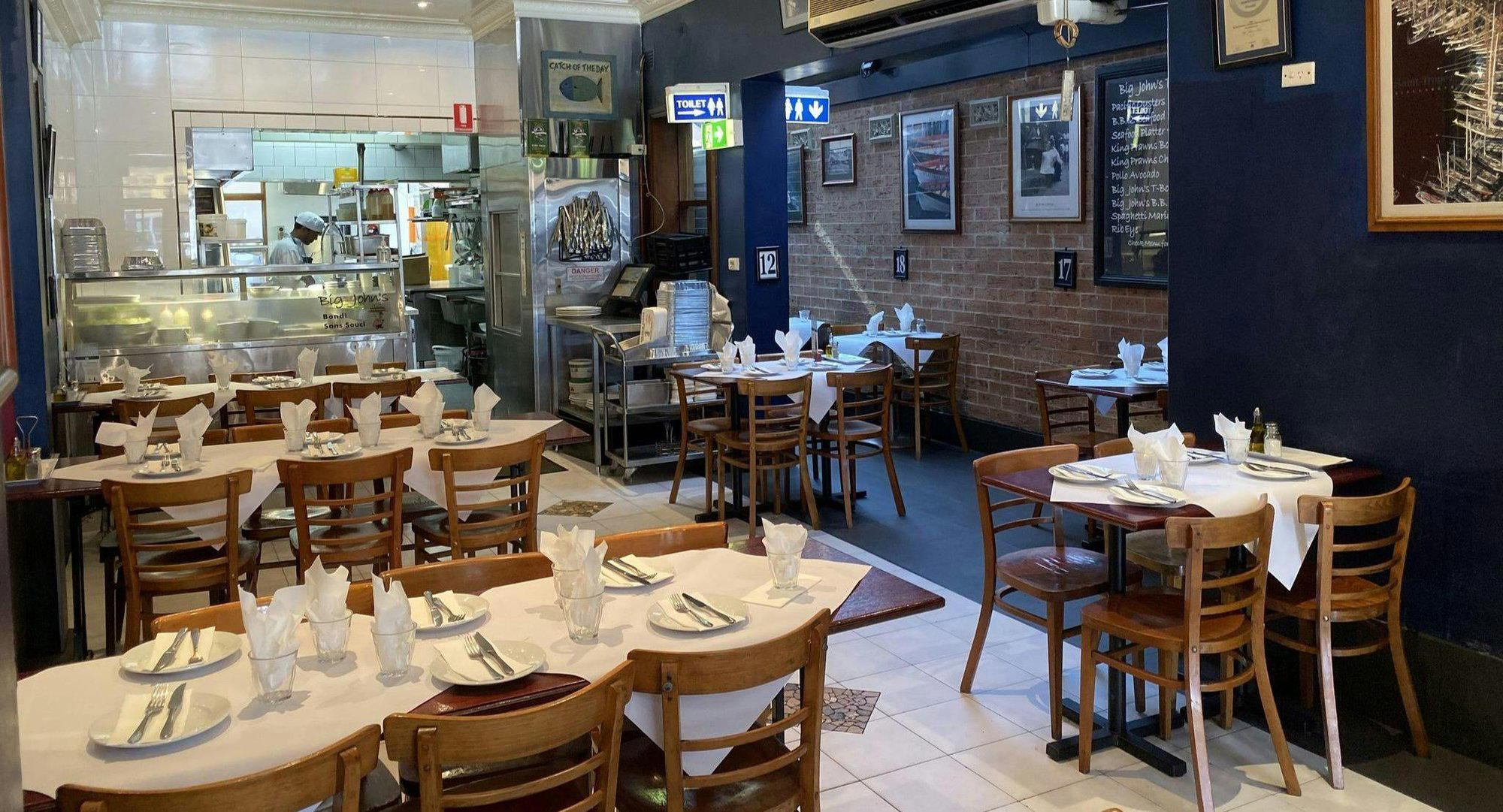
Big John's Italian Seafood Restaurant sits on Rocky Point Road in Sans Souci, a southern Sydney suburb where the Georges River meets the bay. The restaurant brings Italian-inflected seafood cooking to a neighbourhood that sits well outside the city's inner-dining circuit, offering a more grounded counterpoint to the waterfront dining Sydney's central precincts are known for.

Pearl is the En Primeur Club membership app — saves, bookings, and concierge access live there. Same editors, same standards.
- Address
- 502 Rocky Point Rd, Sans Souci NSW 2219, Australia
- Phone
- +61295298094
- Hours
- Mon–Wed 4:30 PM–12 AMThu 4:30 PM–1 AMFri–Sat 4:30 PM–3 AMSun 4:30 PM–1 AM
- Website
- bigjohnspizza.com.au
- Directions
- Get directions
- Booking
- Book on OpenTable
The menu
What to order
- Big John Pizza
- Seafood Platter
- Rack of Lamb
Southern Sydney's Quieter Waterfront Circuit
Sydney's seafood dining conversation tends to cluster around the inner harbour, Circular Quay, and the eastern suburbs. The southern reaches of the city, where Rocky Point Road runs through Sans Souci toward Botany Bay and the Georges River estuary, operate on a different register entirely. The suburb sits roughly 20 kilometres south of the CBD, and the dining strip along that corridor is shaped less by tourism pressure and more by the communities that have lived there for generations, including a long-established Italian-Australian population whose food culture runs through the area's restaurants, fish markets, and delicatessens. Big John's Italian Seafood Restaurant, at 502 Rocky Point Rd, belongs to that tradition rather than to the inner-city seafood showcase circuit typified by venues like Saint Peter or Rockpool.
Italian-Australian Seafood as a Distinct Category
Italian-inflected seafood cooking in Australia occupies a different niche from the produce-driven, minimal-intervention style that defines the country's most recognised fine-dining seafood rooms. Where a venue like Ormeggio at The Spit in Mosman channels northern Italian restraint through local Australian product with considerable critical recognition, the southern Sydney Italian-seafood tradition is less concerned with editorial acclaim and more embedded in the rhythms of family dining, weekend lunches that run long, and cooking that privileges familiarity and generosity. That positioning carries its own integrity. The Italian-Australian community in Sydney's south and south-west built an entire food culture around coastal sourcing long before sustainability became a marketing category, not as ideology but as practicality: what came in from the bay, what the fish markets had that morning, what the season allowed.
That historical relationship between Italian-Australian households and local seafood supply is one of the less-documented chapters in the broader story of Australian food culture. While institutions like Brae in Birregurra and Attica in Melbourne have built formal frameworks around ethical sourcing and seasonal constraint, the same principles have operated informally in neighbourhood Italian-seafood restaurants for decades, without the language of sustainability attached to them.
The Sustainability Dimension Nobody Talks About
Across Australia's more formally recognised dining rooms, sustainability has become a structuring principle. Pipit in Pottsville, Botanic in Adelaide, and Hentley Farm in Seppeltsfield each build their menus around explicit sourcing commitments and waste-reduction frameworks. The critical conversation around seafood sustainability in Australia has accelerated noticeably over the past five years, with pressure on venues to document their supply chains and avoid species under pressure.
Neighbourhood seafood restaurants operating in outer suburban corridors rarely enter that conversation, but they are not necessarily less attentive to sourcing. A restaurant drawing from Sydney Fish Market and the Georges River catchment, serving a local clientele that knows what the water produces, operates under its own form of supply discipline, one set by what is actually available rather than by a stated philosophy. It is worth holding that distinction when assessing how Australian seafood culture is actually distributed across the city, rather than only through its credentialled fine-dining tier. For the full picture of how Sydney's restaurant scene is structured, the EP Club Sydney restaurants guide maps the range from harbourside flagships to neighbourhood institutions.
Where Big John's Sits in the Local Dining Pattern
Sans Souci is not a dining destination in the sense that Surry Hills or Potts Point are destinations. It does not attract interstate food media or international visitors on itinerary. What it has is a stable, returning local base and a seafood-adjacent geography that shapes what restaurants in the area cook and how they source. The Italian-seafood format, as it operates in this part of Sydney, is a distinct subcategory: somewhere between a trattoria and a dedicated fish house, with menus that lean toward crustaceans, whole fish, and pasta with seafood, and a service register that tends toward the convivial rather than the formal.
Within Sydney's broader seafood category, the spectrum runs from the produce-led precision of Saint Peter to the grand-occasion formality of harbour dining rooms to neighbourhood formats like this one. Each tier serves a different function in the city's dining ecology. For context from outside Sydney, the same spectrum exists in most Australian coastal cities: Salt Water Restaurant in Cairns and Lizard Island Resort in Far North Queensland represent the luxury-destination pole, while suburban Italian-seafood rooms represent the everyday end of an equivalent cultural commitment to cooking from the water.
Internationally, the reference points for this kind of cooking sit closer to a mid-market New York red-sauce seafood institution than to the technical seafood focus of Le Bernardin, or the community-cooking-as-fine-dining model that Lazy Bear in San Francisco represents. The Italian-Australian neighbourhood seafood restaurant is its own thing, shaped by migration history, local marine geography, and the particular way that Sydney's outer suburbs have held onto food traditions that the inner city has largely replaced with newer formats. Other inner-city comparisons on the Italian-influenced side include 10 William St and 1021 Mediterranean, both of which take a more edited, wine-bar-adjacent approach to the Mediterranean-Australian crossover.
Planning Your Visit
Big John's Italian Seafood Restaurant is located at 502 Rocky Point Road, Sans Souci, in Sydney's southern suburbs, accessible by car from the CBD in roughly 30 to 40 minutes depending on traffic, or via public transport through the Sutherland or Hurstville lines. The Rocky Point Road strip is a neighbourhood commercial corridor rather than a precinct, so visits work leading as a standalone destination rather than part of a multi-stop dining evening. For anyone exploring Sydney's outer-suburban dining geography alongside the city's more formal options, pairing a visit here with a look at 10 Pounds provides a useful contrast in how different parts of the city approach seafood and Italian influence. Hours, booking requirements, and pricing should be verified directly with the venue before planning your trip.
Frequently asked questions
What should I expect atmosphere-wise at Big John's Italian Seafood Restaurant?
Big John's sits on Rocky Point Road in Sans Souci, a southern Sydney suburb that operates well outside the inner-city dining circuit. The setting is neighbourhood rather than destination dining, which typically means a more relaxed, locally rooted room than you'd find in Surry Hills or Potts Point. Expect familiar regulars, direct service, and a pace set by the community around it rather than by food media trends.
What's the address for Big John's Italian Seafood Restaurant?
Big John's Italian Seafood Restaurant is located at 502 Rocky Point Rd, Sans Souci NSW 2219, Australia, Sydney.
Is Big John's Italian Seafood Restaurant a good option for a seafood dinner away from Sydney's inner harbour crowds?
Big John's offers Italian-inflected seafood cooking in Sans Souci, roughly 20 kilometres south of the CBD, which puts it well clear of the Circular Quay and eastern suburbs dining pressure. For Sydney diners who find the inner harbour restaurant circuit oversubscribed, the southern waterfront corridor around Georges River provides a genuine alternative. Big John's at 502 Rocky Point Road is one of the few restaurants in this part of the city operating in the Italian-Australian seafood category specifically.
What should I order at Big John's Italian Seafood Restaurant?
Big John's positions itself as an Italian seafood restaurant, a category in Sydney that typically spans house-made pasta with local catch, whole fish preparations, and shellfish done in Southern Italian style. The specific menu is best confirmed directly with the restaurant at 502 Rocky Point Road, Sans Souci, as dishes vary with availability and season.
Should I book Big John's Italian Seafood Restaurant in advance?
Sans Souci is a residential neighbourhood, and restaurants here tend to draw a loyal local base that fills weekend tables consistently. Calling ahead is sensible for Friday and Saturday evenings in particular. The restaurant is located at 502 Rocky Point Road and can be contacted directly to confirm availability.
Cuisine and Recognition
| Venue | Cuisine | Price | Awards | Notes |
|---|---|---|---|---|
| Big John's Italian Seafood RestaurantThis venue — the venue you are viewing | Italian Seafood | $30–50 | Not listed | Not listed |
| Rockpool | Modern Australian Steakhouse | $150–200 | World's 50 Best #49 · La Liste Top Restaurants | Australian Cuisine |
| Saint Peter | Modern Australian Seafood | $150–200 | World's 50 Best #66 · La Liste Top Restaurants | Australian Seafood |
| BENTLEY Restaurant & Bar | Modern Australian Fine Dining | $150–200 | La Liste Top Restaurants · Star Wine List | Not listed |
| Bennelong | Modern Australian Fine Dining | $200–300 | La Liste Top Restaurants · Star Wine List | Not listed |
| Bistecca | Florentine Steakhouse | $100–150 | Star Wine List | Not listed |