Beasy
Beasy occupies a Greek Street address in the heart of Soho, placing it squarely within London's most competitive mid-tier dining corridor. The kitchen's sourcing approach positions it closer to the produce-driven school of British cooking than to the theatrical fine dining that dominates nearby. For Soho, that restraint is itself a statement.
Pearl is the En Primeur Club membership app — saves, bookings, and concierge access live there. Same editors, same standards.
- Address
- 58 Greek St, London W1D 3DY, United Kingdom
- Phone
- +447930008464
- Website
- beasybar.co.uk
- Directions
- Get directions
 Saves & bookings on Pearl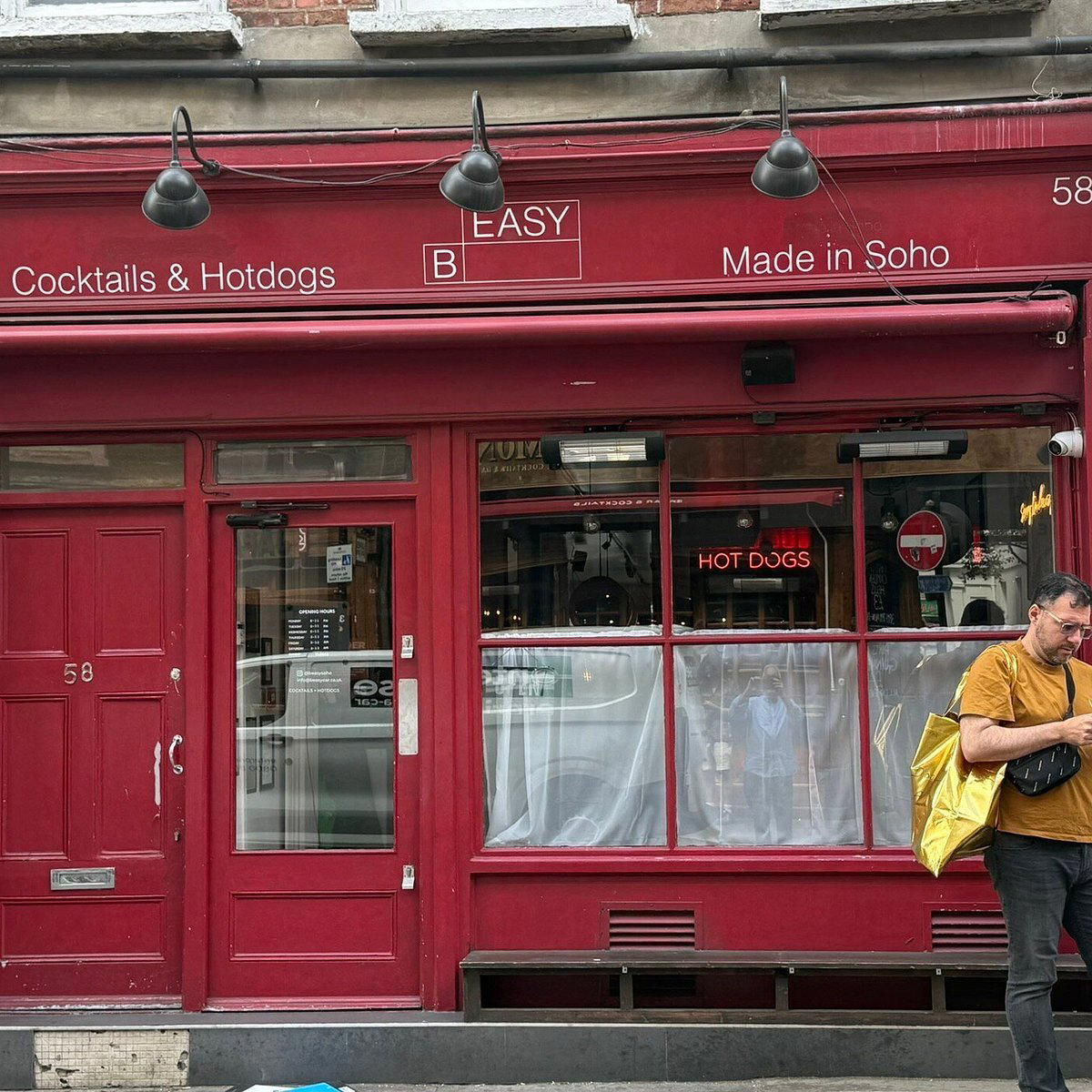
Greek Street, Soho, and the Produce Question
Soho's dining identity has shifted considerably over the past decade. What was once a corridor of late-night Italian trattorias and expense-account brasseries now holds a dense collection of independent restaurants. Greek Street sits at the northern edge of that pressure zone, where rents are high enough to filter out casual operators but the foot traffic still rewards formats that can turn covers. In that context, a kitchen whose editorial identity turns on ingredient sourcing is making a deliberate choice: it is competing on what arrives at the back door rather than on spectacle or name recognition.
That sourcing-first orientation is familiar in the broader British dining conversation. What L'Enclume in Cartmel demonstrated over many years, and what Moor Hall in Aughton has reinforced more recently, is that particularly durable restaurant reputations in Britain now attach to places with direct relationships with growers, smallholders, and coastal suppliers. London has been slower to adopt this at scale, partly because proximity to the source is structurally harder in a city of eight million, and partly because the capital's diners have historically rewarded technique and theatre over raw material fidelity. Beasy, at 58 Greek Street, sits in a city that is still working out where produce-led cooking fits in a restaurant culture built around chefly personality.
The Soho Dining Set
Locating Beasy within its competitive set requires separating Soho's fine dining tier from its broader mid-market. The formal upper bracket in central London is well-documented: CORE by Clare Smyth in Notting Hill, Restaurant Gordon Ramsay in Chelsea, Sketch's Lecture Room and Library in Mayfair, The Ledbury in Notting Hill, and Dinner by Heston Blumenthal at the Mandarin Oriental all operate at the ££££ tier with tasting menus, significant wine programs, and multi-year award histories. Beasy does not appear in that bracket, which places it in a separate conversation: the Soho independent, where the competitive pressure comes from density rather than from comparable award counts.
Internationally, the sourcing-led format that Beasy's positioning implies has found its clearest expression in places like Lazy Bear in San Francisco, where a communal format and a direct-from-farm supply chain define the identity more than any single dish, or Le Bernardin in New York City, where sourcing discipline around seafood has anchored a three-decade reputation. The principle is consistent across those comparisons: when the ingredient is the argument, procurement becomes the kitchen's most visible act of editorial judgment.
Approaching 58 Greek Street
Greek Street runs south from Soho Square toward Shaftesbury Avenue, passing through a stretch of buildings that date largely from the eighteenth century but have been refaced and subdivided so many times that architectural coherence is not the point. What the street retains is density and legibility: at ground level, it reads immediately as a place where eating and drinking are the primary purpose. Number 58 sits in that run of active frontages, which means the physical approach gives little away about what format or price point waits inside. Soho has trained its visitors not to judge by exteriors, and that learned neutrality works in favour of restaurants whose identity is internal rather than projected through signage or street theatre.
The W1D postcode places Beasy within easy reach of Tottenham Court Road and Leicester Square stations, and within the natural catchment of pre-theatre diners heading toward Shaftesbury Avenue as well as the post-work Soho crowd. That dual audience creates a timing dynamic familiar to any Greek Street operator: the room reads differently at six-thirty than it does at nine.
Ingredient Sourcing as Editorial Position
The case for framing a London restaurant around ingredient provenance rather than around chefly biography or tasting menu architecture is partly philosophical and partly commercial. Philosophically, it aligns with the broader British food movement that accelerated after the 2000s farm-to-table wave reached the UK, gaining credibility through a generation of chefs who trained under producers as much as under other chefs. Commercially, it offers a durable point of differentiation in a city where technique can be replicated but supplier relationships take years to build.
Outside London, that logic has produced some of Britain's most discussed restaurants: Gidleigh Park in Chagford draws on Devon's larder in ways that a city kitchen physically cannot replicate; Hand and Flowers in Marlow has built a two-Michelin-star pub identity partly on Thames Valley sourcing credibility; hide and fox in Saltwood operates at the intersection of Kent produce and fine dining ambition. Even further afield, Ynyshir Hall in Machynlleth and Restaurant Andrew Fairlie in Auchterarder demonstrate that the relationship between geography and plate can constitute the entire argument of a restaurant. Midsummer House in Cambridge and Opheem in Birmingham show that the approach scales beyond the obvious rural coordinates.
For a Soho address, applying that framework requires working harder at the procurement layer: London-based kitchens pursuing genuine sourcing credentials typically maintain named relationships with specific farms, fishmongers, and market traders rather than relying on the standard wholesale supply chains that service most of the West End's volume.
Planning Your Visit
The table below positions Beasy against its nearest geographic and conceptual peers for practical planning purposes.
| Venue | Location | Price Tier | Format | Booking Lead Time |
|---|---|---|---|---|
| Beasy | Soho, W1D | Not confirmed | Not confirmed | Not confirmed |
| CORE by Clare Smyth | Notting Hill | ££££ | Tasting menu | Several weeks |
| The Ledbury | Notting Hill | ££££ | Tasting menu | Several weeks |
| Sketch (Lecture Room) | Mayfair | ££££ | À la carte / menu | 2-4 weeks |
For British fine dining outside the capital, Waterside Inn in Bray remains the Thames Valley benchmark.
Peers You’d Cross-Shop
Comparable venues nearby, for context on price, style, and recognition.
| Venue | Cuisine | Price | Notes |
|---|---|---|---|
| BeasyThis venue — the venue you are viewing | American Hot Dogs & Cocktails | $$ | Not listed |
| London Bridge Rooftop | American Street Food Burgers | $$ | River Thames |
| Burger & Beyond | Premium Burgers | $$ | Shoreditch |
| Dirty Burger Shoreditch | British Smash Burgers | $ | Shoreditch |
| Black Bear Burger | Modern American Burgers | $$ | Clerkenwell |
| Big Easy | American BBQ & Lobster Shack | $$ | Chelsea |
Continue exploring
More in London
Restaurants in London
Browse all →

Bars in London
Browse all →
Hotels in London
Browse all →



At a Glance
- Lively
- Trendy
- Cozy
- Energetic
- Casual Hangout
- Date Night
- Late Night
- Open Kitchen
- Craft Cocktails
Current opening hours
- Monday
- 5:30–10:30 PM
- Tuesday
- 5:30–10:30 PM
- Wednesday
- 5:30–11:30 PM
- Thursday
- 5:30–11:30 PM
- Friday
- 5:30 PM–12 AM
- Saturday
- 4 PM–12 AM
- Sunday
- Closed
Hours can change for holidays and private events. Last verified .
Ultra relaxed with party anthems, cool and cozy atmosphere, well-suited for casual hangs with lively energy.