Azura occupies a worn wooden counter inside Mahane Yehuda Market, serving Jerusalem's most discussed slow-cooked Sephardic dishes from a kitchen that has changed little in decades. The market address is both the point and the credential: ingredients arrive steps away, and the cooking reflects that proximity. For anyone mapping traditional Israeli home cooking against the city's newer dining scene, this is the reference point.
 Discover on Pearl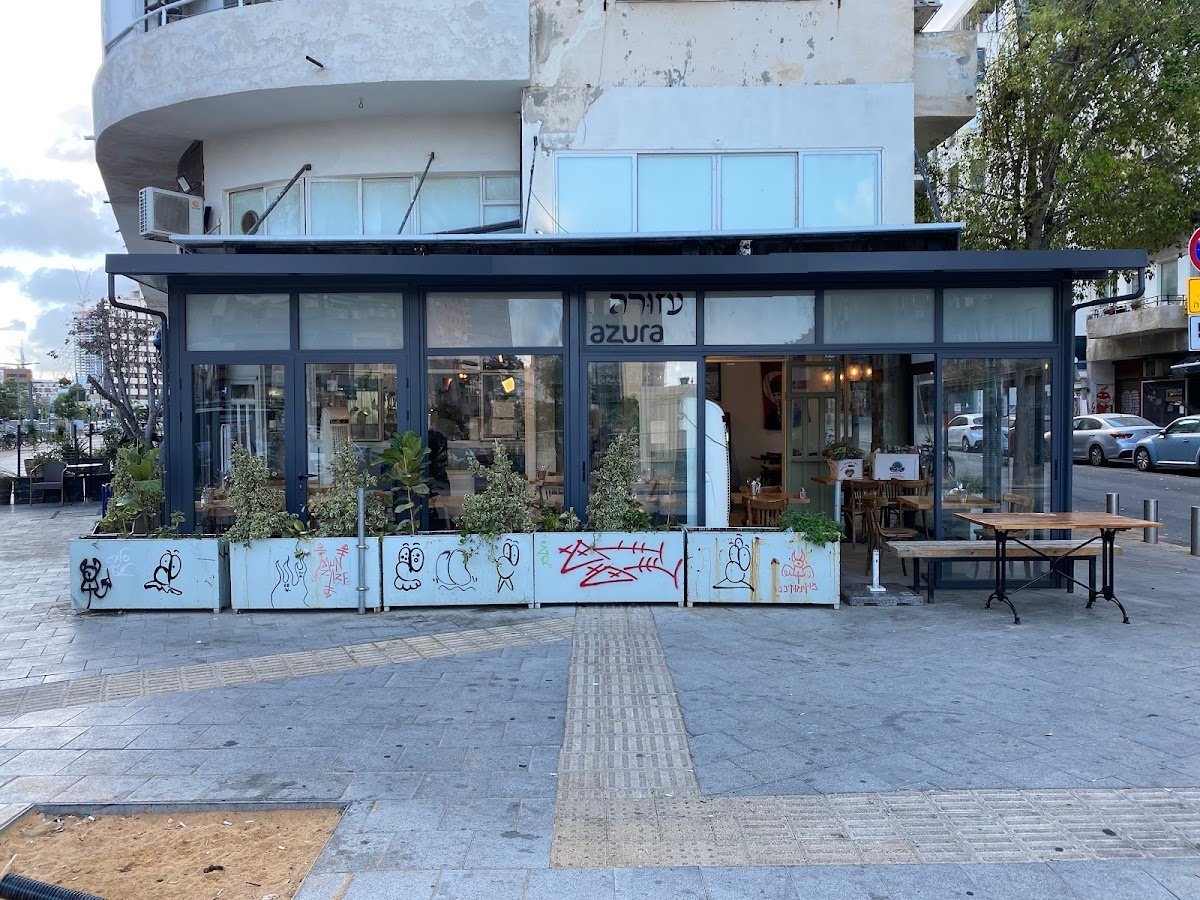
Where the Market Is the Kitchen
Mahane Yehuda Market operates on a different clock from Jerusalem's restaurant scene. By seven in the morning, the covered lanes are already dense with vendors, and the cooking smells that drift from Azura's corner of HaEshkol Street belong entirely to that earlier rhythm. The restaurant opens for breakfast and lunch, shutting before the market transitions into its evening bar-and-street-food mode. That timing is not incidental — it is structural. Azura's menu is built around dishes that require hours of overnight preparation, and the produce that feeds those dishes comes from the stalls immediately surrounding it. The market is not the backdrop; it is the supply chain.
This model — sourcing at market pace, cooking to market hours , places Azura in a small category of Jerusalem restaurants that function less like dining destinations and more like anchored institutions. The comparison set is not the hotel dining rooms on King David Street or the modernist Israeli kitchens opening in the Talpiot neighbourhood. It sits closer to Abu Hassan in Jaffa, another multi-generational address where the cooking's authority comes from repetition and proximity to ingredient sources, not from reinvention. Both operate in covered market or port-adjacent environments where the gap between raw ingredient and finished dish is measured in metres rather than supply-chain logistics.
The shortlist, unlocked.
Hard-to-book tables, cellar releases, and concierge-planned trips.
Get Exclusive Access →Sephardic Slow Cooking and What It Actually Means
The Sephardic and Mizrahi traditions that define Azura's menu are among the least exported of Israel's culinary lineages. In the international conversation about Israeli food, the focus tends to land on hummus, shakshuka, and the mezze-style sharing format that restaurants from Tel Aviv to London have standardised. Azura operates in a different register: slow-braised meats, heavy with cumin and turmeric, cooked in ceramic vessels overnight and served in the same pots they were made in. The slow-cook format is not a technique choice , it is a tradition derived from Shabbat observance, where cooking fires could not be relit and dishes had to hold heat from Friday evening through Saturday lunch. The result is a flavour depth that quicker preparations cannot replicate.
That cooking tradition connects Azura to a broader thread running through Levantine and North African food culture. Diana in נצרת represents a different node of the same regional inheritance , Arab-Palestinian grilling traditions from Nazareth that share the Mizrahi kitchen's preference for spice layering and long cook times, even when the heat source and protein differ. Majda in Har Nof occupies similar territory: a family-run address where the cooking reflects a specific cultural inheritance rather than a designed menu concept. These are restaurants where the editorial question is not what the chef has decided to create, but what the tradition demands and how faithfully it is executed.
The Ingredient Argument
Sourcing from Mahane Yehuda is not simply a matter of convenience. The market draws from agricultural networks across Israel , citrus from the coastal plain, herbs and vegetables from the Galilee, spices imported through the established Arab and Sephardic trader networks that have supplied Jerusalem for generations. A kitchen embedded inside that market can respond to what is available that morning in a way that a restaurant receiving standardised weekly deliveries cannot. The lamb that goes into a hamin or a slow-braised shoulder dish will reflect the season's supply rather than a fixed specification.
This relationship between market sourcing and dish character matters particularly for spice-heavy cooking, where the quality of individual ingredients , dried limes, rose water, preserved lemons , determines whether a dish reads as complex or merely heavy. The difference between a hamin that works and one that doesn't is rarely technique; it is usually the integrity of what went into the pot. Azura's position inside Mahane Yehuda answers that question structurally: the sourcing and the cooking occupy the same geography.
For context on how this compares to sourcing-led restaurants operating outside traditional market formats, Rola Levantine Kitchen in חיפה and Herbert Samuel Herzliya in Herzliya each approach local-sourcing from a more contemporary angle , the former through Levantine ingredient specificity, the latter through a produce-first modern Israeli format. The difference in approach is also a difference in register: Azura's sourcing is embedded and unconscious, a function of location rather than a stated programme.
Jerusalem's Traditional Dining Tier
Jerusalem's restaurant scene has consolidated around two broadly different groups. The first is the modernist or internationally inflected tier , places building menus around technique, plating, and a self-conscious Israeli identity that speaks to a global food conversation. The second is the traditional tier, dominated by long-running family addresses, market stalls, and neighbourhood institutions whose authority derives from continuity rather than innovation. Azura belongs firmly to the second group, and in that group it occupies a senior position.
That placement carries practical consequences. The room is small, seating is communal, and the lunch-only hours mean competition for tables is concentrated. Arriving early is the operational reality; the most popular dishes sell out before early afternoon. Menza in Jerusalem represents the newer, more internationally styled end of Jerusalem dining for comparison , a useful pairing for anyone planning a multi-day visit that covers both registers.
For readers constructing a wider tour of Israel's traditional and market-anchored cooking, the relevant peer set extends beyond Jerusalem. Kab Kem in Tel Aviv offers a different angle on Levantine tradition in a more urban setting. Ali Karawan Abu Hassan (עלי קרואן אבו חסן) in תל אביב-יפו extends the Abu Hassan lineage into a different city context. And for those moving further afield, Uri Buri in Acre demonstrates how the northern coastal cities handle tradition , with more seafood, less spice weight, and a different cultural inheritance. See our full שלם restaurants guide for a broader orientation across price tiers and neighbourhoods.
Planning a Visit
Azura operates during market hours, which in practice means arriving before midday to secure a seat and a full spread of dishes. The address is 4 HaEshkol Street, inside Mahane Yehuda Market , access is on foot through the market lanes, and the restaurant is identifiable by the ceramic pots visible through the counter opening. No advance booking infrastructure appears to exist in the conventional sense; the model is walk-in, and the operational discipline required is arriving early rather than reserving ahead. The price point sits in the lower-mid range for Jerusalem sit-down meals, consistent with the market context. Dress is informal; the environment is communal tables and ceramic crockery, not linen.
The shortlist, unlocked.
Hard-to-book tables, cellar releases, and concierge-planned trips.
Get Exclusive Access →Frequently Asked Questions
Peer Set Snapshot
These are the closest comparables we have in our database for quick context.
| Venue | Cuisine | Price | Awards | Notes |
|---|---|---|---|---|
| Azura (עזורה) | This venue | |||
| Abu Hassan | Humus | Humus | ||
| Dr. Shakshuka | Middle Eastern | Middle Eastern | ||
| Ha'Achim | Israeli | Israeli | ||
| Habasta | Israeli | Israeli | ||
| HaSalon | Israeli - Mediterranean, Israeli | Israeli - Mediterranean, Israeli |
Need a table?
Our members enjoy priority alerts and concierge-led booking support for the world's most difficult tables.
Get Exclusive AccessThe shortlist, unlocked.
Hard-to-book tables, cellar releases, and concierge-planned trips.
Get Exclusive Access →