Azai Hand Roll Sushi
Our verdict
On West 3rd Street, Azai Hand Roll Sushi represents a format gaining serious traction in Los Angeles: the temaki-focused counter that applies Japanese precision to California's seasonal produce supply chain. The hand roll, once an afterthought at larger omakase counters, here becomes the organizing principle, a format that rewards sourcing discipline and punishes shortcuts. A focused, technique-led address in one of the city's most restaurant-dense corridors.

Pearl is the En Primeur Club membership app, where members save venues, book tables and use the concierge.
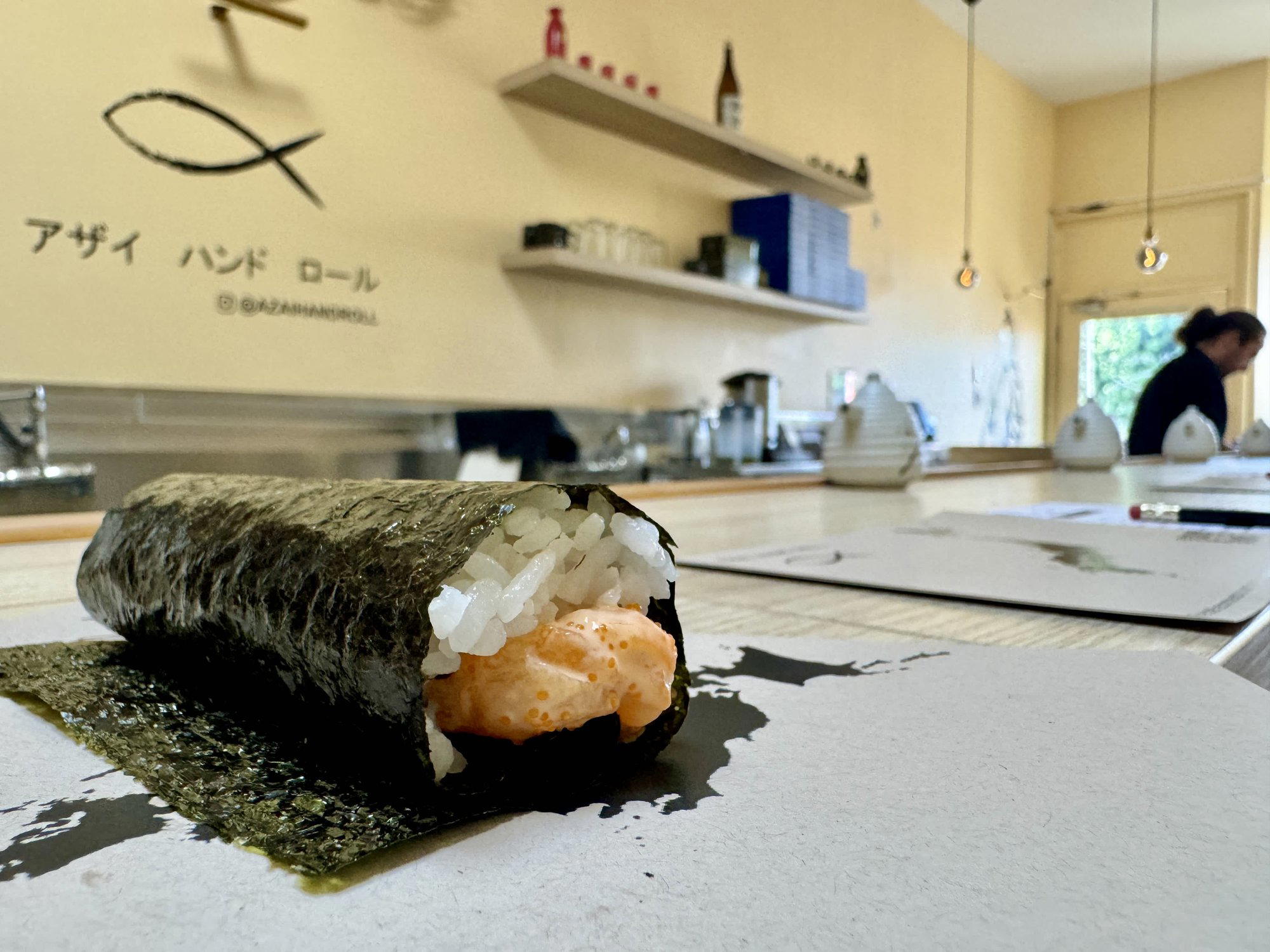
The menu
What to order
- Crispy Rice Spicy Tuna
- Bluefin Tuna Hand Roll
The Hand Roll as a Serious Format
Los Angeles has developed one of the most layered Japanese dining ecosystems outside Japan itself. The city's sushi scene now spans entry-level conveyor belts, mid-market nigiri bars, and rarefied omakase counters like Hayato and Kato, which bring the kind of technique and sourcing discipline usually associated with Tokyo or Osaka. Within that structure, the hand roll counter occupies a specific and increasingly respected position. The temaki format demands that every element, rice temperature, nori crispness, filling composition, be executed in immediate sequence, because a hand roll begins degrading within seconds of assembly. There is nowhere to hide.
Azai Hand Roll Sushi, at 8036 W 3rd Street in the Beverly Grove corridor, positions itself inside this format with the seriousness the discipline requires. West 3rd is one of Los Angeles's more concentrated dining streets, running from the Beverly Center toward Fairfax and hosting a range of independent restaurants that draw from the surrounding residential density of Beverly Grove, West Hollywood, and the Fairfax District. A hand roll counter here competes less with other Japanese venues than with the full spectrum of neighborhood dining, which is itself a signal about how the format is being repositioned in the city's broader culinary conversation.
California Produce, Japanese Discipline
The editorial case for hand roll counters in Los Angeles rests largely on what the city's supply chain makes possible. Southern California's access to premium seafood, from Santa Barbara spot prawns to Pacific bluefin caught off Baja, alongside year-round vegetable harvests from the Central Valley and local farms means that the raw material available to a focused temaki counter is genuinely different from what a Tokyo counterpart would work with. This is where the intersection of imported technique and local product becomes meaningful rather than rhetorical.
At its finest, the hand roll format in LA applies Japanese structural logic, the ratio of seasoned rice to nori to filling, the sequencing of fatty to leaner cuts across a meal, to ingredients that have no Japanese analogue. That tension between inherited method and indigenous product is what distinguishes the serious operators in this tier from those simply riding a trend. The format itself traveled from Japan but the sourcing vocabulary here is distinctly Californian, and the counters that understand both sides of that equation tend to produce something more coherent than those leaning on aesthetics alone.
For a broader look at how this kind of technical Japanese tradition is playing out across Los Angeles dining rooms, the full Los Angeles restaurants guide maps the city's key neighborhoods and format categories in detail.
Positioning Within Los Angeles's Japanese Tier
The hand roll counter sits below the full omakase experience in terms of price and formality but above the casual roll-and-beer category in terms of technique expectations. In Los Angeles, that middle tier has grown considerably over the past decade, as diners who might once have chosen between a $30 lunch box and a $300 omakase now find credible, technique-led options in the $60 to $120 range. The format also tends to run shorter, forty-five minutes to an hour, which fits the way West Side Los Angeles diners actually eat on weekday evenings.
Comparisons within the city's Japanese spectrum are instructive. Counters like Hayato operate at the very best of the omakase format, where kaiseki influence shapes a multi-hour progression. Kato works a New Taiwanese register that draws on similar precision-ingredient thinking. Azai, by contrast, keeps the format narrower and the pacing faster, the hand roll counter model is inherently less ceremonial, which is part of its appeal for diners who want the sourcing and technique without the length of a full tasting menu.
That positioning also explains why the format has expanded across American cities more broadly. From the focused omakase counters of New York, where venues like Atomix demonstrate how Korean-Japanese precision dining can anchor a serious room, to the farm-to-table rigor of addresses like Single Thread Farm in Healdsburg or Blue Hill at Stone Barns in Tarrytown, the American dining room increasingly rewards focused formats over generalist menus. The hand roll counter is one of the sharper expressions of that broader shift.
The West 3rd Street Context
Beverly Grove and the surrounding blocks of West 3rd have historically attracted independent restaurants rather than chain formats, partly because the street's residential catchment area supports consistent weekday traffic without requiring the tourist volumes that drive Melrose or the Grove nearby. This makes it a reasonable address for a focused counter concept: the customer base skews toward repeat local diners rather than one-time visitors, which rewards quality and consistency over novelty.
For comparison, Los Angeles's more maximalist dining expressions, the molecular ambition of Somni, the Italian authority of Osteria Mozza, the seafood precision of Providence, tend to anchor on higher-visibility corridors or require a destination commitment from the diner. The hand roll counter on a residential-commercial strip like West 3rd is making a different argument: that serious food and neighborhood accessibility are not in opposition. That argument is being made at various price points across American cities, from Lazy Bear in San Francisco to Smyth in Chicago to Addison in San Diego, each in its own format register.
Planning Your Visit
Azai Hand Roll Sushi is located at 8036 W 3rd Street, Los Angeles, CA 90048, in the Beverly Grove neighborhood. Street parking on West 3rd can be tight during peak dinner hours; side streets between Fairfax and Crescent Heights tend to offer better availability. The corridor is also accessible from the Beverly Center area on foot if you are coming from nearby hotels. Reservations: Booking details and current availability are best confirmed directly with the venue or via current booking platforms, as policies in this format category can vary. Timing: Hand roll counters in this tier typically run tightest on Thursday through Saturday evenings; earlier seatings on weeknights offer a more relaxed pace. Budget: The format generally sits in a mid-to-upper-mid price tier for Los Angeles Japanese dining, below full omakase pricing. Confirm current pricing directly, as menu structures in this format can shift seasonally.
Frequently asked questions
Does Azai Hand Roll Sushi work for a family meal?
The hand roll counter format at 8036 W 3rd Street suits smaller groups and adults comfortable with a focused, counter-style dining experience. Younger children who prefer broader menus may find the single-format concept limiting. Families with older kids who appreciate Japanese food and a focused menu will find it a practical fit.
What kind of setting is Azai Hand Roll Sushi?
Azai operates in the Beverly Grove stretch of West 3rd Street, a block known for independent restaurant formats rather than chains. The hand roll counter setup places it closer to a purposeful, focused dining bar than a full-service restaurant. Expect a compact, order-driven environment where the format is the point.
How does Azai Hand Roll Sushi fit into Los Angeles's broader Japanese dining scene?
Los Angeles has one of the most developed Japanese dining ecosystems outside Japan, with hand roll counters now forming a distinct tier between casual sushi bars and full omakase rooms. Azai on W 3rd Street in Beverly Grove represents that format specifically, a venue where the hand roll is the entire editorial statement, not a side item. For diners familiar with the temaki-focused counters that emerged in Japanese cities, the model will read immediately.
What's the signature dish at Azai Hand Roll Sushi?
Azai is built around temaki, hand-rolled cones of seasoned rice and filling wrapped in nori, which is both the format and the focus. The hand roll counter model means the menu is intentionally tight, with temaki as the central and defining offering rather than one item among many.
Where exactly is Azai Hand Roll Sushi?
Azai Hand Roll Sushi is located at 8036 W 3rd St, Los Angeles, CA 90048, Los Angeles.
What's the standout thing about Azai Hand Roll Sushi?
In a Los Angeles sushi market that runs from high-volume casual rolls to multi-course omakase, Azai occupies a deliberate middle position: a counter dedicated to a single Japanese format executed with focus. The Beverly Grove address puts it in a neighbourhood where independent operators tend to have a reason to be there beyond foot traffic.
Cuisine and Credentials
| Venue | Cuisine | Price | Awards | Notes |
|---|---|---|---|---|
| Azai Hand Roll SushiThis venue (the venue you are viewing) | Hand Roll Sushi Bar | $30–50 | Not listed | Not listed |
| Kato | Modern Taiwanese Fine Dining | $300–500 | 2 Michelin Stars · World's 50 Best #49 | New Taiwanese, Asian |
| Hayato | Traditional Japanese Kaiseki | $300–500 | 2 Michelin Stars · La Liste Top Restaurants | Japanese |
| Vespertine | Avant-Garde Tasting Menu | $200–300 | 2 Michelin Stars · La Liste Top Restaurants | Progressive, Contemporary |
| Holbox | Modern Mexican Seafood | $30–50 | 1 Michelin Star · World's 50 Best #26 | Mexican Seafood, Mexican |
| Sushi Kaneyoshi | Edomae Omakase | $300–500 | 1 Michelin Star · LA Times 101 Best Restaurants #24 | Sushi, Japanese |
Continue exploring
More in Los Angeles
Restaurants in Los Angeles
All restaurants in Los Angeles →
Bars in Los Angeles
All bars in Los Angeles →
Hotels in Los Angeles
All hotels in Los Angeles →
Wineries in Los Angeles
All wineries in Los Angeles →
Details
- Intimate
- Trendy
- Modern
- Casual Hangout
- Date Night
- Chefs Counter
- Open Kitchen
- Sake Program
- Counter Dining
- A La Carte
Current opening hours
- Monday
- 5–10 PM
- Tuesday
- 11:30 AM–2:30 PM, 5:30–10 PM
- Wednesday
- 11:30 AM–10 PM
- Thursday
- 11:30 AM–10 PM
- Friday
- 11:30 AM–11 PM
- Saturday
- 11:30 AM–11 PM
- Sunday
- 5–10 PM
Hours can change for holidays and private events. Hours as of .
Intimate sushi bar with a contemporary, fast-paced atmosphere and moderate noise levels.