On Rue Jacob in the 6th arrondissement, Assanabel occupies a stretch of Saint-Germain-des-Prés where the dining tradition is as layered as the neighbourhood's literary past. The address places it within a competitive pocket of Left Bank dining, where kitchens must earn repeat custom from a neighbourhood that has seen fashions come and go for decades.
Pearl is the En Primeur Club membership app — saves, bookings, and concierge access live there. Same editors, same standards.
- Address
- 38 Rue Jacob, 75006 Paris, France
- Phone
- +33142968985
- Website
- assanabelparis.com
- Directions
- Get directions
 Saves & bookings on Pearl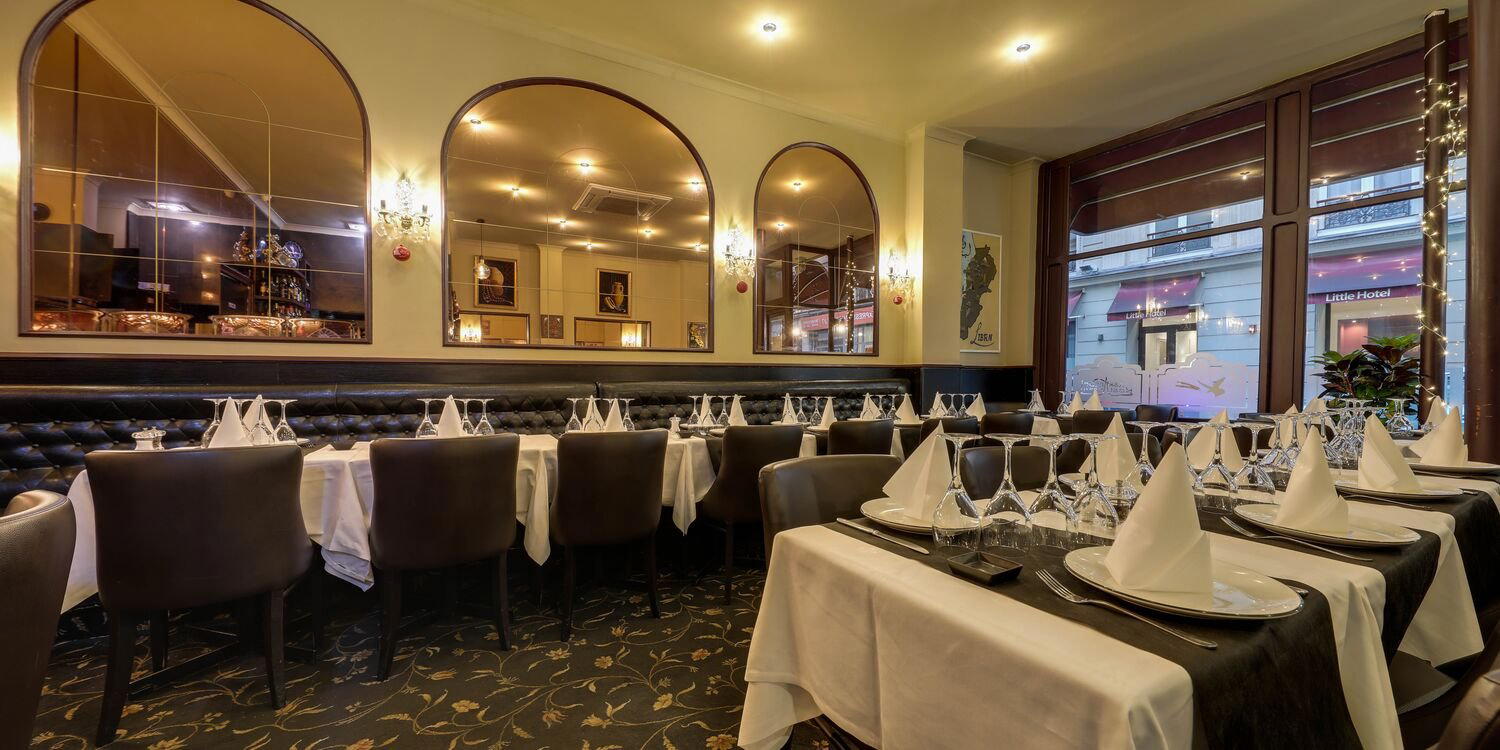
Saint-Germain-des-Prés and the Weight of an Address
Rue Jacob runs through one of Paris's most historically loaded postal codes. The 6th arrondissement's Saint-Germain quarter has cycled through identities, from existentialist café culture to luxury retail consolidation to, more recently, a quiet reemergence as a serious dining corridor. The cafés that once drew philosophers now share blocks with wine bars trading in natural producers and small restaurants whose kitchens operate with the precision more commonly associated with the Right Bank's grander rooms. Assanabel, at number 38, sits in the middle of that ongoing recalibration.
The physical approach along Rue Jacob tells you something before you reach the door. The street is narrow, the buildings compressed and tall in the Haussmann tradition, and foot traffic is local rather than tourist-heavy compared to the Boulevard Saint-Germain two blocks south. That distinction matters in Paris, where who fills the room on a Tuesday evening says as much about a restaurant as any award. Addresses on streets like this one earn their standing through repetition: the same faces returning, adjusting expectations slightly upward each time.
How the Left Bank Dining Scene Has Shifted
A decade ago, the dominant narrative in Paris fine dining was consolidation around a small number of three-Michelin-star rooms, most of them on or near the Right Bank. Alléno Paris au Pavillon Ledoyen and Le Cinq at the Four Seasons Hôtel George V anchored the upper tier of that moment, while the Left Bank operated at a slight remove, its identity tied more to bistrot culture and the classic bourgeois French table than to technical ambition. That gap has narrowed considerably. Arpège had long been the obvious exception, but the broader shift has seen smaller, less-flagged addresses in the 6th and surrounding arrondissements attract kitchens operating with genuine seriousness.
This evolution is not distinctive to Paris. Across France, interesting repositioning in fine dining has happened away from the historic palaces. Mirazur in Menton, AM par Alexandre Mazzia in Marseille, and destinations like Flocons de Sel in Megève have each demonstrated that compelling cooking in France increasingly happens at a remove from the capital's grand institution format. Paris itself has absorbed that lesson, and the result is a more distributed fine dining map, where a room on Rue Jacob can sit in a credible conversation with peers at far grander addresses.
The Evolution Question: What an Address Becomes Over Time
The editorial angle worth applying to any restaurant in this part of Paris is one of reinvention. Saint-Germain-des-Prés has seen more dining concepts open and close over the past two decades than almost any other Parisian neighbourhood at its price point. The ones that persist tend to do so because they have clarified what they are, often through successive adjustments rather than a single founding vision. The French dining tradition has always allowed for this kind of slow accumulation: a kitchen that begins in one register and, through chef changes, ownership evolution, or simply the pressure of a demanding local clientele, arrives at something more defined.
That pattern is visible across French restaurant history at the highest level. Troisgros has reinvented itself across generations and locations without losing the weight of its name. Auberge de l'Ill in Illhaeusern has held its Michelin stars through family successions spanning decades. Even at the level of a single-star address, the restaurants that earn sustained attention in Paris are those that demonstrate a capacity to shift without losing coherence. Kei in the 1st arrondissement is a useful comparison: a kitchen that arrived at its current French-Japanese synthesis through deliberate evolution rather than a fixed opening concept.
Positioning Assanabel within the Paris dining map requires understanding how the 6th arrondissement sits relative to the city's broader competitive tiers. At the leading end, rooms like L'Ambroisie on the Place des Vosges operate in a category defined by decades of accumulated reputation and a price point that functions as a signal in itself. Below that tier, but still within serious-restaurant territory, sits a large cohort of addresses where the competition is for the attention of a well-travelled, locally-rooted clientele that has options. That cohort includes much of what lines the streets of Saint-Germain.
For international context, the discipline required to hold a position in that mid-upper tier in Paris is not unlike what kitchens face in other competitive cities. Le Bernardin in New York has maintained its position through a combination of technical consistency and format clarity over many years. Atomix, also in New York, represents a different model: a room that built its reputation quickly through a clearly defined tasting format and has held it through rigorous execution. Both examples point to the same underlying principle: in markets where serious diners have abundant alternatives, identity clarity matters more than category ambition alone.
The French regional tradition adds another layer of comparison. Houses like Bras in Laguiole, Auberge du Vieux Puits in Fontjoncouse, and Assiette Champenoise in Reims have built their standing in part by being precisely what they are, without apology for their geography or format. Paris restaurants on smaller streets operate under a different kind of pressure, but the underlying requirement is the same: know what you are and deliver it without hedging.
Older institutions like Paul Bocuse's Auberge du Pont de Collonges and Au Crocodile in Strasbourg demonstrate how French restaurant identity can carry across generations when the founding proposition is strong enough. For addresses still building that kind of permanence, the early years are where the template gets set. See our full Paris restaurants guide for a broader map of how the city's dining is currently organised by arrondissement and price tier.
Know Before You Go
- Address: 38 Rue Jacob, 75006 Paris, France
- Neighbourhood: Saint-Germain-des-Prés, 6th arrondissement
- Getting there: Saint-Germain-des-Prés metro station (Line 4) is the closest stop, a short walk along Boulevard Saint-Germain to Rue Jacob
- Booking: Contact details not confirmed at time of publication; check current listings or walk-in availability may apply depending on format
- Price range: Not confirmed at time of publication; the Saint-Germain neighbourhood spans a wide range, from under €30 to well over €100 per head
- Hours: Not confirmed at time of publication; verify before visiting
Continue exploring
More in Paris
Restaurants in Paris
Browse all →
Bars in Paris
Browse all →
Hotels in Paris
Browse all →

At a Glance
- Cozy
- Elegant
- Group Dining
- Special Occasion
- Late Night
- Extensive Wine List
Current opening hours
- Monday
- 12–2:30 PM, 7–11 PM
- Tuesday
- 12–2:30 PM, 7–11 PM
- Wednesday
- 12–2:30 PM, 7–11 PM
- Thursday
- 12–2:30 PM, 7–11 PM
- Friday
- 12–2:30 PM, 7–11 PM
- Saturday
- 12–2:30 PM, 7–11 PM
- Sunday
- 12–2:30 PM, 7–11 PM
Hours can change for holidays and private events. Last verified .
Welcoming decor with oriental colors creating a warm and pleasant atmosphere.