
Tabelog 100 #87
Our verdict
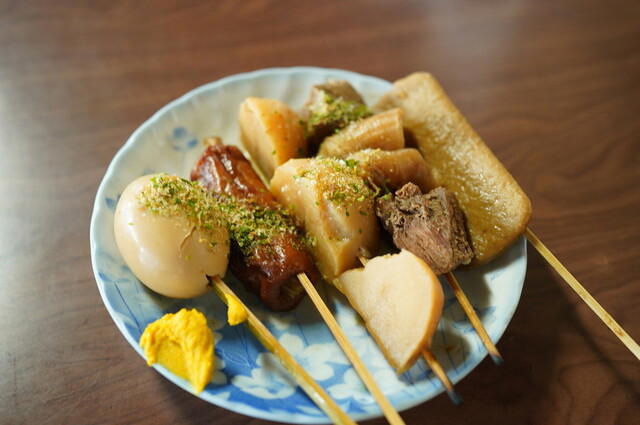
Ooyakiimo puts Shizuoka’s everyday sweet-shop culture in a sharper frame: Japanese sweets, rice balls and oden, with takeaway available and a house-restaurant setting rather than a formal dining room. Its Tabelog 100 selection for Japanese traditional sweets and sweets cafés in East Japan gives it a credentialed place in the city’s low-key, ingredient-led food circuit.

Pearl is the En Primeur Club membership app, where members save venues, book tables and use the concierge.
The menu
What to order
- Shizuoka oden with black broth
- Gyusuji (beef tendon) oden
- Yakiimo (roasted sweet potato)
- Daigakuimo (candied sweet potato)
- Onigiri (rice balls)
- Kakigori (shaved ice, summer only)
Approach this kind of Shizuoka address and the signal is not spectacle. The more telling clues are domestic scale, daytime rhythm and a menu built around foods that belong to daily life rather than ceremony: Japanese sweets, onigiri and oden. In a city better known nationally for tea, seafood, wasabi and access to mountain and coastal produce, that combination reads as local common sense. Ooyakiimo belongs to the category of Japanese food places where sourcing and repetition matter more than theatre.
Shizuoka’s dining identity is often split between destination kitchens and small-format specialists. For the former, the city has serious dining rooms, including places such as Chinese Muramatsu. The sweets-café tier works by a different logic. It asks whether simple ingredients are handled with enough discipline to justify a detour, not whether the room can stage a long dinner. Ooyakiimo’s 2023 Tabelog Hyakumeiten recognition places it in that specialist bracket, and its 3.62 Tabelog score gives a useful measure of local traction without turning the experience into fine-dining arithmetic.
Sweet-shop cooking that sits close to Shizuoka's pantry
Japanese sweets cafés are easy to underestimate from outside Japan because the category sounds narrow. In practice, the good ones often act as compact maps of regional appetite: starch, sugar, tea, pickles, broth, seasonal produce and takeaway habits all passing through the same counter. Here, the registered categories matter. A café featuring Japanese sweets, onigiri and oden is not chasing a single tasting-menu identity. It is closer to a daytime food stop where sweet and savoury share the same practical vocabulary.
The ingredient angle is especially relevant in Shizuoka. The prefecture’s tea culture shapes how sweetness is calibrated, even when no specific tea service is the headline. Rice balls point toward the everyday importance of rice quality, seasoning and portability. Oden brings the shop into a savoury snack tradition rather than leaving it in the confectionery lane. This is the useful distinction: the format is humble, but the culinary references are not random.
That is also why Ooyakiimo sits differently from a conventional restaurant itinerary. A visitor using our full Shizuoka restaurants guide will find a range of dining competing for meal slots. This address makes more sense as a daytime counterpoint, a place to understand how Shizuoka eats between meals or around them. Other dining in Shizuoka underlines how varied the local register is: not every serious food address needs to look serious.
The format is casual, but the recognition is specific
Tabelog’s Hyakumeiten lists are useful because they reward depth within narrow genres. A sweets-café selection is not the same signal as a Michelin star, and it should not be read like one. It points instead to category authority: enough consistency, local attention and genre relevance to sit among selected addresses in a focused field. For travellers, that is a more precise signal than generic popularity.
The venue’s listed categories reinforce the point. Ooyakiimo is presented as a café featuring Japanese sweets, onigiri and oden, a mix that belongs to Japan’s casual-food culture as much as to confectionery. It allows the same address to make sense for a sweet stop, a simple savoury bite or a low-key pause without changing identity. It also keeps the emphasis on the food itself, not on a scripted service arc.
There is an old-fashioned advantage to this kind of place: it resists the flattening effect of travel checklists. Many visitors arrive in Shizuoka looking for the grand markers, then leave with a clearer memory of a modest specialty shop because it gives the city a daily-life texture. That texture pairs well with broader planning across our full Shizuoka hotels guide, our full Shizuoka bars guide, our full Shizuoka wineries guide and our full Shizuoka experiences guide, where the city reads less as a single dining destination and more as a cluster of compact, specialized habits.
How to place it in a Shizuoka food day
The smart use of Ooyakiimo is not to force it into a grand meal slot. Let it do what the format is built to do: connect a day’s walking, errands or sightseeing with a low-cost, ingredient-forward stop. The listed budget sits at Dinner: JPY 1,000 - JPY 1,999 and Lunch: JPY 1,000 - JPY 1,999, which makes it useful for travellers balancing one serious reservation with smaller, local meals. In that sense it belongs closer to everyday specialists such as Suien Dosai Honten or Kawachi Ya than to the city’s formal dinner economy.
It also fits a broader Japan itinerary for readers who track small-format food culture across cities. A casual specialist in Shizuoka can be read alongside other compact, narrow-format addresses elsewhere in Japan and beyond. The comparison is not about sameness; it is about how limited formats can reveal more than sprawling menus.
For travellers moving through Japan’s larger food map, Shizuoka’s scale is part of the appeal. A sweets café here has a different pressure than a major-city counter or a destination café elsewhere. Compared with more performance-driven dining in larger urban settings, the Shizuoka case feels quieter, more local and less declarative. That is its editorial value: it shows how regional Japan often communicates through small, repeatable foods rather than grand declarations.
Frequently asked questions
Would Ooyakiimo be comfortable with kids?
Ooyakiimo’s listed format is casual: a café featuring Japanese sweets, onigiri and oden in Shizuoka. The budget of Dinner: JPY 1,000 - JPY 1,999 and Lunch: JPY 1,000 - JPY 1,999 keeps it in an accessible range for a simple outing. Check the venue's official channels for the latest details.
Is Ooyakiimo better for a quiet night or a lively one?
It reads more as a low-key sweets-café stop than a late-night scene. The 2023 Tabelog Hyakumeiten recognition points to a focused specialist format, with Japanese sweets, onigiri and oden listed as the core categories.
What's the pricing like at Ooyakiimo?
Pricing at Ooyakiimo is listed as JPY 1,000 - JPY 1,999 JPY 1,000 - JPY 1,999 View spending breakdown.
What are the opening hours for Ooyakiimo?
Check the venue's official channels before visiting.
Comparison Snapshot
Comparable venues by cuisine and price in the same metro.
| Venue | Cuisine | Price | Awards | Notes |
|---|---|---|---|---|
| OoyakiimoThis venue (the venue you are viewing) | Shizuoka oden & roasted sweet potato shop | $10–20 | Tabelog 100 #87 | Not listed |
| Seki Beya | Traditional Japanese wagashi & Abekawa mochi | $1–10 | Tabelog 100 #47 | Aoi-ku |
| Oomura | Shizuoka chicken wings & oden izakaya | $20–30 | Tabelog 100 #76 | Aoi-ku |
| Aozora | Japanese cafeteria specializing in local sakura shrimp | $10–20 | Tabelog 100 #58 | Shimizu-ku (Yui Station area) |
| Sakume | Traditional Unagi (Grilled Eel) | $20–30 | Tabelog 100 #19 | Mikkabichosakume, Kita-ku |
| 成生 | Itamae Tempura | $150–200 | La Liste Top Restaurants · Tabelog Chef's Gold #7 | Autocity |
Recognition history
Dated appearances from independent guides and award organizations, with the underlying list record or original source where available.
Tabelog 100 #87 · No. 87
Tabelog · Tabelog 100 - Japanese traditional sweets / Japanese sweets cafe - EAST - 2023
Continue exploring
More in Shizuoka
Restaurants in Shizuoka
All restaurants in Shizuoka →
Hotels in Shizuoka
All hotels in Shizuoka →
Wineries in Shizuoka
All wineries in Shizuoka →
Details
- Classic
- Cozy
- Rustic
- Well Known
- Solo
- Family
- Casual Hangout
- After Work
- Historic Building
- Standalone
- A La Carte
- Counter Dining
Current opening hours
- Monday
- Closed
- Tuesday
- Closed
- Wednesday
- 10:30 AM–4:30 PM
- Thursday
- 10:30 AM–4:30 PM
- Friday
- 10:30 AM–4:30 PM
- Saturday
- 10:30 AM–4:30 PM
- Sunday
- 10:30 AM–4:30 PM
Hours can change for holidays and private events. Hours as of .