Anuzha operates within Aleppo's layered dining tradition, where centuries of trade-route cuisine meet contemporary Syrian hospitality. Located in حلب, one of the world's continuously inhabited cities, the restaurant sits inside a culinary culture shaped by Silk Road spice commerce, Ottoman court influence, and Armenian, Kurdish, and Arab kitchen traditions converging in a single urban geography. Detailed booking and menu information should be confirmed directly with the venue.
 Discover on Pearl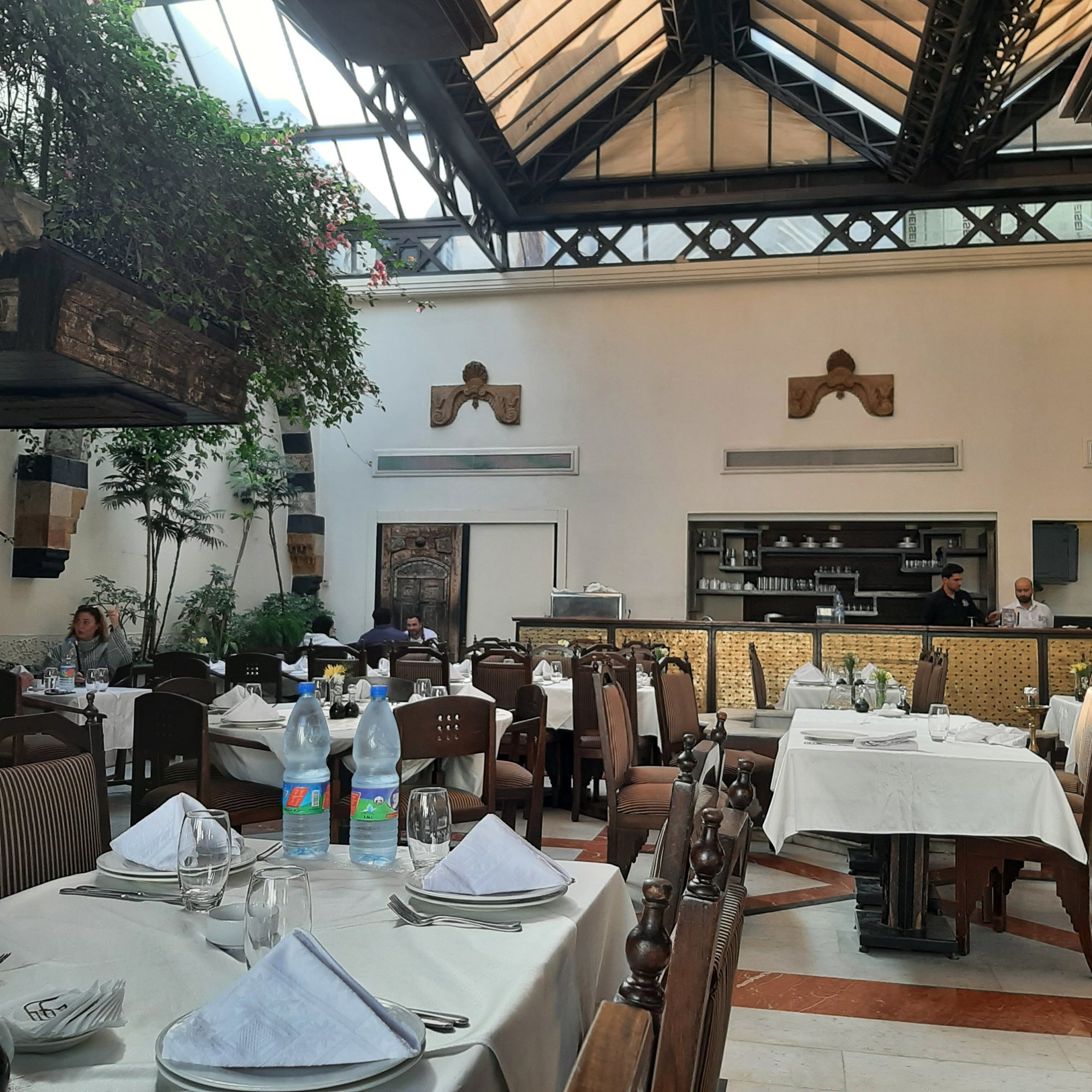
Aleppo and the Weight of Its Table
Few cities carry as much culinary freight as Aleppo. Long before the term "farm-to-table" entered the vocabulary of Western dining, Aleppo's cooks were working with ingredients specific to the city's own agricultural belt: the dark, semi-dried Halaby pepper that shares the city's name, pomegranate molasses pressed from local orchards, and lamb raised on the steppe grasses of the surrounding countryside. The city sits at the intersection of trade routes that once connected the Mediterranean coast to Mesopotamia and Persia, and its cuisine absorbed something from every caravan that passed through. The result is a kitchen tradition with more internal complexity than almost any other city-specific food culture in the Arab world.
Anuzha operates inside this tradition. The address places it within Aleppo's urban geography, a city that, despite the devastation of more than a decade of conflict, retains neighborhoods where the rhythms of local hospitality persist. Dining in Aleppo today is not a neutral act. It is a statement about continuity — the idea that a culinary culture specific enough to have exported its name to a spice (Aleppo pepper is now stocked in professional kitchens from Le Bernardin in New York City to Amber in Hong Kong) can outlast the conditions that tried to erase it.
The shortlist, unlocked.
Hard-to-book tables, cellar releases, and concierge-planned trips.
Get Exclusive Access →What Aleppan Cuisine Actually Means
The phrase "Syrian cuisine" flattens distinctions that matter significantly at the table. Damascus has its own register, shaped by its role as a political capital and its proximity to Lebanese influence. Restaurants like Naranj Restaurant in Al Qaimarryeh and Bakdash in Damascus represent that capital-city tradition. Coastal cities like Latakia carry Mediterranean inflection. See the full range in our View Restaurants in لاذقية listings. Aleppo's food culture is different in emphasis and technique: more reliant on dried fruit and nut combinations, more complex in its spicing, more indebted to the Armenian community that settled in the city in large numbers and contributed dishes that blended Anatolian and Arab approaches.
The city's kibbeh tradition alone runs to dozens of variants. Its kebab repertoire is distinct from the shwarma traditions you'll find at places like Shawrma Sharif in دمشق. Aleppan muhammara — the roasted red pepper and walnut paste finished with pomegranate molasses , is categorically different from versions made elsewhere in the region, leaning darker and more acidic. These distinctions are not trivial. They represent accumulated culinary knowledge passed across generations, and they are what restaurants operating in Aleppo today are, consciously or not, custodians of.
Anuzha Within Aleppo's Current Dining Scene
Aleppo's restaurant scene in the post-conflict period has been characterized by a tension between preservation and reinvention. Some establishments hold to classical formats: mezes served in the traditional sequence, grilled meats presented without reinterpretation, sweets drawn from the city's confectionery tradition that runs through the same family operations for multiple generations. Others have attempted to update the presentation while retaining the ingredient logic that defines Aleppan cooking. Establishments like Abu Youssef and Al Zammar House represent different points along that spectrum in the city's current dining geography.
Anuzha enters that scene at a moment when Aleppo's food culture is the subject of international attention in ways it wasn't before the war , partly because diaspora communities in Europe and North America have brought Aleppan cooking to new audiences, and partly because the global food media has begun to document what was at risk of being lost. The city's position in that conversation is genuinely significant. For broader context on where Anuzha sits relative to other venues in the city, our full حلب restaurants guide maps the current scene across cuisines and formats.
Syria's Culinary Geography, From Aleppo to the Coast
Understanding Anuzha requires placing Aleppo within Syria's wider culinary geography. The country's food culture fragments in ways that mirror its geography: the Orontes River valley cities like Kitaz Restaurant in حماه and Julia Palace Restaurant in حمص produce a middle register between coastal and northern cuisine. Aleppo sits at the northern end of this axis, closer in some respects to the food cultures of southern Turkey and northwestern Iran than to the Levantine cooking of Beirut or the southern Syrian table.
This geography matters for understanding what you are eating when you sit down in an Aleppan restaurant. The spicing tends toward complexity rather than heat. The sourness comes from sumac, pomegranate, and tamarind rather than from citrus. The fat base shifts depending on whether you are eating in a working-class neighbourhood joint or a more considered dining room: rendered tail fat and clarified butter carry different signals than olive oil. These are not decorative distinctions. They are the grammar of a regional cuisine that has been developing since at least the medieval period, when Aleppo was documented as a center of sophisticated urban food culture.
Planning a Visit
Current venue-specific operational details for Anuzha, including hours, contact information, pricing, and booking format, are not available through EP Club's verified data at this time. Given Aleppo's ongoing recovery and the variability of restaurant operations across the city, we recommend confirming details directly with the venue before visiting. For travelers arriving in Aleppo, the city's dining culture tends toward the evening; lunch services are often shorter and more limited in menu scope than dinner. The broader Syrian dining context suggests that venues in this category are leading approached without rigid advance planning, as formats and availability can shift. Compare this with the more structured booking environments of venues like Alinea in Chicago, Atomix in New York City, or Lazy Bear in San Francisco, where reservations are made months in advance and formats are fixed. Aleppo operates on a different hospitality logic, one that has always prioritized the present guest over the scheduled one.
Frequently Asked Questions
- What's the must-try dish at Anuzha?
- Aleppo's culinary identity is built around dishes that carry specific local character: muhammara with Halaby pepper, kibbeh in its many regional variants, and preparations using pomegranate molasses as a souring agent. These dishes define what Aleppan restaurants do differently from the rest of Syria. We are not able to confirm Anuzha's specific menu offerings through verified data, so we recommend asking staff directly about the day's preparation when you arrive.
- How hard is it to get a table at Anuzha?
- Without confirmed booking information, it is not possible to state definitively how accessible Anuzha's tables are at any given time. In Aleppo's current dining environment, walk-in culture remains more prevalent than advance reservation systems. If you are visiting from outside Syria, checking local contacts or arriving during off-peak evening hours is a reasonable approach.
- What's the standout thing about Anuzha?
- Anuzha operates within a culinary tradition of genuine historical depth. Aleppan cuisine's distinction, built on a specific spice vocabulary, a layered meze culture, and techniques shaped by centuries of trade-route exchange, gives any serious restaurant in the city a strong foundation. The standout quality is contextual: eating in Aleppo today carries a cultural weight that very few dining experiences anywhere can replicate.
- How does Anuzha handle allergies?
- No verified information is available on Anuzha's allergy policies. Contact details for the venue are not currently on record with EP Club. Travelers with serious dietary restrictions should seek to communicate directly with the restaurant before visiting. Traditional Aleppan cuisine uses tree nuts, sesame, and gluten-containing grains extensively, which is relevant context for those with allergies common to Middle Eastern food traditions.
- Is Anuzha representative of traditional Aleppan cuisine, or does it take a more contemporary approach?
- This is one of the defining questions in Aleppo's post-conflict dining scene, where restaurants split between preserving classical formats and adapting them for a changed city. Without confirmed menu or style data for Anuzha, EP Club cannot place it definitively on that spectrum. What is clear is that the city's culinary tradition, documented since the medieval period and shaped by Armenian, Arab, Kurdish, and Silk Road influences, provides the framework within which any Aleppan venue operates. Visiting with an understanding of that context will sharpen your read of what Anuzha is doing relative to its peers, including Al Zammar House and Abu Youssef, and relative to internationally recognized venues drawing on Middle Eastern culinary traditions, such as Alain Ducasse at Louis XV in Monte Carlo or Alléno Paris au Pavillon Ledoyen, which have each engaged with Levantine and North African ingredients through a fine-dining lens. Also worth considering is 8 1/2 Otto e Mezzo Bombana in Hong Kong and Emeril's in New Orleans as examples of how regional culinary traditions anchor serious restaurants across different geographies.
Price Lens
A fast peer set for context, pulled from similar venues in our database.
| Venue | Price | Awards | Notes |
|---|---|---|---|
| Anuzha | This venue | ||
| Al Zammar House | |||
| Abu Youssef | |||
| View Restaurants | |||
| Kitaz Restaurant | |||
| Naranj Restaurant |
Need a table?
Our members enjoy priority alerts and concierge-led booking support for the world's most difficult tables.
Get Exclusive AccessThe shortlist, unlocked.
Hard-to-book tables, cellar releases, and concierge-planned trips.
Get Exclusive Access →