Ambler
Our verdict
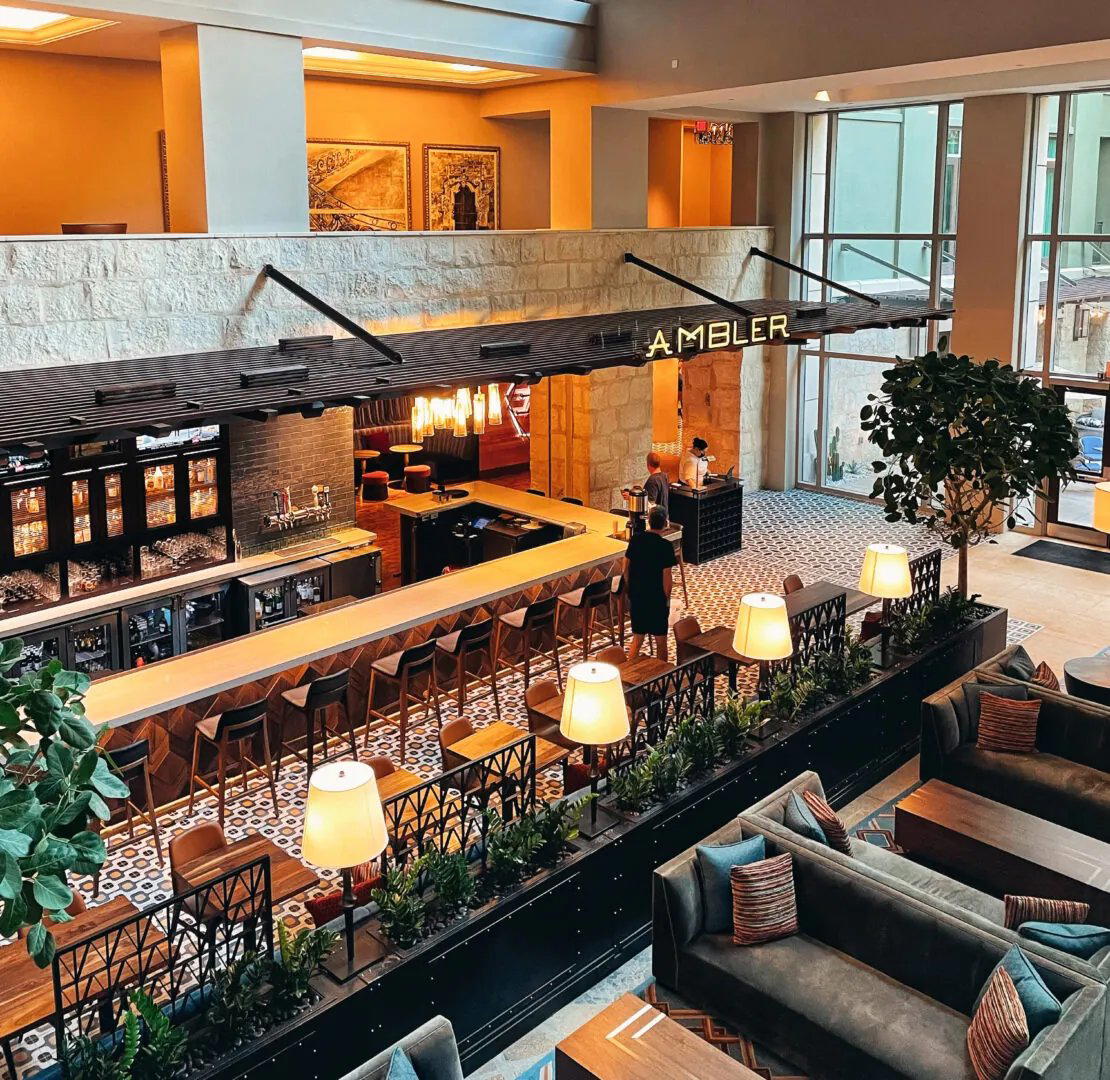
Ambler occupies a Market Street address in downtown San Antonio, placing it inside the city's most active dining corridor.

Pearl is the En Primeur Club membership app — saves, bookings, and concierge access live there. Same editors, same standards.
- Address
- 306 W Market St, San Antonio, TX 78205
- Phone
- (210) 298-8040
- Hours
- Mon–Thu 7 AM–9 PMFri–Sat 7 AM–10 PMSun 7 AM–9 PM
- Website
- amblersanantonio.com
- Directions
- Get directions
- Booking
- Book on OpenTable
The menu
What to order
- Texas Brisket
- Chili-Glazed Short Rib
- Lone Star Street Tacos
Downtown San Antonio and the New Seriousness of Market Street
West Market Street runs through the heart of downtown San Antonio with a directness that the city's more famous Riverwalk deliberately avoids. Where the Riverwalk curves and descends, bending the city's commercial energy toward leisure and tourism, Market Street operates at street grade, facing the Bexar County Courthouse and drawing a different kind of foot traffic: lawyers, city workers, hotel guests from the adjacent convention district, and, increasingly, the local professionals who have driven a quiet but sustained shift in what downtown San Antonio's restaurants are expected to do. Ambler sits at 306 W Market St inside that context, and the address alone signals something about its intended register.
San Antonio's downtown dining corridor has evolved considerably since the early 2010s. For a long time, the Riverwalk dominated the visitor conversation while the blocks above it remained relatively thin on serious kitchen operations. That gap has narrowed. The emergence of venues like Mixtli, which operates a deeply researched Mexican tasting format, and Isidore, which brings a contemporary Texan sensibility to fine-casual dining, signals that the city now supports restaurants with genuine editorial ambition rather than just high-volume covers. Ambler occupies that same general geography, and its Market Street positioning places it in conversation with those shifts rather than on the margins of them.
San Antonio's Dining Character: What the City Asks of Its Restaurants
To understand what a downtown San Antonio address demands of a restaurant, it helps to understand what the city's food culture is actually built on. San Antonio is often described as a Mexican-American food city, and that framing is accurate but incomplete. The city's culinary foundation draws from deep Tejano traditions, from norteño cooking that crosses the border with regional specificity, from German and Czech immigrant foodways that shaped the Hill Country meat culture immediately to its north, and from a Gulf Coast proximity that keeps seafood in circulation even this far inland.
This layering matters because it means San Antonio diners, particularly those eating downtown, are not a blank slate. They carry expectations shaped by generations of specific flavors: the chile-forward complexity of Tex-Mex at its most considered, the smoke discipline of the barbecue tradition that venues like 2M Smokehouse carry with documented seriousness, and the all-day diner culture represented by places like 410 Diner. A new restaurant landing on Market Street enters a market with genuine culinary memory, not one waiting to be educated.
What the city also has, increasingly, is an appetite for formats that sit between the casual and the formal. The tasting-menu model, which has driven so much of the national fine-dining conversation at restaurants like Lazy Bear in San Francisco, Smyth in Chicago, or Blue Hill at Stone Barns in Tarrytown, has local expression in venues like Mixtli. But the larger market demand in San Antonio skews toward restaurants that take the food seriously without requiring the diner to commit to a three-hour seated experience. That middle register is where the city's growth is happening.
The Cultural Weight of a West Market Street Kitchen
For any kitchen operating at this address, the cultural stakes are specific. Downtown San Antonio is not neutral ground. It carries the historical compression of the Alamo, the political geography of a majority-Hispanic city with deep pride in its culinary heritage, and the commercial pressures of a convention economy that can flatten a restaurant's identity toward the generic if the kitchen isn't deliberate about resisting it. The restaurants that have built lasting reputations in this part of the city are the ones that found a way to serve the visitor economy without being entirely defined by it.
That balance is visible across the city's more considered operators. 1Watson reads the downtown hotel-dining dynamic carefully. Mixtli's reservation-only tasting format creates a deliberate filter. Even the broader San Antonio restaurant conversation is increasingly shaped by kitchens that have made explicit choices about who they are cooking for and why. Ambler's Market Street location puts it in the middle of that ongoing negotiation.
Nationally, the restaurants that handle this tension most successfully tend to be the ones with a clear point of view on sourcing or technique: consider how Single Thread Farm in Healdsburg uses hyper-local agricultural control as its anchor, or how Providence in Los Angeles builds its identity around seafood sourcing discipline. Those commitments give a kitchen something to communicate beyond the menu itself. The question for any newer downtown San Antonio entrant is whether it has found an equivalent organizing principle.
Within San Antonio's current dining tier structure, the Market Street address and downtown positioning suggest Ambler is aiming at a mid-to-upper register rather than a casual neighborhood operation. The city's top-tier restaurants, including the tasting-format specialists, occupy a small and relatively expensive bracket. Below that sits a broader band of serious casual and modern bistro operations where most of downtown's growth has occurred. Venues like Cullum's Attaboy, operating in the French-bistro register at a mid-range price point, and Leche de Tigre, which brings a French-Peruvian hybrid to the city's international options, illustrate the range that serious downtown operators now occupy.
For comparison outside Texas, the restaurants that most closely model the kind of positioning a downtown address like this can sustain include Addison in San Diego, which operates serious tasting formats in a city with strong casual competition, and Emeril's in New Orleans, which for years anchored a downtown dining corridor with a kitchen that had to serve both visitors and locals convincingly. The challenge is the same across those contexts: build a room and a menu that doesn't feel like it's performing for tourists while remaining accessible enough to fill covers on a convention-heavy Tuesday.
Planning a Visit
Ambler is located at 306 W Market St in downtown San Antonio, within walking distance of the Riverwalk hotels, the Henry B. González Convention Center, and the historic courthouse district. Downtown San Antonio's parking situation around Market Street is manageable on evenings and weekends; rideshare drop-off is direct from any of the major hotel clusters within a half-mile radius. For a fuller picture of the San Antonio dining scene and how Ambler fits within it, see our full San Antonio restaurants guide.
Frequently asked questions
What's the address for Ambler?
Ambler is located at 306 W Market St, San Antonio, TX 78205, San Antonio.
Is Ambler a good option for dining near the San Antonio Riverwalk?
Ambler sits at 306 W Market St in downtown San Antonio, putting it within walking distance of the Riverwalk corridor. That proximity places it among the restaurants that draw both hotel guests and locals navigating the downtown core. Its mid-to-upper positioning in the San Antonio dining tier suggests it is aimed at a more considered dining occasion than the tourist-facing options that cluster along the waterway itself.
What do people recommend at Ambler?
Given its downtown San Antonio address on West Market Street, the kitchen operates in a competitive mid-to-upper tier where the expectation is ingredient-led cooking that reflects the city's deep Tex-Mex and South Texas culinary tradition.
Can I walk in to Ambler?
The 306 W Market St location places it squarely in downtown San Antonio's hotel and convention district, where foot traffic is high and weekend demand tends to fill tables quickly. Contacting the restaurant directly ahead of your visit is the safest approach, particularly on evenings around convention center events.
A Quick Peer Check
Comparable venues nearby, for context on price, style, and recognition.
| Venue | Cuisine | Price | Notes |
|---|---|---|---|
| AmblerThis venue — the venue you are viewing | Modern Texas Cuisine | Not listed | Not listed |
| Cavalier | American Brasserie | $50–100 | Houston Street District |
| Landrace | Modern Texas American | $50–100 | North Downtown |
| Carriqui | South Texas Wood-Fired | Not listed | River North District |
| Sugar Factory - San Antonio | American Brasserie with Over-the-Top Sweets | $30–50 | Alamo District |
| Pullman Market | Texas Farm-to-Market Eclectic | Not listed | River North District |