
Tabelog 100 #39
Our verdict
Aji no Tonkatsu Maruichi gives Kagoshima’s pork culture a focused tonkatsu expression: direct, local in implication, and priced for regular eating rather than ceremony. Its Tabelog Tonkatsu 100 selections in 2017, 2018, 2024, and 2026 place it among Japan’s specialist cutlet addresses, with counter seating and tatami rooms keeping the format closer to a neighbourhood dining room than a destination tasting counter.

Pearl is the En Primeur Club membership app — saves, bookings, and concierge access live there. Same editors, same standards.
- Address
- Japan, 〒892-0844 Kagoshima, Yamanokuchicho, 1−10 鹿児島中央ビル B1F
- Phone
- +81 99-226-3351
- Hours
- Mon–Fri 11:30 AM–2 PM, 5:30–7:30 PMSat 11:30 AM–2 PMSun Closed
- Website
- tabelog.com
- Directions
- Get directions
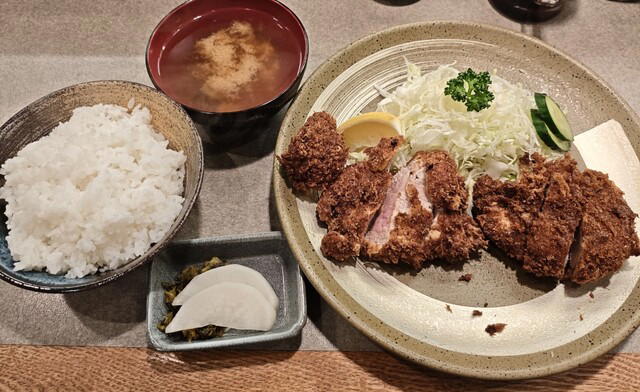
The menu
What to order
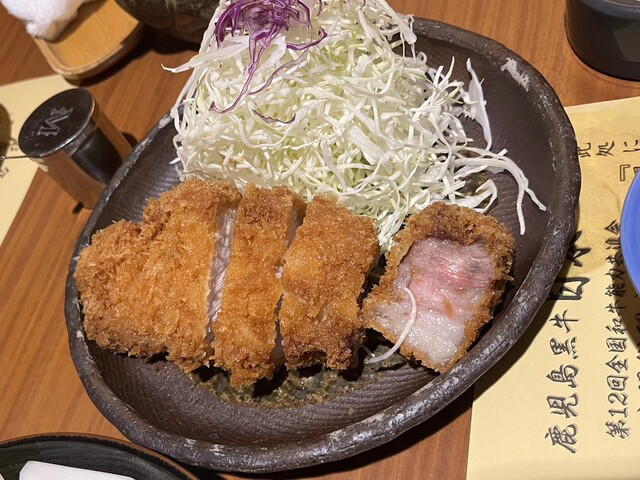
- Kurobuta Pork Tonkatsu
- Black Tonkatsu (Kurobuta)
Basement restaurants in Japanese cities often ask for a quick recalibration: the street noise drops, the room tightens, and the meal becomes less about spectacle than execution. In Kagoshima, that setting matters. The prefecture’s food identity is tied closely to pork, shochu, charcoal, rice, and practical lunch-counter rhythms, so tonkatsu here carries a different charge than it does in districts where the cutlet is just another comfort-food option. Aji no Tonkatsu Maruichi sits inside that everyday-specialist category: a pork-cutlet room with counter seating, tatami space, and enough national recognition to draw attention beyond Yamanokuchicho.
Kagoshima pork culture, translated through tonkatsu
Tonkatsu is a simple form only on paper. Breaded pork, shredded cabbage, rice, and sauce can be served cheaply across Japan, but serious tonkatsu depends on decisions that are easy to miss: cut thickness, fat management, breading weight, oil control, resting time, and how much sweetness the sauce is allowed to bring. Kagoshima adds a further layer because pork is not an imported luxury signal here; it is part of the prefecture’s culinary grammar. The region’s association with kurobuta gives local pork dishes a stronger sense of place than the same format might have in a generic station-mall dining floor.
That is the useful way to read Maruichi’s reputation. Its presence on Tabelog’s Tonkatsu 100 list in 2017, 2018, 2024, and 2026 is not a chef-myth credential, and there is no need to turn it into one. The more interesting point is category discipline. Tonkatsu specialists are judged against other cutlet specialists, not against kaiseki rooms, sushi counters, or wagyu theatrics. Recognition in that field signals consistency in a narrow craft: pork, fry, rice, pace. For travelers building a Kagoshima eating itinerary, that makes the restaurant a counterweight to chicken grills, market seafood, and black-pork shabu-shabu.
The comparison inside the city is instructive. Akadori Sumiyaki Daiyasu expresses Kagoshima through grilled chicken and a more evening-led spend, while Charcoal-grilled Fish & Clay Pot-cooked Rice Ochawan, Japanese Set Meal Diner works through fish, rice, and set-meal structure. Ichiba Shokudo Jounan ten points toward the market-dining side of the city, and Ichinii San Tenmonkan ten puts pork into a different service tradition. Tonkatsu occupies the middle: ingredient-led but informal, focused but not ceremonial.
A specialist room with practical local habits
The format is compact and low-friction by design. Counter seating suits solo diners and pairs who want the meal to move at the pace of the fryer; tatami seating gives the room a family and friends use-case rather than a narrow enthusiast-only mood. Non-smoking status also matters in a fry-focused restaurant, where oil aroma and room ventilation can shape the meal as much as the plate. Shochu appears naturally in this context, not as a pairing performance but as a Kagoshima drinking habit that belongs with pork and fried food.
Payment culture is another reminder that serious food in Japan does not always travel with luxury-service infrastructure. Credit cards and electronic money are not part of the setup, and parking is not part of the offer. Reservations are unavailable, which places the meal in the older Japanese specialist model: arrive, wait if necessary, eat decisively, move on. That system can be inconvenient, but it also protects the restaurant from becoming a reservation trophy. The reader’s decision is less about securing a rare seat than about choosing the right category of meal for the day.
Price is part of the argument. Tonkatsu at this level in Kagoshima sits closer to a regular meal than a splurge, which changes how it should be used in an itinerary. It works before or after tram-based sightseeing, between heavier regional meals, or as the pork-focused lunch when dinner is reserved for yakitori, seafood, or shochu bars. For broader city planning, Our full Kagoshima restaurants guide, Our full Kagoshima bars guide, Our full Kagoshima hotels guide, Our full Kagoshima wineries guide, and Our full Kagoshima experiences guide give the wider frame.
How to place it in a Japan eating itinerary
Japan rewards travelers who stop treating every meal as a grand occasion. A refined itinerary needs specialists at different registers: the fish counter, the noodle shop, the pork room, the bar, the set-meal diner. In that mix, Maruichi is not trying to replace a formal dinner. It gives Kagoshima’s pork reputation a direct, repeatable form, backed by a category-specific award history and a format that has little interest in theatrics.
That restraint is the appeal. The city already offers higher-spend dining routes, including beef and multi-course pork formats, but tonkatsu’s value is precision under constraint. The cutlet has to carry the meal without a long menu narrative. For travelers comparing regional Japanese dining styles, that makes Kagoshima a useful stop alongside broader references such as -Grilled beef Sukiyaki- KAMAKURA TANUKIAN 鎌倉 たぬき庵 in Kamakura. 鮪と炭火焼き うお炭 秋葉原店 in Tokyo.cafe in Osaka.know in Kumamoto, (Shoku) Vietnam in Kawasaki, [Curry Senmon Ten] Maruyama Kyoju. in Sapporo, Jōdo Saké Bar in Los Angeles, and Onigiri Time in Pasadena.
The cleanest editorial read is this: Kagoshima’s pork culture deserves at least one meal where the ingredient is not buried under ceremony. Aji no Tonkatsu Maruichi provides that meal in a specialist format, with enough recognition to justify attention and enough everyday structure to keep the experience grounded.
Frequently asked questions
When can I go to Aji no Tonkatsu Maruichi?
Hours at Aji no Tonkatsu Maruichi: Mon: 11:30 AM–2 PM, 5:30–7:30 PM; Tue: 11:30 AM–2 PM, 5:30–7:30 PM; Wed: 11:30 AM–2 PM, 5:30–7:30 PM; Thu: 11:30 AM–2 PM, 5:30–7:30 PM; Fri: 11:30 AM–2 PM, 5:30–7:30 PM; Sat: 11:30 AM–2 PM; Sun: Closed.
What price level is Aji no Tonkatsu Maruichi?
Pricing at Aji no Tonkatsu Maruichi is listed as JPY 1,000 - JPY 1,999 JPY 1,000 - JPY 1,999.
What's Aji no Tonkatsu Maruichi's location?
Aji no Tonkatsu Maruichi is located in Kagoshima.
What's Aji no Tonkatsu Maruichi best at?
Its strongest credential is its repeated selection for Tabelog Tonkatsu "Tabelog 100," including 2026, 2024, 2018, and 2017. In practical terms, it is a Kagoshima tonkatsu specialist with counter seating, a tatami room, and pricing in the JPY 1,000–1,999 range.
Comparison Snapshot
Nearby venues at a similar price tier for orientation.
| Venue | Cuisine | Price | Awards | Notes |
|---|---|---|---|---|
| Aji no Tonkatsu MaruichiThis venue — the venue you are viewing | Kagoshima Kurobuta Tonkatsu | $20–30 | Tabelog 100 #39 | Not listed |
| Kumasotei (熊襲亭) | Authentic Satsuma Shabu-Shabu | $20–30 | Not listed | 天文館 |
| Torisen Ippo | Traditional Yakitori & Chicken Izakaya | $30–50 | Tabelog 100 #14 | Tenmonkan |
| Yakitori Kouun | Yakitori | $30–50 | Tabelog 100 #80 | Hinohiguchi-cho |
| Unagi no Sueyoshi | Traditional Kagoshima charcoal-grilled eel (unagi) | $20–30 | Tabelog 100 #80 | Tenmonkan |
| Kawakyu (とんかつ川久) | Traditional Japanese Tonkatsu | $10–20 | Tabelog 100 #98 | 鹿児島中央 |
Recognition history
Dated appearances from independent guides and award organizations, with the underlying list record or original source where available.
Tabelog 100 #39 · No. 39
Tabelog · Tabelog 100 - Tonkatsu - 2026
Continue exploring
More in Kagoshima
Restaurants in Kagoshima
Browse all →
Hotels in Kagoshima
Browse all →
Wineries in Kagoshima
Browse all →
Details
- Classic
- Lively
- Cozy
- Solo
- Family
- Group Dining
- Casual Hangout
- After Work
- Standalone
- Chefs Counter
- Local Sourcing
- A La Carte
- Set Menu
- Counter Dining
- Beer
- Shochu
Current opening hours
- Monday
- 11:30 AM–2 PM, 5:30–7:30 PM
- Tuesday
- 11:30 AM–2 PM, 5:30–7:30 PM
- Wednesday
- 11:30 AM–2 PM, 5:30–7:30 PM
- Thursday
- 11:30 AM–2 PM, 5:30–7:30 PM
- Friday
- 11:30 AM–2 PM, 5:30–7:30 PM
- Saturday
- 11:30 AM–2 PM
- Sunday
- Closed
Hours can change for holidays and private events. Last verified .
Traditional, no-frills basement tonkatsu shop with counter and tatami seating, bright and bustling at peak times, focused on efficient service and hearty portions rather than design flourishes.