Our verdict
Douhua in Taiwan is rarely as simple as it looks, and A Eh Douhua in Chiayi makes the point quietly. The shop sits inside a city that has long treated tofu pudding as a daily ritual rather than a novelty, placing it in close company with other ingredient-led street staples that define Chiayi's food identity. If you are reading Chiayi's traditional snack culture, this is a reliable data point in that story.

Pearl is the En Primeur Club membership app, where members save venues, book tables and use the concierge.
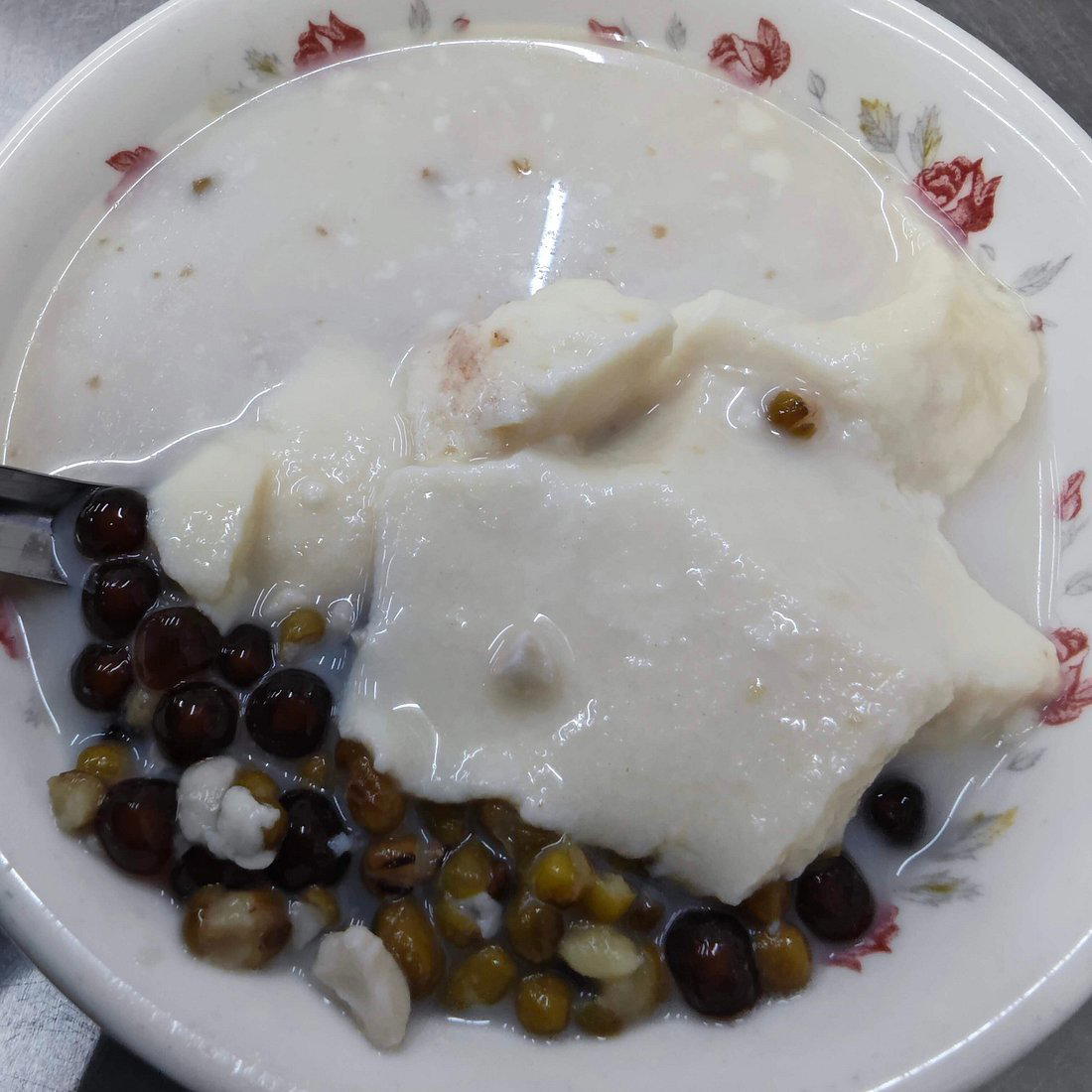
The menu
What to order
- Douhua (tofu pudding)
Where Tofu Pudding Becomes a Measure of a City
There is a particular quality to the light in Chiayi's older market districts in the morning: flat, useful, and indifferent to tourism. Stalls arrange themselves for the people who live here, not for the people passing through. Douhua shops, selling silken tofu pudding from vats kept warm on low heat, are part of that daily infrastructure. A Eh Douhua operates inside this tradition, in a city that has treated the dish as a staple for generations rather than a heritage attraction.
Understanding what A Eh Douhua represents requires understanding what douhua actually demands. The dish looks effortless: a bowl of soft tofu, a ladleful of sweetened syrup, perhaps some toppings. But the quality of the result depends almost entirely on the soy itself, the variety of soybean, how it was grown, and how recently it was processed. In Taiwan's older douhua culture, sourcing was a local matter by necessity. The leading shops worked with suppliers they knew, often within the same county. That geographic constraint, which once looked like a limitation, now reads as a quality signal.
Chiayi's Ingredient Logic and the Douhua Tradition
Chiayi sits in the agricultural heartland of southwestern Taiwan, within reach of some of the island's most productive farmland. The county produces rice, vegetables, and notably high-quality soybeans in its inland areas. For a dish as ingredient-dependent as douhua, this geography matters. Silken tofu's texture depends on protein content and coagulation technique; the flavour depends almost entirely on the quality of the base milk pressed from the beans. A shop drawing on local supply has a shorter chain between field and bowl than a chain operation sourcing centrally.
This is the context in which shops like A Eh Douhua earn their place. The competition in Chiayi's douhua category is not with fine-dining tofu preparations, as found at technically accomplished restaurants like JL Studio in Taichung or logy in Taipei, but with other long-running local shops that have built their reputations on consistency and sourcing proximity. Chiayi Pin An Soy Milk Tofu is one such peer, operating in the same tier and drawing a similar morning crowd. The differentiation between these shops is rarely dramatic; it lives in small details of texture and sweetness calibration.
Reading the Menu as an Argument for Simplicity
Taiwan's douhua menus have expanded considerably over the past decade. Modern shops in Taipei and Taichung now offer matcha bases, fruit toppings, and cold-brew variations aimed at a younger, more photographically oriented customer. Chiayi's traditional shops have been slower to follow that trend, and in many cases that conservatism is a deliberate positioning. A warm bowl of plain douhua with ginger syrup or peanut toppings is not a simplified version of something more complex, it is the form in its intended state.
The argument for restraint runs through Chiayi's broader snack identity. Lin Family Turkey Rice, one of the city's most discussed street dishes, wins on a similar logic: a small number of carefully sourced ingredients, prepared without embellishment. Granny's Grilled Corn operates on the same principle at the snack level. The city's food culture rewards depth of execution over breadth of menu, and douhua fits that preference precisely.
Within Chiayi's traditional snack category, A Eh Douhua occupies ground shared with a small number of shops that have maintained consistent local followings. It is not positioned against the modernist or fusion end of Taiwan's tofu culture, that conversation happens elsewhere, in cities with larger international dining audiences.
For visitors arriving from Taipei's more curated dining circuits, where restaurants like Atomix in New York City and Le Bernardin in New York City set a reference point for ingredient rigour at the fine-dining level, the lesson from Chiayi's douhua culture is that similar sourcing discipline exists at street-food scale. The price points are different; the underlying logic is not.
Chiayi also offers enough adjacent dining context to build a full day around the ingredient-sourcing theme. Can Xi Izakaya Restaurant and CASA represent different points in the city's dining range, while further afield, A Xia in Tainan and GEN in Kaohsiung extend the southwest Taiwan food trail in the direction of more formal dining. For a complete picture of Chiayi's restaurants across categories and price points, the full Chiayi restaurants guide is the practical starting point.
Planning Your Visit
Douhua shops in Taiwan's traditional market areas typically open in the morning and close when the day's batch sells out, which in well-regarded shops can happen before noon on weekends. The format does not require advance booking, this is counter service, paid at the point of ordering, at prices that reflect the street-food tier. The practical challenge is not reservation logistics but timing: arriving early avoids both queues and the risk of finding the kitchen finished for the day. Chiayi's central market area is walkable and accessible by high-speed rail from Taipei in under two hours, with the HSR station connected to the old city by shuttle bus.
For visitors building an itinerary around Taiwan's traditional food culture rather than its fine-dining credentials, the southwest corridor, Chiayi, Tainan, Kaohsiung, offers the densest concentration of long-running, ingredient-led street operations. A Eh Douhua sits at the accessible, low-cost end of that spectrum, which is precisely where the category is most honestly expressed.
Frequently asked questions
How does A Eh Douhua fit into Chiayi's broader food culture, and why do locals return regularly?
Chiayi sits at the centre of southwestern Taiwan's agricultural output, and douhua shops here have historically drawn on nearby soybean cultivation to maintain a consistent base product. A Eh Douhua occupies the traditional end of that spectrum in a city where the snack functions as a morning routine rather than an occasional treat. The format, walk-in service, market-adjacent location, and batch-limited daily production, reinforces a rhythm built around local demand rather than visitor traffic. That operational logic is what keeps a fixed local customer base returning on a near-daily basis.
What's the best thing to order at A Eh Douhua?
Douhua itself is the focus here, served in the traditional southwestern Taiwan style with a silken, lightly set texture that depends on the quality of the soybean base rather than supplementary flavourings. Chiayi's agricultural position in southwestern Taiwan means the raw ingredient sourcing is taken seriously by shops with long local followings. Toppings at traditional Chiayi douhua counters tend toward peanuts, red bean, or plain syrup rather than the matcha and fruit combinations now common in Taipei. Ordering the shop's standard configuration is the clearest way to read what the kitchen prioritises.
Do I need a reservation for A Eh Douhua?
Douhua shops in Taiwan's traditional market districts do not operate on reservation systems. A Eh Douhua follows the standard format for Chiayi's market-circuit stalls: walk-in only, with service running from morning until the day's batch sells out. At well-regarded shops in this category, that window can close by mid-morning or early afternoon. Arriving early is the practical approach.
What's the standout thing about A Eh Douhua?
A Eh Douhua holds consistent local standing within Chiayi's traditional snack category, a city where the standard for douhua is set by decades of daily production rather than by awards or media coverage. The shop's position in the market circuit gives it a regulars-first character that tourist-facing venues in larger cities rarely maintain. In a regional food culture where tofu pudding functions as a genuine daily staple, that kind of sustained local following is its own credential.
At-a-Glance Comparison
A quick peer list to put this venue’s basics in context.
| Venue | Cuisine | Price |
|---|---|---|
| A Eh DouhuaThis venue (the venue you are viewing) | Taiwanese Douhua Dessert Stall | $1–10 |
| CASA | Taiwanese Turkey Rice | Not listed |
| Can Xi Izakaya Restaurant | Chiayi Turkey Rice | $1–10 |
| 燒瓶子。大肆の鍋 嘉義店 | Taiwanese Hotpot | $10–20 |
| Granny’s Grilled Corn | Grilled Corn | Not listed |
Continue exploring
More in Chiayi
Restaurants in Chiayi
All restaurants in Chiayi →

Bars in Chiayi
Browse all →




Details
- Classic
- Cozy
- Casual Hangout
- Solo
- Standalone
- Counter Dining
- Vegetarian Friendly
- Vegan Options
- Gluten Free Options
A humble, no-frills street-stall atmosphere centered on a simple Taiwanese dessert experience.