On a quiet stretch of Guofeng Street in Zuoying District, 115港式燒臘 occupies the specific niche that Hong Kong-style roast meat shops have carved across Taiwan's southern cities: counter-forward, ingredient-driven, and indifferent to fanfare. The focus is on the craft of Cantonese siu mei, char siu, roast duck, and crispy pork, executed with the sourcing discipline that separates workmanlike roasteries from genuinely good ones.
Pearl is the En Primeur Club membership app — saves, bookings, and concierge access live there. Same editors, same standards.
- Address
- No. 25號, Guofeng St, Zuoying District, Kaohsiung City, Taiwan 813
- Phone
- +886 7 585 9115
- Website
- facebook.com
- Directions
- Get directions
 Saves & bookings on Pearl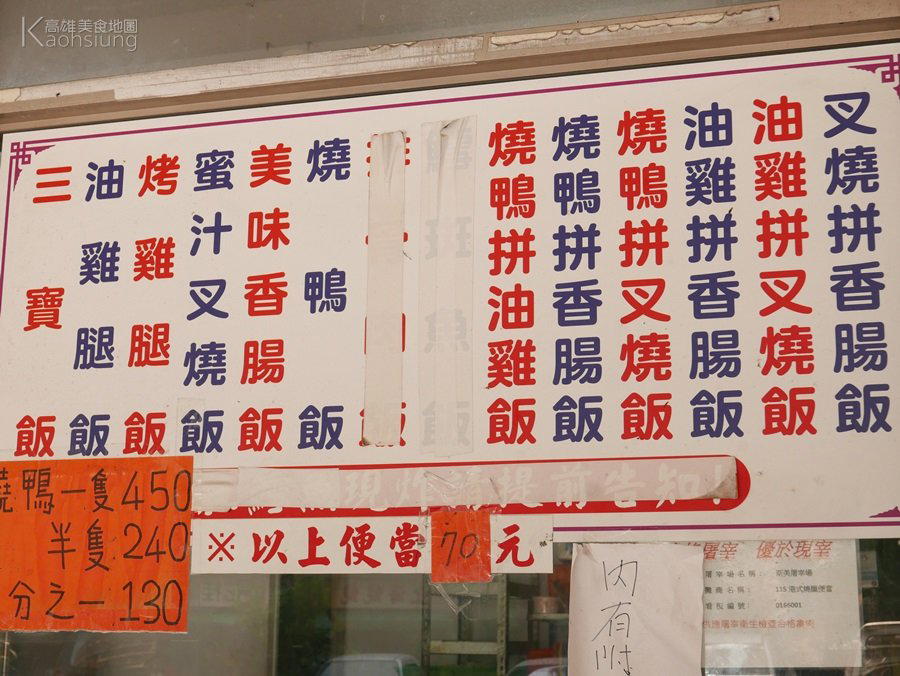
Siu Mei in the South: How Kaohsiung's Roastery Culture Differs from Taipei
Hong Kong-style roast meat, siu mei, the category that encompasses char siu, crispy pork belly, roast duck, and soy-poached chicken, arrived in Taiwan through several waves of migration and has since fractured into distinct regional interpretations. In Taipei, the genre skews toward glossy, tourist-adjacent shopfronts. In Kaohsiung and its surrounding districts, including Zuoying, the tradition holds closer to its utilitarian roots: open-fronted counters, hanging carcasses, and a transaction that happens in under two minutes. 115港式燒臘 on Guofeng Street operates inside that southern Taiwanese version of the form, where the proof is in the sourcing and the roasting rather than the presentation.
The Sourcing Logic Behind Cantonese Roasting
Siu mei is a discipline where ingredient quality is almost impossible to disguise. Unlike braised or stewed preparations that can compensate for lower-grade proteins through extended cooking time and sauce depth, the roasting process is reductive: heat, time, and the animal's own fat. A char siu cut from a commodity pork loin and one from a traditionally raised breed that carries more intramuscular fat will produce categorically different results under the same marinade and the same oven temperature. The fat renders differently, the caramelisation behaves differently, and the texture at the moment of slicing tells the whole story.
This is why sourcing conversations matter disproportionately in the siu mei category. The leading roasteries in Hong Kong and across the Cantonese diaspora, including those that have planted roots in Taiwan's southern cities, tend to maintain supplier relationships as a competitive differentiator. The variables a roast meat shop controls beyond sourcing (marinade ratios, roasting temperature, resting time) are real but secondary to what walks through the door as raw material.
Taiwan's domestic pork supply has its own geography. Producers in the central and southern regions, particularly those operating at smaller scale with slower-growing breeds, have supplied serious restaurants and specialist food businesses throughout Kaohsiung and Tainan for decades. For a roastery on Guofeng Street in Zuoying, proximity to that supply chain is a structural advantage that larger, centrally supplied operations in northern Taiwan don't automatically share.
The Atmosphere on Guofeng Street
Zuoying District carries a particular character within greater Kaohsiung. It functions partly as a commuter zone, the high-speed rail terminal anchors its southern edge, but Guofeng Street and the surrounding residential grid operate at a different pace, oriented toward the daily rhythms of the neighbourhood rather than transit traffic. A roast meat counter in this context serves a specific local function: it's where you collect lunch on the way back from the market, or where you solve the question of dinner with a half-duck and a container of rice without ceremony.
The physical register of 115港式燒臘 fits that context. Hong Kong-style roasteries are not designed for lingering. The counter, the hanging display, the quick exchange, these are the grammar of the format, and venues that try to inflate that grammar with ambient lighting and plated presentation tend to lose the thread of what makes siu mei worth eating in the first place. The unadorned directness of Guofeng Street is the appropriate setting for this kind of cooking.
This positions 115港式燒臘 clearly outside the tier occupied by Taiwan's fine-dining Cantonese establishments. That separate conversation, about Cantonese cuisine at the $$$$ level, involves places like GEN in Kaohsiung or, further north, the Michelin-recognised work being done at JL Studio in Taichung and logy in Taipei. The roastery format answers a different question entirely, and the comparison that matters is within its own comparable set.
Where This Fits in Taiwan's Casual Eating Continuum
Taiwan's strength as a food destination is partly a function of how well it maintains quality across price tiers. The same intellectual seriousness about ingredients and technique that shows up at A Xia in Tainan or at Golden Formosa Taiwanese Cuisine in 士林 also surfaces, in a different register, at neighbourhood counters and roasteries that have been refining the same process for years without media attention.
The siu mei category sits in an interesting position within that continuum. It's street-accessible in price and format, but the technical demands of the craft, particularly the management of the roasting chamber, the timing of the glaze applications on char siu, and the scoring and drying process for crispy pork, are not simple. Shops that get those details right over years of daily production earn a standing in their neighbourhoods that operates independently of awards or editorial coverage. The comparison isn't with a tasting menu restaurant; it's with every other roastery in the district, assessed by the daily vote of the lunch crowd.
Other parts of Taiwan's specialist food culture operate on similar logic. Ah Zhen Rou Bao in Lukang and Chenggong Douhua in Chenggong occupy comparable positions in their respective categories: single-focus, neighbourhood-embedded, evaluated by the standards of the craft rather than by the metrics used to assess multi-course restaurants.
Planning Your Visit
Guofeng Street in Zuoying District is accessible from the Zuoying HSR and MRT interchange, making it reachable without a car from other parts of Kaohsiung. The roastery format typically operates on lunch and early-dinner cycles aligned with peak demand; arriving at the margins of the lunch rush, rather than at its height, generally means a shorter wait and fresher cuts that haven't been sitting under the lamps. Its regular hours run Monday through Friday and Sunday from 10 AM to 7:20 PM, with Saturday service from 10 AM to 1:30 PM.
For visitors building a broader Kaohsiung eating itinerary, the roastery fits neatly as a casual anchor around which more planned meals can be arranged.
Comparison Snapshot
Comparable venues nearby, for context on price, style, and recognition.
| Venue | Cuisine | Price | Notes |
|---|---|---|---|
| 115港式燒臘This venue — the venue you are viewing | Hong Kong-style Roast Meats | $$ | Not listed |
| 天水玥秘境鍋物殿 | Zen Hot Pot with Sukiyaki | $$ | Zuoying |
| 香港波記茶餐廳 | Hong Kong-Style Cha Chaan Teng | $$ | 東區 |
| 京星港式飲茶二 | Hong Kong-style Dim Sum | $$ | Da_an |
| 葉桑生炒鴨肉羹 | Tainan Charcoal Grilled Eel Rice | Not listed | Tainan |
| 五花馬 水餃館 | Traditional Taiwanese Dumpling House | $$ | 霧峰區 |
At a Glance
- Casual Hangout
- Family
Current opening hours
- Monday
- 10 AM–7:20 PM
- Tuesday
- 10 AM–7:20 PM
- Wednesday
- 10 AM–7:20 PM
- Thursday
- 10 AM–7:20 PM
- Friday
- 10 AM–7:20 PM
- Saturday
- 10 AM–1:30 PM
- Sunday
- 10 AM–7:20 PM
Hours can change for holidays and private events. Last verified .
Casual and bustling atmosphere typical of a busy local roast meat shop.