鴨肉珍 serves Traditional Taiwanese Duck Rice in Kaohsiung with duck rice, sliced duck and mixed offal. Casual service, lively pace and a quick-bite format suit lunch or dinner plans.

Pearl is the En Primeur Club membership app — saves, bookings, and concierge access live there. Same editors, same standards.
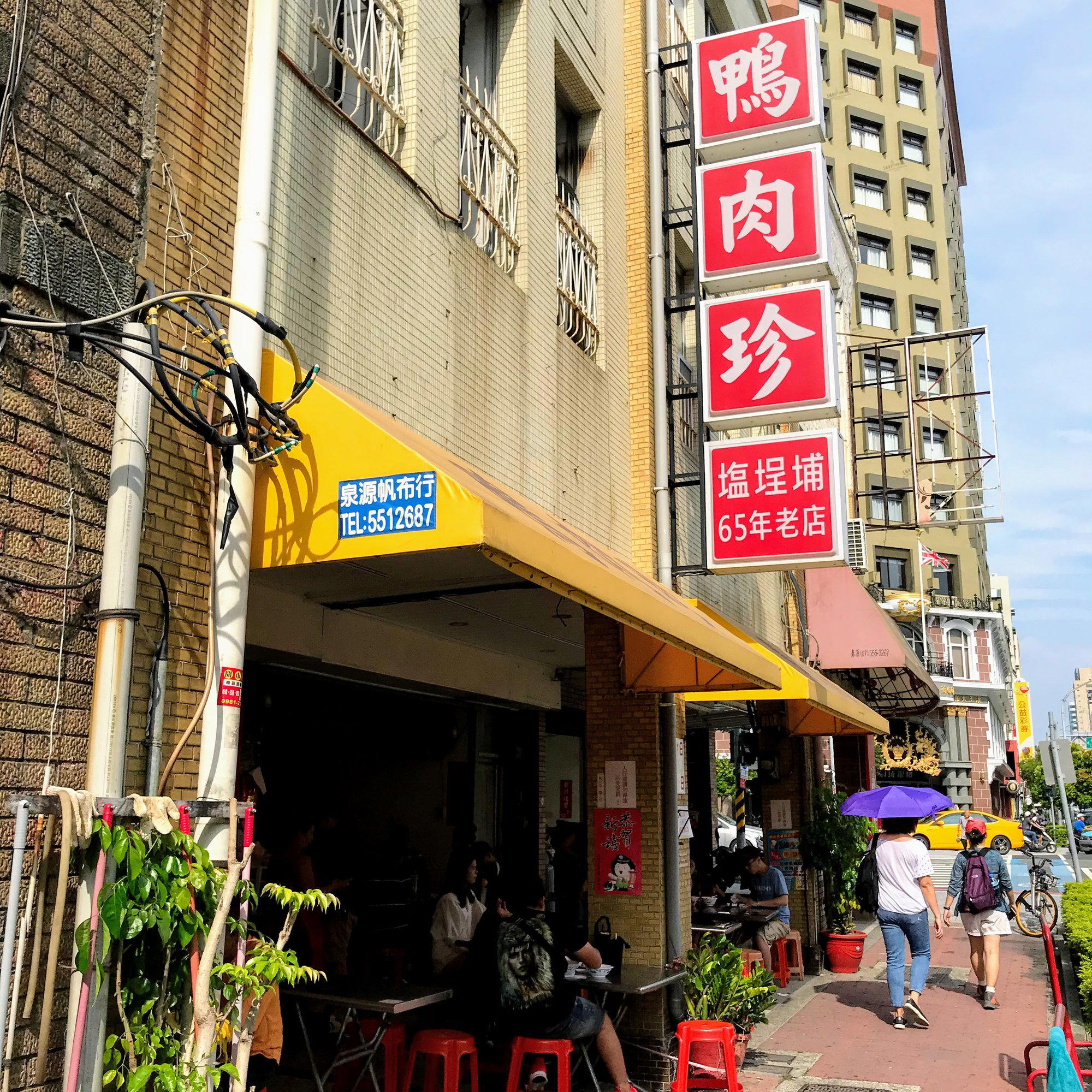
Salt District Duck, Decades On
鴨肉珍 is a traditional Taiwanese duck rice restaurant in Kaohsiung's Yancheng District, with a casual walk-in format and a price around US$5 per person. Yancheng District in Kaohsiung carries a particular kind of institutional memory. The neighbourhood, built around the old salt trading port, developed its own food character before the city's modern restaurant scene arrived, and that character runs on working-hour rhythms, cash transactions, and dishes that have not changed because nobody has asked them to. 鴨肉珍 (Duck Meat Zhen) sits on Wufu 4th Road in precisely this tradition: a street-address institution that long-time Kaohsiung residents cite when pressed to name a place that has endured on Wufu 4th Road.
Taiwan's southern cities have a distinct relationship with duck cookery. While Taipei's food culture drifts toward Japanese influence and Taichung's newer tables lean international (see JL Studio in Taichung for a reference point at the other end of that spectrum), Kaohsiung kept its port-district Minnan and Hakka flavour traditions running in parallel with whatever arrived later. Duck prepared in the southern style, typically braised low with soy, five spice, and preserved aromatics, belongs to that older stratum. It is the category of food that critics often recognize for value and consistency rather than fine-dining formality, because the format, the setting, and the price point operate on different logic from tasting-menu dining.
How the Neighbourhood Shaped the Kitchen
The evolution of a place like 鴨肉珍 is gradual. The change is quieter: the city has grown up around it. Kaohsiung now has tasting-menu counters (GEN (Cantonese), Sho (Japanese)), modern midrange tables (Haili (Modern Cuisine), Anchovy (European Contemporary)), and a growing roster of destinations that price against regional and international peers rather than the local street-level market. Against that backdrop, the duck shop on Wufu 4th Road has not changed its logic, which is itself a kind of positioning. It stays in the register of places like A Fung's Harmony Cuisine (Taiwanese), where the transaction is immediate, the setting functional, and the food is the entire point.
This matters for the traveller trying to read Kaohsiung's food map accurately. The same afternoon that someone might book a kaiseki counter for dinner might include a stop at a duck rice stall for lunch. Understanding that split is more useful than treating 鴨肉珍 as a curiosity or a detour from the serious dining. For Taiwan as a whole, the argument holds: the country's Michelin coverage has repeatedly acknowledged that particularly significant eating does not cluster exclusively at the leading price points. Comparable dynamics appear in Tainan (see A Xia in Tainan for the fine-dining end of that city's spectrum) and across the island's market towns.
Duck as a Category, Not a Dish
In southern Taiwanese cooking, duck rice is a specific form with its own internal hierarchy. The base is soy-braised duck sliced and served over white rice, typically accompanied by broth, pickled vegetables, and offal sides. The variables that separate one shop from another are the fat rendered into the braising liquid over years of use and the ratio of five spice. Shops that have been operating long enough accumulate a braising base with depth that a new kitchen cannot replicate quickly, which is one reason why longevity functions as a trust signal in this category rather than mere nostalgia. The same principle operates in comparable traditions elsewhere in Asia: the master stock in a Cantonese roast kitchen, the dashi base at a long-running Tokyo counter. Time in service is an ingredient.
The peer group is other long-running duck and braised meat specialists, some of which appear in local food press and guidebook coverage of the southern Taiwan street-food circuit. Across Taiwan's older food cultures, these operators tend to open early, close when the product sells out, and operate on cash or simple payment.
Placing 鴨肉珍 in Kaohsiung's Wider Picture
For a reader building a Kaohsiung itinerary, the question is what role a place like this plays relative to the city's other options. Kaohsiung's restaurant scene covers the breadth of that picture, from the tasting-menu tier down through midrange and casual formats. 鴨肉珍 fits into the lower end of the price register and the higher end of the provenance argument for traditional southern Taiwanese duck cookery. Those two things are not in tension.
Taiwan's most serious food travel increasingly asks the reader to hold both registers at once: the logy in Taipei bracket and the braised-duck-at-a-plastic-table bracket. The country's food identity is built on the proposition that both are worth taking seriously. Against a global reference point, this is not so different from the argument that a three-Michelin-star table in New York (Le Bernardin in New York City, for instance, or Atomix in New York City) does not make a pastrami counter irrelevant. The category is different, but the seriousness of intent is similar.
Across Taiwan's smaller city circuits, analogous specialists reward the same approach. The dumpling shops of Hsinchu, the beef noodle counters of Taichung, operators like Chenggong Douhua in Chenggong and GARDENh in Yonghe District in the Taipei basin, the braised pork rice shops of Tainan, all occupy versions of this same position: specific, local, durably relevant, operating outside the awards and reservation infrastructure that organises international travel decisions. 鴨肉珍 is Kaohsiung's entry in that category.
Planning Your Visit
鴨肉珍 is located at 258 Wufu 4th Road, 1st Floor, Yancheng District, Kaohsiung 805. The Yancheng area is accessible from central Kaohsiung and well within range of the Kaohsiung MRT network, with Yanchengpu Station on the Orange Line serving as a practical reference point for the neighbourhood. No booking is needed at 鴨肉珍, which aligns with its walk-in-friendly format.
Where the Accolades Land
Comparable venues nearby, for context on price, style, and recognition.
| Venue | Cuisine | Price | Notes |
|---|---|---|---|
| 鴨肉珍This venue — the venue you are viewing | Traditional Taiwanese Duck Rice | $ | Not listed |
| 曾式福建炒麵 | Fujian Stir-Fried Noodles | $ | Zuoying |
| 三餐暖食-中興店 | Traditional Taiwanese Home Cooking | $$ | Kaohsiung |
| Niu Lao Da | Taiwanese Beef Hotpot | $$ | Qianjin District |
| 台南旺海鮮料理餐廳 | Seafood Hot Pot | Not listed | Kaohsiung |
| 前金肉燥飯 | Taiwanese | Not listed | Kaohsiung |
Continue exploring
More in Kaohsiung
Restaurants in Kaohsiung
Browse all →
Bars in Kaohsiung
Browse all →
At a Glance
- Classic
- Casual Hangout
- Family
- Standalone
Casual, bustling old-school eatery with constant crowds and lively atmosphere during peak hours.