Whichaway Camp
Whichaway Camp occupies one of the most remote corners of the planet, set against the ice fields of Antarctica's Schirmacher Oasis. The camp represents a small-footprint, specialist tier of polar accommodation where access, design, and environmental conditions dictate every aspect of the guest experience. For those considering deep polar travel, it sits alongside a handful of comparable operations worldwide.

Pearl is the En Primeur Club membership app, where members save venues, book tables and use the concierge.
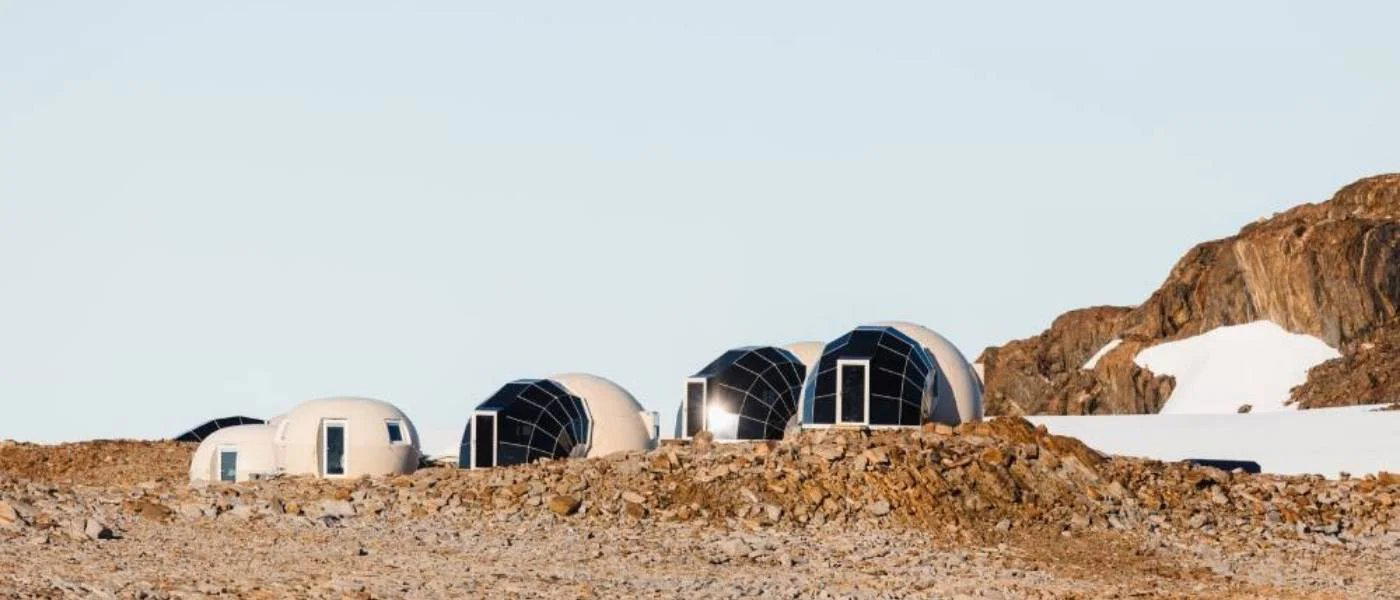
At the Edge of the Accessible World
Antarctica does not reward passive travelers. The continent imposes conditions that strip away the conventions of conventional hospitality, no road access, no urban infrastructure, no seasonal rhythm that resembles anywhere else on Earth. What exists here instead is a category of travel property defined entirely by its relationship to the environment: camps and field stations where design, logistics, and physical form are shaped by wind chill, ice sheet stability, and the mechanics of air access across one of the most inhospitable terrains on the planet. Whichaway Camp, positioned in the Schirmacher Oasis on the Antarctic continent, operates within this category, a small-scale, high-commitment property where the physical context is the primary architectural fact.
The Schirmacher Oasis itself is a detail worth pausing on. This narrow, ice-free strip of exposed rock and meltwater lakes runs approximately 17 kilometres along the Queen Maud Land coast, flanked on one side by the continental ice sheet and on the other by the Lazarev Ice Shelf. The exposed bedrock gives the area a geological character that distinguishes it from the vast white continuity of most Antarctic terrain. For a camp built here, the oasis is not a setting, it is a structural condition. The ground is real ground. The lakes are liquid for part of the year. The visual relationship between dark rock, pale ice, and open sky creates a quality of light that has no equivalent in temperate-zone travel.
Structure in the Southern Ice
Polar camp design has evolved considerably over the past two decades, splitting between two approaches. The first prioritises minimal intervention, tents, modular systems, and rapid-deployment infrastructure that leaves almost no trace. The second attempts to bring a degree of considered architecture and material comfort into the field, creating structures that hold their form against Antarctic conditions while still allowing guests to register where they are. Whichaway Camp sits closer to the latter model. The pod-based accommodation format that defines the camp's structure is a response to specific engineering constraints: Antarctic wind loads, temperature ranges that can fall well below -30°C, and the requirement that all materials arrive and depart by air.
The pods themselves reflect a design logic shaped by those constraints. Curved forms reduce wind resistance. refined platforms separate sleeping and living spaces from direct contact with the ice and rock below, which matters for both thermal insulation and structural stability across a melt-refreeze cycle. The result is a form vocabulary that reads as deliberately minimal, not because minimalism is fashionable, but because excess mass and complexity are genuinely impractical at this latitude. Comparable polar operations like White Desert in Halley and Dixie's Camp in South Pole face analogous design pressures, and each has resolved them differently, White Desert with its white fiberglass shell pods, Dixie's with a more utilitarian field-station aesthetic. Whichaway's approach represents one coherent answer to the same underlying problem.
The Architecture of Remoteness
In the broader context of design-led remote accommodation, the most interesting properties tend to be those where the physical form of the building is inseparable from its location. Amangiri in Canyon Point is an instructive comparison: its concrete structures are poured to follow the topography of the Utah desert, so the building reads as geological rather than imposed. Castello di Reschio in Lisciano Niccone takes an opposite approach, restoring a medieval structure until the architecture absorbs the landscape's history. Whichaway Camp operates on a different axis entirely, there is no historical precedent to draw on, no local vernacular, and no supply chain for conventional building materials. The design is a direct negotiation with physics and climate, which gives it a kind of structural honesty that more conventionally resourced properties rarely achieve.
That honesty extends to the camp's relationship with darkness and light. The Antarctic summer, during which the camp operates, brings continuous daylight for weeks at a stretch. The experience of reading, sleeping, or moving through the camp under a sun that does not set is a spatial condition that no amount of interior design can replicate or substitute. Curtains and sleep masks solve the practical problem, but the underlying fact, that the sun is circling rather than setting, alters the guest's sense of time in ways that are genuinely difficult to prepare for. This is not a comfort feature. It is a condition of the place.
Planning a Polar Departure
Access to Whichaway Camp is exclusively by private charter flight, typically routing through Cape Town or another southern-hemisphere hub before crossing the Southern Ocean. Weather windows on the continent are narrow and unpredictable, and departures can be delayed by days when conditions close. Any travel plan to this region should build in buffer time at the departure city, Cape Town, for instance, offers its own depth of high-end accommodation and dining for guests held in transit. The planning timeline for a trip of this nature typically extends to twelve months or more, and the guest-to-guide ratio at camps in this tier is kept low by design rather than by accident.
Hotel Plaza Athénée, La Réserve Paris, Badrutt's Palace Hotel in St. Moritz, Aman Venice, Bvlgari Hotel Tokyo, HOTEL THE MITSUI KYOTO, Mandarin Oriental Bangkok, and Mandarin Oriental Ritz, Madrid all sit within a recognisable luxury hospitality framework. Whichaway Camp sits outside that framework. The relevant comparison is with a small number of polar field camps that prioritise access to an extreme environment over the conventional metrics of hotel comfort. See our full Schirmacher Oasis guide for broader regional context.
Other properties worth considering for context on design-led remote travel include Hotel Esencia in Tulum, One&Only; Mandarina in Riviera Nayarit, Casa Maria Luigia in Modena, Hotel Bel-Air in Los Angeles, Hotel Du Cap-Eden-Roc in Cap d'Antibes, Hôtel de Paris Monte-Carlo, Hotel Sacher Wien in Vienna, The Fifth Avenue Hotel in New York City, and Cipriani, A Belmond Hotel, Venice, each representing a distinct version of what design-led, location-specific hospitality looks like when it works at its most considered.
| Venue | Cuisine | Price | Awards |
|---|---|---|---|
| Whichaway CampThis venue (the venue you are viewing) | This venue | Not listed | Not listed |
| White Desert | Not listed | $2,500+ | Virtuoso Luxury Hotel Partner |
Details
- Scenic
- Intimate
- Elegant
- Sophisticated
- Modern
- Romantic Getaway
- Panoramic View
- Private Dining
- Destination Spa
- Wi Fi
- Sauna
- Massage
- Bar
- Spa
- Mountain
Ethereal and otherworldly with floor-to-ceiling windows framing pristine glacial landscapes; minimalist modern interiors contrast with the raw polar wilderness; soft natural light during the Antarctic summer with the midnight sun creating an dreamlike atmosphere.