White Desert

Virtuoso Luxury Hotel Partner
White Desert operates at the outer edge of accessible travel: a seven-time World Travel Awards winner running two design-distinct eco-camps on the Antarctic interior, reached by private jet from Cape Town. With a maximum of 12 guests per camp and a founding mandate of responsible exploration, this is expedition travel stripped of compromise between comfort and environmental accountability.

Pearl is the En Primeur Club membership app, where members save venues, book tables and use the concierge.
Designing for the Edge of the World
There is a category of luxury travel where the accommodation is not merely a place to sleep between activities but is itself the primary argument for going. Antarctica's interior belongs to that category, and White Desert, operating since 2005 out of coordinates 71° 31' S, 8° 48' E, has spent two decades refining the case. The operation runs two camps, Whichaway and Echo, each with a cap of 12 guests, and each arriving by private aircraft from Cape Town. Seven World Travel Awards later, the structural premise remains the same: access the continent's interior by air, house guests in architecture that responds to rather than fights the environment, and keep the footprint as close to zero as logistics allow.
The design conversation in ultra-remote hospitality has historically defaulted to one of two positions: the colonial-expedition aesthetic of canvas, timber, and muted khaki, or the hermetically sealed resort that could be anywhere. White Desert's two camps occupy neither. They represent a third position, where architectural language is drawn from the environment itself, not as camouflage, but as dialogue.
Whichaway: Restraint as Philosophy
Whichaway Camp takes its formal cues from Scandinavian minimalism, which turns out to be a coherent choice for ice. The six Polar Pods, housing up to 12 guests across a landscape that has no visual noise whatsoever, use neutral tones and clean geometry that neither compete with nor romanticise the surrounding white. The material palette runs to wool and wood, both of which perform thermally and visually in ways that synthetic finishes cannot. The overall effect is not stark in the way the exterior environment is stark; it is calibrated. Warmth is delivered through texture rather than colour, and the interiors carry a density of considered detail that reads as residential rather than hospitality-standard.
This approach places Whichaway in a competitive tier with properties like Amangiri in Canyon Point, where architecture also functions as an argument about landscape rather than a retreat from it. The comparison is instructive: both properties use restraint as a design instrument and limit guest count to preserve the integrity of the experience. Whichaway's six pods against Amangiri's 34 suites indicates where it sits on the scale of intimacy, toward the operational minimum that still constitutes a viable camp.
Echo: Geodesic and Forward-Looking
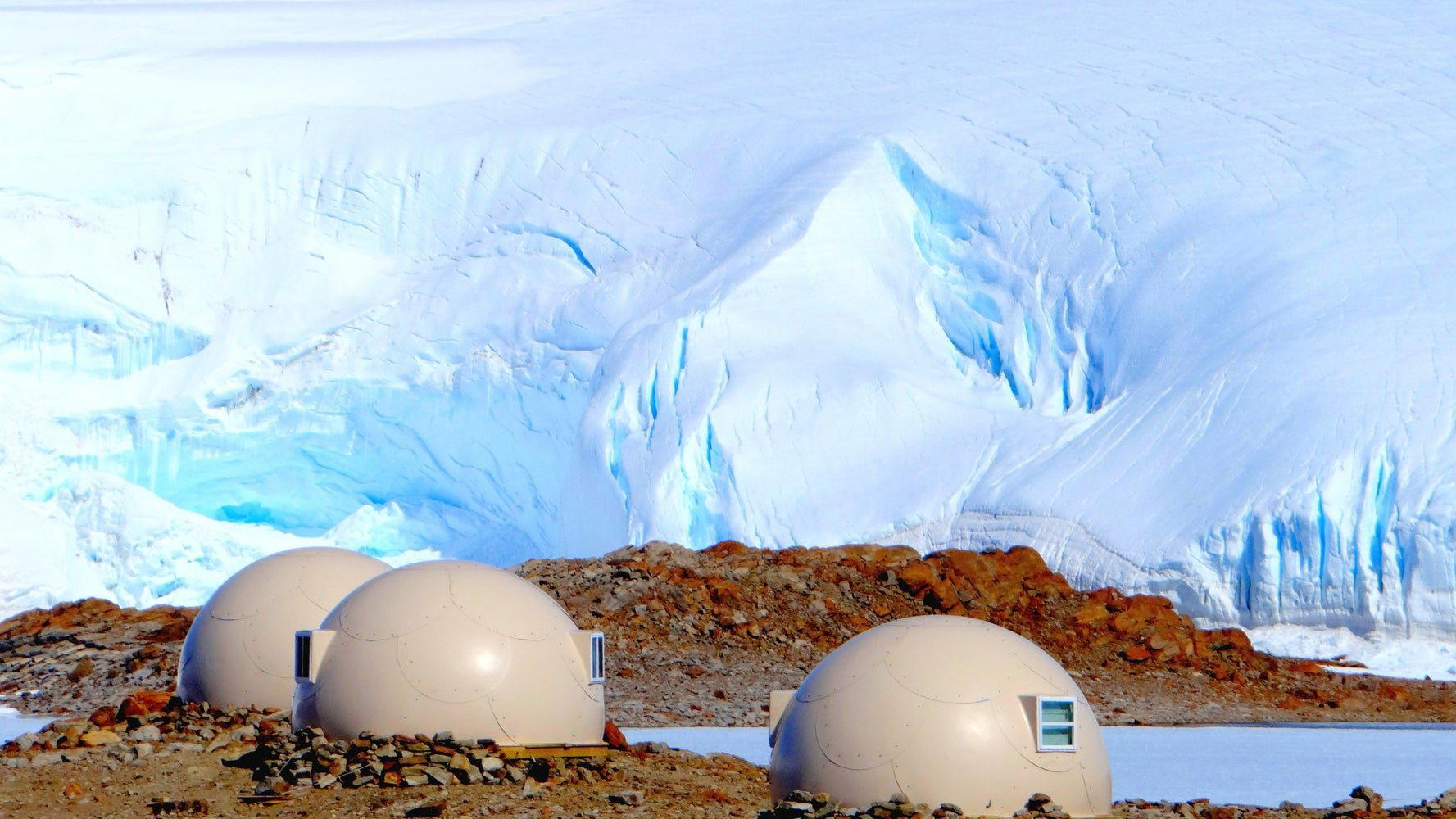
Echo Camp takes a different position, drawing from the visual language of space exploration rather than Nordic domesticity. The geodesic pod structures have an aerodynamic profile that reads as purpose-built for hostile environments, which they are, while the interior palette of crisp whites and metallic finishes references a future-facing aesthetic rather than a historical one. The reference point is not the Shackleton era but the ISS.
This is a meaningful distinction in the design of remote luxury. The space-exploration register has been arriving in high-end hospitality for the past decade, in furniture, material choices, and the broader influence of industrial design on interiors, but Echo applies it at a scale and in a context where it becomes coherent rather than decorative. In an environment where the horizon is uniformly white and the temperature is uniformly hostile, the argument that you are operating on a frontier planet is not metaphor. It is essentially accurate.
Echo is configured for exclusive use and accommodates up to 12 guests, making it the stronger option for corporate or private group bookings where the entire property needs to function as a single environment. For a comparison at the other end of the climate spectrum, properties like Hotel Esencia in Tulum or One&Only; Mandarina in Riviera Nayarit operate on similar principles of design-led seclusion, though in conditions that require entirely different architectural responses.
The Environmental Constraint as Design Brief
In most luxury hospitality, sustainability is a layer added to an existing operational model. At White Desert, the environmental constraints of Antarctica are the operational model. The continent is governed by the Antarctic Treaty System, which places strict limits on what can be built, left behind, or disturbed. Working within those limits is not optional, and the camps' minimal footprint is as much a function of legal compliance as it is of philosophy.
What that produces, architecturally, is structures that are designed to be removed. The Polar Pods at Whichaway and the geodesic structures at Echo are not permanent installations; they are deployable systems in an environment that does not permit permanence. This constraint has a design consequence that most luxury properties never encounter: every element must justify its presence and its weight, literally. The result is a kind of enforced rigour that distinguishes the aesthetic of both camps from properties where design choices are purely expressive.
The World Travel Award recognitions, seven of them, reflect an industry acknowledgment that this approach to responsible luxury in extreme environments is not just viable but replicable as a model. That track record also positions White Desert alongside properties in entirely different geographies that have built their identity around environmental accountability, including Castello di Reschio in Lisciano Niccone and Casa Maria Luigia in Modena, where the relationship between architecture and landscape is similarly load-bearing for the identity of the property.
What the Camps Offer Beyond the Architecture
The experience programme runs from emperor penguin visits and Geographic South Pole access to mountain climbing, ice tunnel exploration, and yoga, a range that deliberately accommodates both the physically ambitious and those who want to be present in the environment without the exertion. With 12 guests maximum per camp, the ratio of staff to guests and guide to participant is high enough to allow real customisation of daily pace and itinerary. Access to the South Pole itself is a significant logistical achievement; most Antarctic tourism operates along the Peninsula and does not penetrate the interior at all. White Desert's private aircraft access from Cape Town is what makes interior access viable at the luxury end of the market, and it places the operation in a category with almost no direct competitors. For context on the broader Antarctic accommodation spectrum, Dixie's Camp at the South Pole and Whichaway Camp in the Schirmacher Oasis represent adjacent reference points in the region.
Operationally, the season runs during the Antarctic summer, which in practical terms means November through January. Outside those months, the continent is not accessible for this type of travel. Planning accordingly is not optional, this is not a trip that can be booked on short notice, and the lead time required is substantial relative to most luxury travel. Those accustomed to last-minute access at properties like Aman New York or Cheval Blanc Paris should factor in a fundamentally different booking horizon. See our full Halley guide for broader regional context.
Recognition history
Dated appearances from independent guides and award organizations, with the underlying list record or original source where available.
Virtuoso Luxury Hotel Partner
Virtuoso
Details
- Scenic
- Quiet
- Intimate
- Elegant
- Sophisticated
- Romantic Getaway
- Wellness Retreat
- Destination Wedding
- Panoramic View
- Private Dining
- Destination Spa
- Historic Building
- Design Destination
- Waterfront
- Sauna
- Restaurant
- Spa
- Mountain
- Skyline
Serene and transformational with cozy living spaces filled with exploration memorabilia, dramatic views of ice formations and distant peaks, warm hospitality contrasting the stark polar environment, and contemplative silence broken only by natural sounds.