Dixie’s Camp
Dixie's Camp occupies one of the most extreme addresses on earth: the South Pole, where the architecture of shelter becomes indistinguishable from the architecture of survival. In a continent where every structure is a statement about endurance and design intent, the camp sits within a small tier of deep-field Antarctic operations that prioritise access over comfort, and in doing so, redefine what a premium experience can mean at the bottom of the world.

Pearl is the En Primeur Club membership app, where members save venues, book tables and use the concierge.
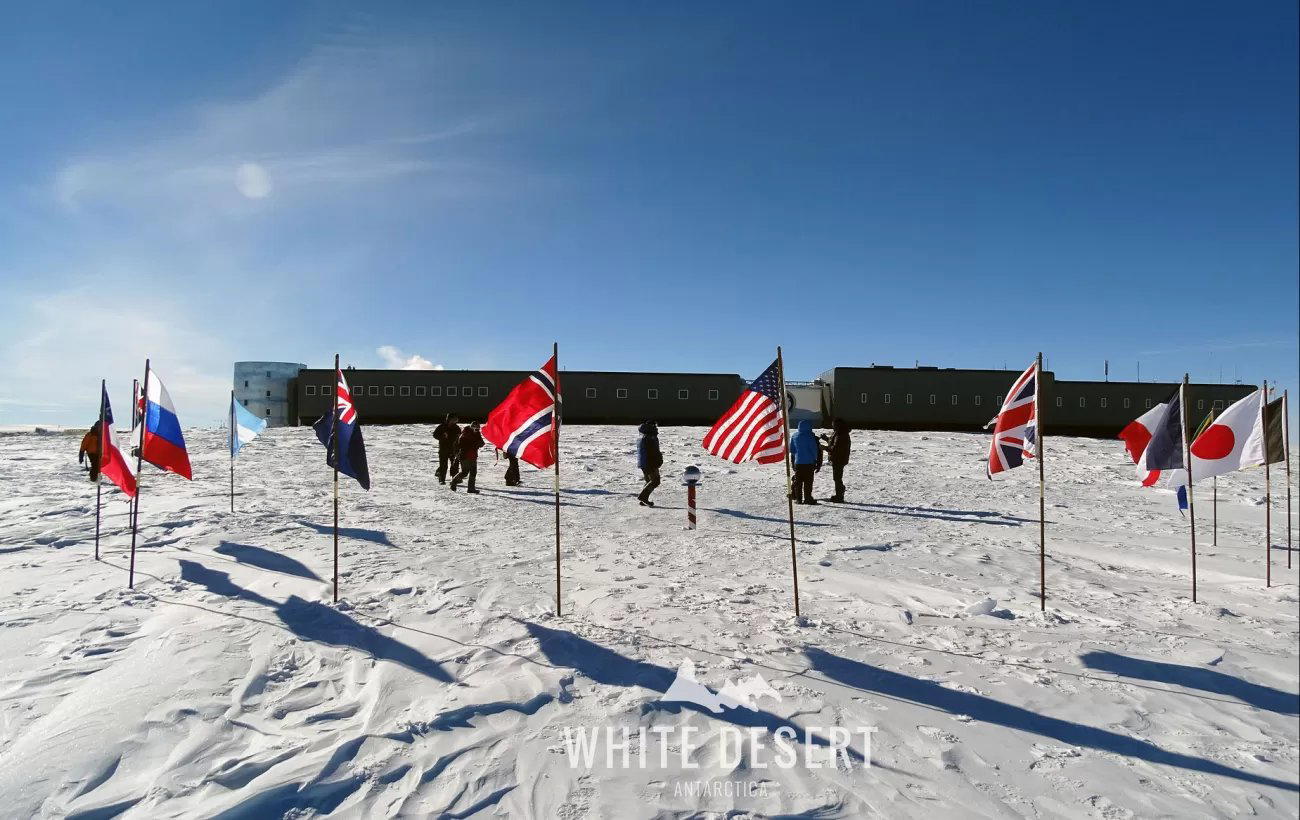
At the Edge of Everything
The South Pole is not a destination that rewards casual interest. Getting there requires either a government-sanctioned research program or a private expedition budget that runs well into six figures. Within that narrow access tier, accommodation splits between the utilitarian infrastructure of national science programs and a handful of private camps that approach the continent on different terms. Dixie's Camp sits within that private category, at a latitude where the sun either refuses to set or refuses to rise for months at a stretch, and where the built environment must solve problems that no temperate-zone architect has ever faced.
Antarctica's private camps have developed along two broad lines. The first prioritizes mobility and minimum footprint, using modular or inflatable structures that can be disassembled and removed without trace, in accordance with the Antarctic Treaty's environmental protocols. The second attempts a more considered spatial experience within those same environmental constraints, where the quality of the enclosure, the relationship between interior and the surrounding white, and the management of light become the primary design challenges. The design response to that environment is what separates one camp from another.
For context on how other operators have approached this spatial problem on the continent, Whichaway Camp in Schirmacher Oasis and White Desert in Halley represent the benchmarks that Antarctica's private camp sector is measured against. Both have built reputations on the quality of their physical environments as much as their access to the continent's geography. Dixie's Camp at the South Pole occupies the most symbolically charged coordinates on earth, which places particular pressure on whatever physical form the camp takes: the location does the conceptual work, and the architecture must live up to it.
The Architecture of Extreme Latitude
Designing for the South Pole means designing for a place where the ground is a two-mile-thick ice sheet, where temperatures can drop below minus forty Celsius, and where the concept of a view is both maximally simple and maximally demanding. There is nothing to see except ice and sky, which means every spatial decision, every window placement, every transition between inside and outside, carries more weight than it would in a landscape with competing visual information. The relationship between a shelter and its surroundings is absolute in a way that temperate architecture never has to confront.
Camps in this category tend to use refined platforms or sled-mounted structures to prevent snow accumulation from burying them over successive seasons, a problem that consumed the original Amundsen-Scott South Pole Station and has shaped every subsequent structure at this latitude. The thermal envelope is the primary engineering challenge, but the secondary challenge, the one that determines whether a camp feels designed or merely functional, is how it manages the Antarctic light. At polar summer, light is constant but low-angled, coming from every direction across the compass as the sun circles overhead. At polar night, there is no daylight at all. The camps that handle this well treat light as a material, not an afterthought.
The broader shift in premium Antarctic travel has been toward camps that justify their price point through the quality of the experience, not just the logistics of getting guests to a difficult location. That means the physical environment, the warmth and spatial intelligence of the interior, the way a sleeping space or dining area frames the outside, matters as a differentiator in the same way design matters at a property like Amangiri in Canyon Point, where the relationship between built form and extreme landscape is the central proposition. At the South Pole, the stakes of that relationship are simply higher.
Placing Dixie's Camp in the Antarctic Access Picture
Reaching the South Pole by private means involves either a ski traverse from the Antarctic coast, a journey that takes weeks and requires serious expedition preparation, or a fly-in operation using wheeled aircraft on blue-ice runways, typically departing from Union Glacier camp in the Heritage Range. The fly-in route is what most private camp guests use, and the logistics are managed through a small number of specialist operators who control the aircraft and the access windows during the austral summer, roughly November through January. Outside those months, private access to the South Pole is effectively impossible.
The seasonal constraint shapes everything about how South Pole camps operate. A six-to-eight week operational window means that the camp infrastructure must be deployable and recoverable within that period, and that guest scheduling is compressed into a narrow band. This is a meaningful difference from camps in the Antarctic Peninsula region, which can operate for a longer season due to milder conditions and easier ship or air access. For guests planning around Dixie's Camp, the operational window in the austral summer is the fixed variable that all other planning bends around. Those who travel to the continent's other extreme latitudes through operations like White Desert in Halley will recognize the same seasonal logic.
For those accustomed to booking through conventional luxury hotel channels, a useful comparison point is the advance planning required for properties like Hotel Du Cap-Eden-Roc in Cap d'Antibes or Badrutt's Palace Hotel in St. Moritz during peak season. The difference is that at the South Pole, the constraint is not demand but operational window. Spots are limited by aircraft capacity and camp infrastructure, not by room inventory in the conventional sense.
What the South Pole Asks of a Camp
The camps that have earned recognition in this category, from operations linked to Whichaway Camp to the White Desert network, have done so partly by solving the comfort problem at extreme latitude and partly by framing what the environment offers in terms a guest can actually receive. That second part is harder. The South Pole is a place of such visual and conceptual extremity that the camp's role is partly interpretive: helping guests understand what they are experiencing, why this specific point on earth has the history it does, and what it means to stand at a location where every direction is north.
The Amundsen and Scott expeditions reached the South Pole within weeks of each other in 1911 and 1912. The site has carried the weight of that history ever since, and any camp operating at these coordinates is, whether it addresses this explicitly or not, in conversation with that record. The design and programming choices a camp makes, what it foregrounds, what it leaves to the silence, reflect a position on how that history should be held.
For the full picture of what the South Pole region offers and how Dixie's Camp fits within the broader Antarctic private travel picture, see our full South Pole restaurants guide. Those planning a wider luxury circuit before or after an Antarctic expedition may also find reference points in properties built around extreme landscape relationships: Amangiri in Canyon Point, Hotel Esencia in Tulum, and One&Only Mandarina in Riviera Nayarit each demonstrate how the built environment can respond to a powerful natural setting without competing with it. The South Pole, of course, makes all of them look moderate by comparison.
Planning and Practical Context
Contact for Dixie's Camp and logistics for the South Pole operational window run through specialist Antarctic expedition operators rather than conventional hotel booking platforms. The austral summer season, November through January, is the only viable window for private camp guests. Travel from the nearest continental landmass involves multiple flight stages and a weather-dependent final leg on ski-equipped or wheeled aircraft. Those researching comparable camp-style properties elsewhere in Antarctica will find the access logic at Whichaway Camp in Schirmacher Oasis and White Desert in Halley instructive as preparation for what South Pole access involves.
A Quick Peer Check
| Venue | Price | Awards |
|---|---|---|
| Dixie’s CampThis venue (the venue you are viewing) | Not listed | Not listed |
| White Desert | $2,500+ | Virtuoso Luxury Hotel Partner |
Details
- Rustic
- Scenic
- Intimate
- Celebration
- Panoramic View
Heated lounge tent with cushy chairs, explorer motifs, fire, and shared hearty meals in a silent, solitary polar environment.