
The oldest family-run hotel in Norway, Walaker has stood beside the Sognefjord in the village of Solvorn for nearly four centuries. Its 22 rooms are spread across four buildings spanning the 1630s to the 1970s, each shaped by the era that produced it. A four-course set-menu dinner and breakfasts featuring house-grown jam anchor the food program, while the fjord, glaciers, and hiking trails define why guests come.
Pearl is the En Primeur Club membership app — saves, bookings, and concierge access live there. Same editors, same standards.
- Address
- Solvornvegen 324, Fv338 5, 6879 Solvorn
- Phone
- +47 57 68 20 80
- Website
- walaker.com
- Directions
- Get directions
 Saves & bookings on Pearl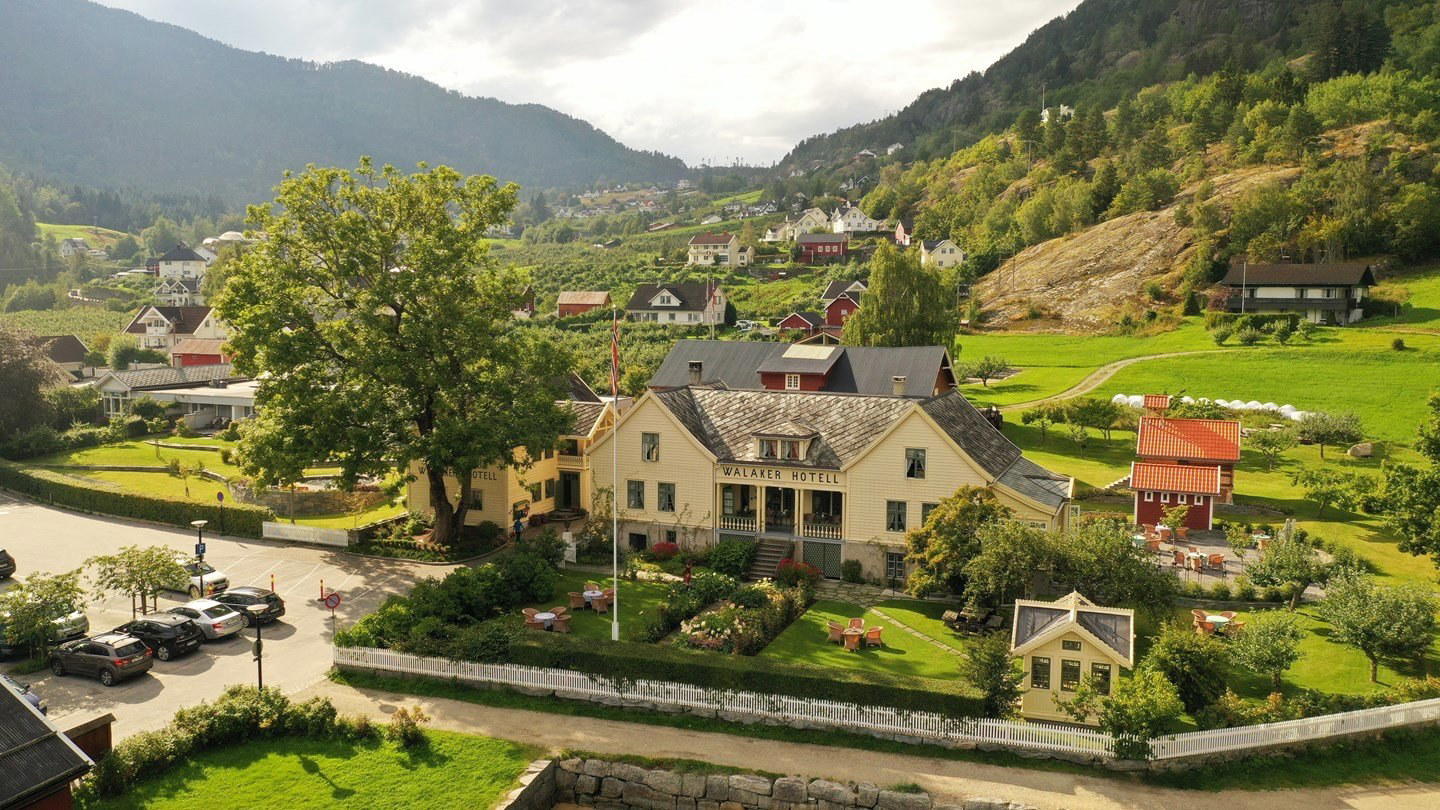
Four Centuries of Fjordside Hospitality
Arrive at Solvorn by road and the village announces itself gradually: a narrow ribbon of asphalt pressing between forested slopes and the Sognefjord, Norway’s longest and deepest, until a cluster of painted timber buildings appears at the water’s edge. Walaker Hotel occupies that threshold, positioned where the mountains meet the fjord with an abruptness that concentrates the eye. What arrives before any sense of the interior is the physical fact of the setting: water on one side, steep rock on the other, and a group of structures that have absorbed several centuries of Norwegian architectural history between them.
That history is the first thing worth understanding about this property. Norway’s hospitality offer ranges widely, from avant-garde design experiments like Juvet Landscape Hotel in Valldal to storied coastal properties like Hotel Union Øye in Norangsfjorden, but no other operating hotel in the country carries the same unbroken family lineage. Walaker has been in continuous family hands for well over three centuries, placing it in a category of European heritage hospitality where the institution itself has become the offering, as much as any individual room or meal.
Buildings as a Timeline
The editorial angle here is architectural, and it rewards attention. Rather than a single coherent structure, the property assembles four distinct buildings across different periods, and moving between them is the closest thing to a physical timeline of Norwegian vernacular building. Tingstova, the oldest structure on site, dates to the 1630s. The main inn followed in the 1930s. Later additions in the 1960s and 1970s brought a different sensibility entirely, shifting from antique timber proportions toward the spare, functional modernism that characterised Scandinavian building in that era.
The result is that the hotel’s 22 rooms are not a uniform product. They share enough visual DNA to feel coherent as a collection, but the rooms in Tingstova carry the compressed ceilings, dark wood tones, and accumulated texture of a seventeenth-century rural structure, while rooms in the mid-century additions read flatter and lighter. This architectural heterogeneity is not a design strategy in the contemporary sense; it is simply the physical record of a property that has grown across four centuries rather than been conceived in a single gesture. For guests who read spaces with that kind of attention, the layering is one of the more interesting things about the stay.
Comparable Norwegian properties that work with heritage structures, among them Storfjord Hotel in Glomset and Boen Gård in Kristiansand, tend to present a more curated or restored aesthetic. Walaker’s buildings feel less mediated than that, which is either its greatest appeal or a reason to look elsewhere, depending on what a guest is seeking. Those who want design precision might be better served by Opus XVI in Bergen or Amerikalinjen in Oslo. Those who want the sense of a building that has simply been lived in across generations will find that Walaker has few peers.
The Outdoor Environment as Primary Amenity
The hotel is candid about its priorities. Comfort and warmth are present throughout; the interiors lean into the coziness that rural Norwegian hospitality has always treated as non-negotiable. But neither the rooms nor the architecture are positioned as the main reason to be here. The Sognefjord and the terrain around Solvorn carry that weight. Kayaking directly from the fjordside, hiking into the surrounding mountains, reaching waterfalls and glaciers by day: these are the activities that structure a stay, and the hotel organises accordingly. The village of Solvorn is small, which concentrates activity outward into the landscape rather than inward toward any local amenity. For reference on how other Norwegian properties handle the tension between interior comfort and exterior access, Elva Hotel in Skulestadmo and Lilløy Lindenberg in Herdla operate with a similar logic. At the further extreme, Manshausen on Manshausen Island makes landscape access the explicit product proposition.
Dinner and Breakfast: Format Over Fuss
The restaurant at Walaker runs a four-course set-menu dinner, a format that suits the property’s context. In a village this small, a la carte breadth would be logistically difficult to sustain and would likely dilute the kitchen’s ability to source and execute at any consistent level. The set-menu approach is also, broadly, the format that Norwegian farm and fjordside hotels have settled on for good reason: it allows the kitchen to work with what’s available locally and seasonally without over-promising variety. The register is described as elegant and notably formal for the setting, which places it a step above the casual farmhouse style and closer to the kind of structured dinner service associated with heritage rural hotels elsewhere in Europe. Breakfast extends that care into the morning: house-made jam produced from fruit grown on the hotel’s own land is a specific, verifiable detail that signals the kitchen’s orientation toward the property’s immediate surroundings. You will find more celebrated restaurant programs at properties like Britannia Hotel in Trondheim, but Walaker’s dining is not trying to compete on that axis. It is part of a self-contained stay experience rather than a destination in itself. For those who want to explore the wider area’s food and drink options,
Planning a Stay
Solvorn sits within the Sognefjord region, reachable by ferry and road connections from Flåm and Sogndal. The village is not on a major transit corridor, so arrival requires deliberate planning; the remoteness is structural to the experience rather than incidental. The hotel carries 22 rooms across its four buildings, which keeps the property at a scale where the heritage character remains legible rather than being absorbed into conference-hotel infrastructure. Those building a broader Norwegian itinerary might pair a Solvorn stay with properties along the western coast or further north: Ålesund’s Hotel Brosundet, Eilert Smith Hotel in Stavanger, Aurora Lodge in Tromsø, or Sakrisøy Rorbuer in Reine for Lofoten. For those comparing Norwegian heritage properties against international benchmarks, the closest analogues in terms of multigenerational family ownership and architectural layering might be found at Castello di Reschio in Lisciano Niccone or Badrutt’s Palace Hotel in St. Moritz, though both operate at a different scale and price tier entirely. Closer in spirit, if not in geography, are Aman Venice and Vestlia Resort in Geilo for guests who prioritise a sense of place over brand infrastructure. Urban alternatives for those combining Norway’s cities with this kind of rural stay include The Well in Sofiemyr and Nusfjord Village and Resort in Ramberg.
Quick Comparison
Comparable venues nearby, for context on price, style, and recognition.
| Venue | Cuisine | Price | Awards | Notes |
|---|---|---|---|---|
| Walaker HotelThis venue — the venue you are viewing | Historic family-owned property blending traditional Norwegian coziness with modern comforts across multiple eras' buildings. | $$$ | Michelin 2 Key | Not listed |
| Hotel Continental | Grand classic hotel blending historic elegance with modern luxury | $$$$ | Michelin 1 Key | Vika |
| Britannia Hotel | Classic British style luxury hotel with historic charm renovated in 2019 | $$$$ | Michelin 1 Key | city center |
| Elva Hotel | Eco-friendly design retreat blending architecture with nature | $$$ | Michelin 1 Key | Skulestadmo |
| Juvet Landscape Hotel | Architectural landscape integration with freestanding glass cabins | $$$$ | Michelin 1 Key | Valldal |
| Storfjord Hotel | Secluded luxury boutique hotel comprising classic Norwegian log cabins with contemporary comfort and rustic elegance. | $$$$ | Michelin 2 Key | Glomset, Skodje Municipality |
Recognition history
Dated appearances from independent guides and award organizations, with the underlying list record or original source where available.
Michelin 2 Keys
Michelin
At a Glance
- Romantic
- Quiet
- Classic
- Scenic
- Cozy
- Elegant
- Rustic
- Romantic Getaway
- Anniversary
- Weekend Escape
- Waterfront
- Historic Building
- Panoramic View
- Terrace
- Wi Fi
- Restaurant
- Room Service
- Free Parking
- Garden
- Waterfront
- Mountain
- Garden
- Wi Fi
- Restaurant
- Room Service
- Free Parking
- Garden
Cozy and elegant with nostalgic furniture, fireplaces, and serene fjordside atmosphere praised for quiet relaxation.