
Nine glass-and-timber cabins set against the forests and rivers of Valldal, Juvet Landscape Hotel is the property that largely defined what a landscape hotel could be, each room treating the Norwegian wilderness as its primary wall. Rates are available on request, and reservations require direct contact through EP Club's team. Recognisable to many from its role in the film Ex Machina.
Pearl is the En Primeur Club membership app — saves, bookings, and concierge access live there. Same editors, same standards.
- Address
- Alstad 24, 6210 Valldal
- Phone
- +47 95 03 20 10
- Website
- juvet.com
- Directions
- Get directions
 Saves & bookings on Pearl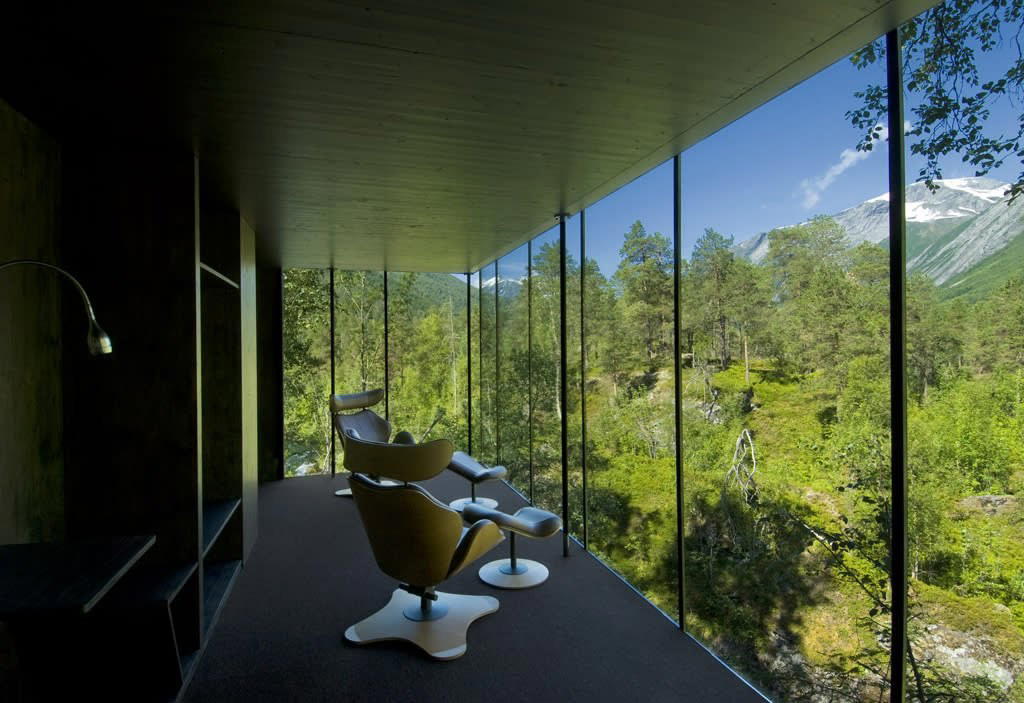
Glass, Timber, and the Norwegian Forest
Juvet Landscape Hotel is a 4-star hotel in Valldal, Norway, with 10 rooms and a 1-key distinction. The building does not compete with the landscape, it defers to it. Situated in Valldal, approximately ninety minutes inland from Ålesund along the fjord roads, the property sits in a forested river valley in Møre og Romsdal, one of the more geographically intense regions of western Norway. The approach by car, tracing the Norddalsfjord, gives little indication of what the property actually is until the cabins appear through the trees.
Valldal itself occupies a narrow strip of agricultural land between steep valley walls, better known domestically for its strawberry farms than for international hospitality. Juvet changed that framing. The property is a primary reason many international visitors arrive.
The Architecture of Absence
The design concept at Juvet is easiest to understand through what is missing rather than what is present. Each of the nine cabins is a timber-and-glass box, refined slightly from the ground on discrete supports, with one or two walls replaced entirely by floor-to-ceiling glazing. The framing is deliberate: whichever wall carries the glass faces the compositionally considered view, the bend of the Valldøla river, a stand of birch, a section of the valley slope. The cabin does not offer a view so much as it assigns one, and the interior furniture is positioned accordingly.
This kind of architecture, where the building's primary function is to curate a relationship between the occupant and a specific piece of terrain, has precedents in Japanese rural hospitality and in certain Scandinavian design traditions, but it remains rare at hotel scale. Most properties in this format, including some of Norway's more celebrated rural retreats such as Storfjord Hotel in Glomset and Hotel Union Øye in Norangsfjorden, balance landscape with heritage interiors or historical weight. Juvet strips that back. There is no local antique, no folkloric textile program, no gesture toward regional decorative tradition. The rooms are spare to the point of austerity, which is the correct choice: anything more would compete with the window.
The property became more widely known internationally after serving as a filming location for Alex Garland's 2014 film Ex Machina. For many visitors, that film provides their first encounter with what Juvet looks like. Seeing the actual space tends to confirm rather than diminish the impression.
Communal Dining and the Bath House
With 10 rooms, Juvet operates at a scale where communal dinner makes practical and social sense. The restaurant serves a single sitting. This model works here because the guest count is low enough to make shared dining feel like a gathering rather than an obligation.
The Bath House functions as the property's spa, with a carefully framed view of the river. This approach to wellness, where the environment does more work than the treatment menu, is increasingly common in Nordic hospitality but rarely executed with this degree of architectural commitment.
Where Juvet Sits in the Norwegian Hospitality Scene
Norway's premium rural hotel market has developed along several distinct lines. There are the fjord-facing grand hotels with historical depth, the fishing lodge conversions in the far north such as Manshausen on its island in Nordland, the village-scale resorts such as Nusfjord in the Lofoten archipelago, and the design-led small properties where architectural concept is the primary differentiator. Juvet belongs firmly in the last category, and within that category it remains among the more architecturally resolved examples in the country.
The 10-room scale places it in a category defined by intimacy rather than amenity breadth. Comparable properties in Norway, including Elva Hotel in Skulestadmo and Lilløy Lindenberg in Herdla, operate on similar low-capacity models where the quality of the experience depends on the setting and the design rather than the range of facilities. Internationally, the closest analogs in architectural philosophy include Amangiri in Canyon Point, where the building is also positioned as a frame for terrain, and certain properties in the Aman collection such as Aman Venice, which similarly subordinate hotel function to a pre-existing environmental or architectural condition. The comparison is not one of scale or price bracket but of design intent.
Urban Norway offers a different set of reference points. Amerikalinjen in Oslo and Opus XVI in Bergen represent the city-based end of Norwegian premium hospitality, where the building's character comes from adaptive reuse of significant architecture rather than from environmental positioning. Britannia Hotel in Trondheim adds historical pedigree to that urban cohort. Juvet is not competing with any of them; it is doing something categorically different.
Planning a Stay
Juvet is reached most naturally via Ålesund, which has domestic connections from Oslo and Bergen and some international service. The drive from Ålesund takes approximately ninety minutes, passing through Ørskog and following the fjord road inland toward Valldal. The road itself is part of the experience and requires reasonable comfort with Norwegian mountain driving conditions, particularly outside summer months.
Rates are available on request only, and the property has limited weekend availability, which means mid-week flexibility substantially improves booking prospects. Reservations are essential. The property has 10 rooms, so availability across any given period is genuinely constrained. Summer brings the fullest light and access to the surrounding trails; autumn delivers colour across the valley slopes; winter provides the starkest version of the glass-and-forest concept, with snow redefining the framing of every window.
For those building a broader Norwegian itinerary, Walaker Hotel in Solvorn on the Sognefjord offers a complementary fjord experience with stronger historical character, while Aurora Lodge in Tromso extends a trip northward for those chasing winter light phenomena. Hotel Brosundet in Ålesund makes a logical overnight before or after the Juvet stay, given the city's position as the primary arrival point for the region.
A Quick Peer Check
Comparable venues nearby, for context on price, style, and recognition.
| Venue | Cuisine | Price | Awards | Notes |
|---|---|---|---|---|
| Juvet Landscape HotelThis venue — the venue you are viewing | Architectural landscape integration with freestanding glass cabins | $$$$ | Michelin 1 Key | Not listed |
| Hotel Brosundet | Historic warehouse converted to modern boutique luxury | $$$$ | Michelin 1 Key | historic district |
| Eilert Smith Hotel | High-end boutique in restored Norwegian functionalist architecture with contemporary luxury. | $$$$ | Michelin 1 Key | Stavanger center |
| Britannia Hotel | Classic British style luxury hotel with historic charm renovated in 2019 | $$$$ | Michelin 1 Key | city center |
| Elva Hotel | Eco-friendly design retreat blending architecture with nature | $$$ | Michelin 1 Key | Skulestadmo |
| Hotel Continental | Grand classic hotel blending historic elegance with modern luxury | $$$$ | Michelin 1 Key | Vika |
Recognition history
Dated appearances from independent guides and award organizations, with the underlying list record or original source where available.
Michelin 1 Key
Michelin
Continue exploring
More in Valldal
Restaurants in Valldal
Browse all →
At a Glance
- Quiet
- Modern
- Scenic
- Minimalist
- Intimate
- Romantic Getaway
- Honeymoon
- Wellness Retreat
- Weekend Escape
- Panoramic View
- Design Destination
- Wi Fi
- Spa
- Sauna
- Pool
- Restaurant
- Mountain
- Waterfront
- Wi Fi
- Spa
- Sauna
- Pool
- Restaurant
Minimalist Scandi-noir interiors with dark tones and warm lighting focus attention on panoramic nature views through floor-to-ceiling glass, complemented by candlelit communal dining in a rustic barn.