


Housed in Tbilisi's former central post and telegraph office on Rustaveli Avenue, the 239-room Telegraph Hotel is a Leading Hotels of the World member that converts a Brutalist Soviet-era landmark into a design-led address with a rooftop bar, jazz club, and a food offering ranging from Thai street food to modern Georgian. The address sits at the cultural and commercial centre of the Georgian capital.
 Discover on Pearl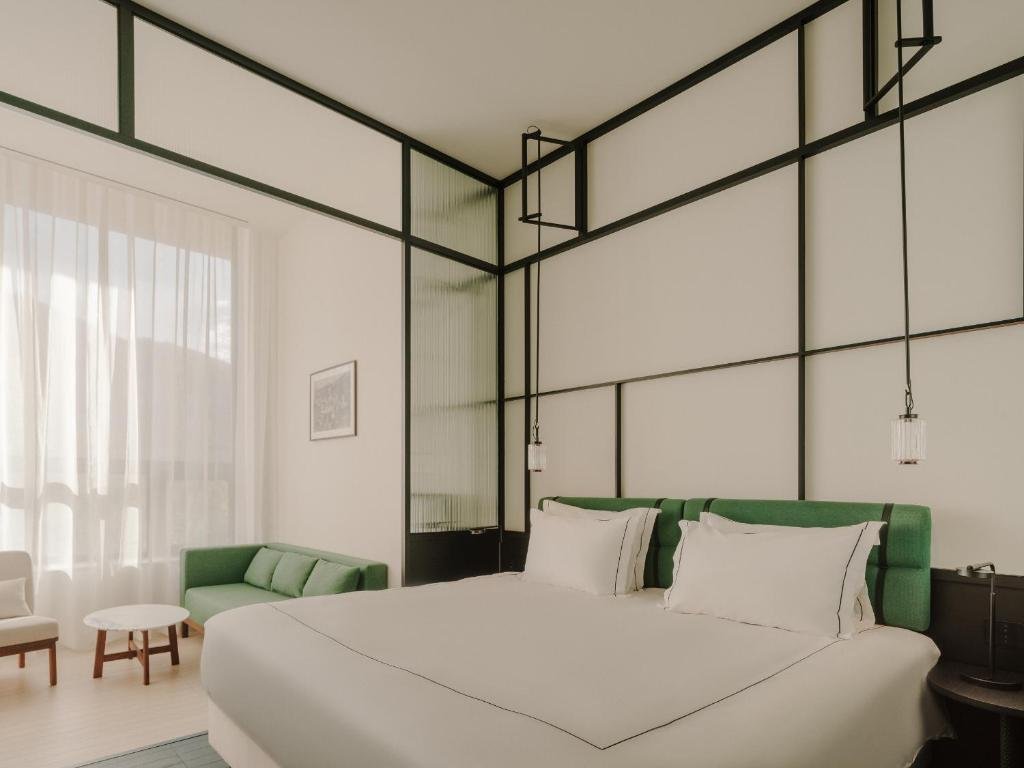
A Brutalist Landmark Repurposed at the Heart of Tbilisi
Rustaveli Avenue is the spine of Tbilisi's civic life, and No. 31 occupies a specific kind of weight on that street. The building that now operates as the Telegraph Hotel was the city's central post and telegraph office through much of the Soviet period, and its Brutalist frame carries the particular confidence of state architecture that expected permanence. Walking toward it, the scale announces itself before the signage does. The proportions are institutional, the materials are uncompromising, and the conversion — rather than softening those qualities — has worked with them. The original architecture is largely intact; the hotel's design layers sit within it rather than over it.
This approach to heritage conversion reflects a broader pattern in Tbilisi's hospitality development over the past decade. The city has produced a cohort of design-led hotels that take Soviet or pre-Soviet buildings seriously as physical objects rather than erasing them in favour of generic luxury finishes. Stamba Hotel works through a repurposed Soviet printing house on Kostava Street; Rooms Hotel Tbilisi occupies a mid-century building with a different but comparable sense of material honesty. The Telegraph sits in that cohort, though its address on Rustaveli gives it a specific positional logic that the others do not share.
The shortlist, unlocked.
Hard-to-book tables, cellar releases, and concierge-planned trips.
Get Exclusive Access →What the Address on Rustaveli Actually Provides
Rustaveli Avenue connects the National Parliament with the city's main cultural institutions, including the Rustaveli National Theatre, the Georgian National Museum, and the opera house. The 239-room Telegraph Hotel at No. 31 is within a few minutes' walk of each. For a traveller who wants to read Tbilisi's civic and cultural layer without relying on taxis, the address functions as a base from which much of the centre is accessible on foot. The old town of Abanotubani , with its sulphur bath houses and Metekhi Church cliff , is reachable in fifteen to twenty minutes depending on pace and route.
That kind of centrality is not universal among Tbilisi's design hotels. The Blue Fox Hotel occupies a different positioning in the city's accommodation map. The Telegraph's specific value is the immediacy it offers to the institutional Tbilisi that most first-time visitors want to engage with, combined with the proximity to the Vake and Vera neighbourhoods where the city's contemporary food and bar scene is concentrated. Our full Tbilisi restaurants guide maps that scene in detail; most of it is within a short ride or extended walk from Rustaveli.
The Building as the Experience
Tbilisi's design hotel market has split between properties that lead with their building's history and those that treat their location primarily as a backdrop. The Telegraph belongs firmly to the first category. The Brutalist structure is the narrative; the 239 rooms, the rooftop bar, and the jazz club below street level all operate as programming within a building that was already doing something before hospitality arrived. That distinction matters when choosing between this and a purpose-built or thoroughly renovated alternative.
The room count , 239 , places the Telegraph in the larger end of Tbilisi's design-led hotel spectrum. Rooms are described as understated and comfortable rather than sensory showcases, which is consistent with a property where the building and its communal spaces carry the experiential weight. The rooftop bar provides an aerial read of the city's skyline from one of its most central points, which is a different proposition from the garden or courtyard experiences that some of Tbilisi's smaller properties offer.
The jazz club operates on a separate register. Subterranean venue programming within a heritage hotel is a format with precedent in European cities, and the Telegraph uses its basement in a way that suits the building's original institutional gravity. Whether the programming is consistent with what cultural insiders consider serious jazz, or functions more as atmosphere, is a distinction worth investigating closer to a stay.
The Food Offer: Range Over Specialism
Georgian hotel dining has historically defaulted to a narrow interpretation of local cuisine, and the Telegraph's approach reads as a deliberate departure from that convention. The food offering runs from Thai street food formats to modern Georgian, which is a wider register than most Tbilisi hotels attempt within one property. For a city that now has genuine depth in its independent restaurant scene , covered in detail in our Tbilisi restaurants guide , a hotel with serious standalone dining is no longer the default requirement it might be in a less developed food city.
The range suggests the hotel is positioning its food and beverage operation as destination programming for non-guests as well as internal convenience for residents. That is a different commercial logic from a hotel that treats dining as amenity. Whether the execution matches the ambition is venue-specific information that warrants verification at time of booking, but the format signals an intention to be part of Tbilisi's broader food and cultural conversation rather than separate from it.
Peer Context and Positioning
As a Leading Hotels of the World member, the Telegraph sits within a global collection that emphasises independent properties with architectural or cultural distinction over brand-driven consistency. That membership signals a peer set , properties like Casa Maria Luigia in Modena, Castello di Reschio in Lisciano Niccone, or Badrutt's Palace Hotel in St. Moritz , that have in common an identity built on the specificity of the building and place rather than brand standards. For the traveller, LHW membership is a reasonable proxy for a certain quality threshold, even if the properties within the collection vary considerably in scale and approach.
Within Tbilisi specifically, the Telegraph competes with Stamba and Rooms Hotel Tbilisi for the design-conscious traveller who wants a property with cultural positioning. Stamba runs a tighter, more curated operation on Kostava Street and has positioned itself as a creative-industry hub with stronger bar and dining credentials in some critical assessments. Rooms operates with a comparable design sensibility and has been part of the city's hospitality conversation for longer. The Telegraph's differentiator is scale , 239 rooms gives it service infrastructure and event capability the others do not match , and the Rustaveli address, which none of its direct competitors share.
For those travelling beyond Tbilisi into the wine regions of Kakheti, Lopota Lake Resort and Spa in Napareuli, Tsinandali Estate, and Vazisubani Estate in Gurjaani Municipality represent the natural continuation of a Georgian itinerary. Our Tbilisi wineries guide provides context for the natural wine culture that has become one of the city's most discussed exports.
Planning a Stay
Rates from approximately $258 per night place the Telegraph in the upper-mid tier for Tbilisi, below the leading end of the city's luxury market but above the converted guesthouse sector that defines much of the old town accommodation offer. At 239 rooms, availability is less constrained than at smaller design properties, but the hotel's central location and cultural programming mean it sees demand from non-leisure segments including press, cultural events, and institutional visitors connected to the Parliament and National Theatre nearby. Booking a few weeks in advance for standard periods is advisable; the shoulder seasons in spring and autumn, when Tbilisi's climate is most amenable, will see tighter availability.
The hotel's position on Rustaveli places it close to the city's main metro line, reducing dependence on taxis for airport transfers and cross-city movement. Tbilisi International Airport is approximately 18 kilometres from the city centre; the metro connects from a station within short walking distance of the hotel. For broader itinerary planning in Tbilisi, our full Tbilisi hotels guide, bars guide, and experiences guide map the city's offer across categories.
Frequently Asked Questions
- What is the defining thing about The Telegraph Hotel?
- The building. The hotel occupies Tbilisi's former central post and telegraph office on Rustaveli Avenue, and the Brutalist Soviet-era architecture is intact rather than erased. The Rustaveli address also places it at the centre of the city's civic, cultural, and commercial life in a way no comparable design hotel in Tbilisi can match. As a Leading Hotels of the World member, it sits within a global collection that prioritises architectural and cultural specificity, and at rates from around $258 per night it is positioned accordingly.
- What is the leading room type at The Telegraph Hotel?
- The hotel's 239 rooms are described as understated and comfortable, with the experiential emphasis sitting in communal spaces rather than individual rooms. Given the building's scale and heritage status, upper-floor rooms are likely to offer views that reward the address more fully, but specific room-type data is not publicly detailed. Consulting the hotel directly about floor and aspect at the time of booking is the practical approach, particularly if the Rustaveli streetscape or rooftop-level perspective matters to your stay.
- Do I need a reservation at The Telegraph Hotel?
- For the hotel itself, advance booking is advisable, particularly in spring and autumn when Tbilisi sees its heaviest visitor traffic. The 239-room scale means the hotel is less likely to sell out at short notice than Tbilisi's smaller design properties, but the Rustaveli location attracts demand from cultural and institutional visitors as well as leisure travellers. For the rooftop bar and jazz club, availability may depend on event programming; checking ahead is sensible if those spaces are part of your plan.
- Does The Telegraph Hotel's food offer reflect Georgian cuisine or is it primarily international?
- The Telegraph's dining spans modern Georgian and international formats including Thai street food, which is an unusually broad register for a Tbilisi hotel. This positions the food and beverage operation as destination programming rather than purely in-house convenience, though the depth and quality of each format warrants verification at the time of your visit. For independent Georgian dining in the city, our full Tbilisi restaurants guide covers the options beyond the hotel.
A Tight Comparison
A compact peer snapshot based on similar venues we track.
| Venue | Notes | Price |
|---|---|---|
| The Telegraph Hotel | This venue | |
| Rooms Hotel Tbilisi | ||
| Stamba Hotel | ||
| The Blue Fox Hotel |
Preferential Rates?
Our members enjoy concierge-led booking support and priority upgrades at the world's finest hotels.
Get Exclusive AccessThe shortlist, unlocked.
Hard-to-book tables, cellar releases, and concierge-planned trips.
Get Exclusive Access →