The Ritz-Carlton, St. Thomas


After a $100 million post-hurricane rebuild, The Ritz-Carlton, St. Thomas returned with a redesigned interior that trades tired tropicalia for a modern beach-chic aesthetic across 180 ocean-view rooms and suites. Four restaurants, a 55-foot catamaran, and direct beach access make it one of the more self-contained resorts in the U.S. Virgin Islands, sitting within the Marriott International portfolio at the upper end of the St. Thomas market.
 Discover on Pearl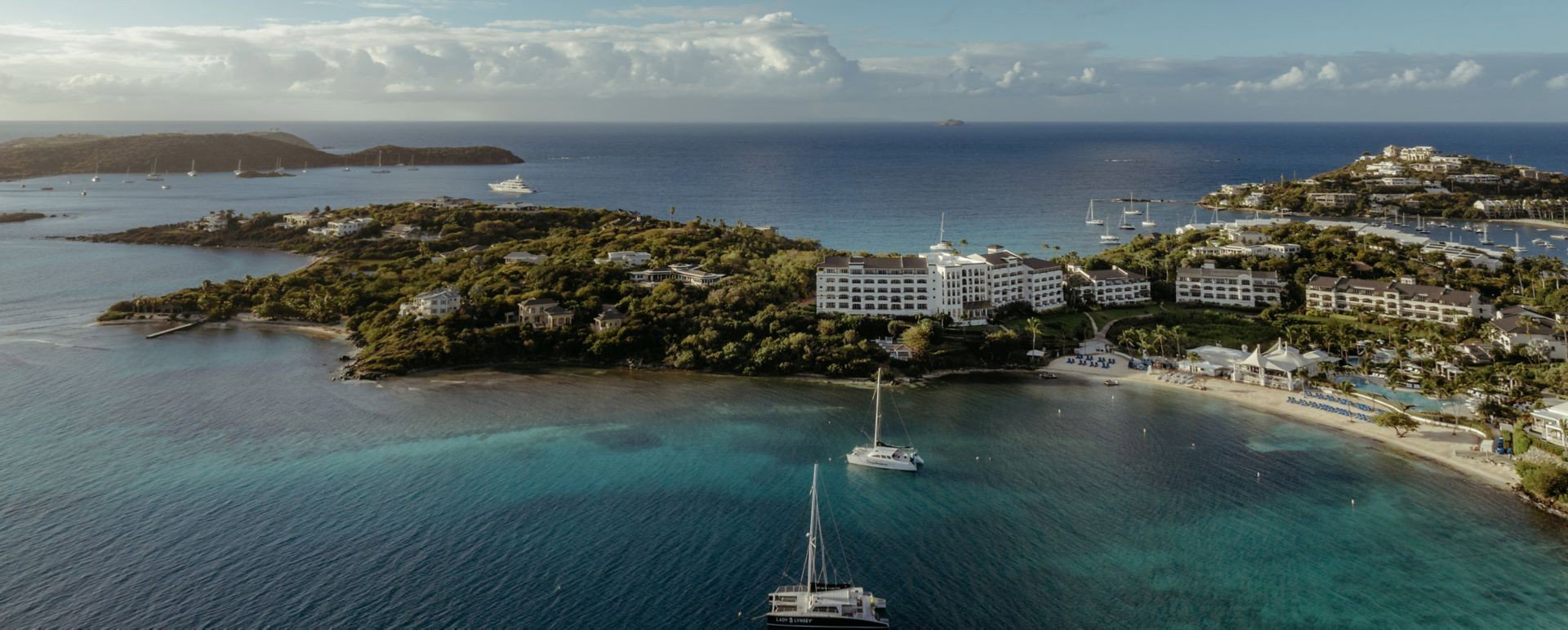
A Resort Rebuilt: Design, Scale, and the St. Thomas Upper Tier
The geography of Great Bay does most of the work before you reach the lobby. Arriving at 6900 Great Bay in Nazareth, the water appears before the building does, framed between low tropical plantings and the open-air reception pavilion. That panorama, encompassing nearby islands and the shifting blues of the Caribbean, is the resort's primary architectural statement: the structure is oriented entirely around the view, with the ocean functioning less as backdrop and more as the main room.
This is not accidental. The $100 million renovation that followed Hurricane Irma's 2017 damage was an opportunity to do more than repair, and the result is a property that reads differently from the pre-storm version. Contemporary island design replaced the older aesthetic across the full resort: wicker baskets and woodgrain desks share space with cool-toned palettes and current appliances, a combination that sits closer to a considered Caribbean modernism than to the generic resort tropicalia that dominates much of this market tier. The renovation took more than two years to complete, a timeline that reflects the scope of both the storm damage and the rebuild ambition.
Among the St. Thomas luxury hotel set, this positions the Ritz-Carlton in a specific band: large-footprint, brand-flagged, with the capital investment and room count (180 keys) that smaller design-led independents in the region, such as Lovango Resort and Beach Club in St. John, do not attempt. For the traveller comparing properties across the Caribbean and globally, the relevant peer set is the full-service international luxury resort rather than the intimate villa or the boutique independent. Those looking at comparable grand-scale properties in other contexts might reference Hotel Du Cap-Eden-Roc in Cap d'Antibes or Badrutt's Palace Hotel in St. Moritz as analogues for the combination of resort scale, renovation investment, and brand-backed positioning.
The Rooms: Ocean Views as Standard, Suites as Upgrade Logic
Every one of the 180 rooms carries at least a partial ocean view and a furnished balcony, which in this tier is a baseline commitment rather than a premium add-on. The design language across standard rooms balances the tactile (wicker, woodgrain) with the functional (contemporary appliances, cool color fields), and the bathrooms push beyond what most resort rooms deliver at this scale: double sinks, a separate shower, and a standalone curved soaking tub are standard inclusions.
The suite tier breaks into two categories. Sixteen Executive Suites offer expanded space within the same design framework. Four Presidential Suites operate at a different scale entirely, with two showers, two sinks, and a soaking tub in bathrooms large enough to absorb those fixtures without compression. For guests choosing between room categories, the Freesia building warrants specific attention: rooms there carry panoramic views of both Great Bay and St. John, a sight-line upgrade over standard ocean-view inventory.
The resort's size (180 rooms across multiple buildings) creates a circulation challenge that the property addresses with paved pathways and golf cart service between buildings. In practice, the scale that might feel overwhelming in a dense urban hotel reads differently when spread across a Caribbean resort footprint: inspector notes describe a property that never feels crowded, even at volume.
Four Restaurants and the Logic of a Self-Contained Resort
Post-renovation food and beverage program runs four outlets, each positioned at a different daypart and register. Bleuwater handles tropical breakfast; Sails operates as the beachside lunch venue; Coconut Cove carries Caribbean cuisine; and Alloro, added as part of the renovation, offers Sicilian dinner. The addition of an Italian-focused dinner restaurant to a Caribbean resort property is a deliberate positioning move, placing the evening dining option in a culinary tradition with broader international recognition rather than doubling down on regional Caribbean fare. For a broader picture of where this fits within St. Thomas dining, see our full St. Thomas restaurants guide.
Four-outlet structure is common to full-service luxury resorts at this scale, where the goal is to minimize the need for guests to leave the property for any meal. Whether that works as intended depends partly on the individual restaurants' execution, which the database does not allow specific claims about, and partly on whether the guest's travel style leans toward resort immersion or outward exploration.
The Catamaran, the Spa, and the Practical Architecture of the Stay
Beyond rooms and restaurants, the amenity set that defines the stay experience here clusters around two poles. The first is water access: the resort's 55-foot catamaran, Lady Lynsey, departs daily to St. John and the British Virgin Islands, with additional sunset sail departures from the property's dock. This is a meaningful logistical advantage in a destination where inter-island movement is one of the primary activities. Boat shoes are worth packing.
The second is the spa, recently refreshed as part of the wider renovation cycle, with an extensive service menu. Inspector notes single out the Stress Relief Massage as a guest favorite. The broader wellness amenity, including yoga sessions at the seaside pavilion, reflects the current convention for Caribbean luxury resorts of this scale: a complete on-property program oriented around the idea that the resort itself is the destination.
A partnership with Little Switzerland handles jewelry retail, with pieces deliverable to the hotel from any island location or available through a curated lobby selection. For day trips off-property, the property's guidance leans toward timing Charlotte Amalie's historic downtown shopping around cruise ship schedules (more stores open when ships are in) and toward Red Hook for a consistently active dining and nightlife scene regardless of the day.
Where It Sits in the St. Thomas Market
The U.S. Virgin Islands luxury hotel market is not large, and St. Thomas specifically has a limited supply of properties operating at full international brand-flag standards. The Ritz-Carlton, within the Marriott International portfolio, occupies a defined position in that market: the largest-scale luxury option with the brand recognition and points-program access that independent properties cannot replicate. For the traveller who values that infrastructure, the $100 million renovation signals a property that has been materially reset rather than maintained in place.
Comparisons to other premium resorts in the broader Caribbean and global luxury set are worth making for context. Properties like Hotel Esencia in Tulum represent the design-led independent model at the opposite end of the scale spectrum. Brand-flagged urban luxury, such as Aman New York or Cheval Blanc Paris, operates in an entirely different context but shares the renovation-as-repositioning logic. European palace hotels including Hotel Plaza Athénée in Paris, Le Bristol Paris, La Réserve Paris, Hôtel de Paris Monte-Carlo, and Hotel Sacher Wien illustrate how renovation investment functions as a trust signal in premium hospitality globally. In Asia, properties such as Bvlgari Hotel Tokyo and HOTEL THE MITSUI KYOTO show design-led repositioning at comparable scale. Italian countryside properties including Casa Maria Luigia in Modena and Castello di Reschio represent the independent alternative in Europe, while Cipriani, A Belmond Hotel, Venice and Aman Venice anchor the Venice luxury tier. Amangiri in Canyon Point, Hotel Bel-Air in Los Angeles, and The Fifth Avenue Hotel in New York City round out the domestic U.S. comparison set for travellers building a benchmark across markets.
For everything else happening on the island, our full St. Thomas hotels guide maps the broader accommodation options, while our St. Thomas bars guide, wineries guide, and experiences guide cover the island's wider scene. The Ritz-Carlton holds a Google rating of 4.2 across 1,039 reviews, a stable signal for a resort of this size operating in a destination market.
Frequently Asked Questions
- What is the atmosphere like at The Ritz-Carlton, St. Thomas?
- The atmosphere sits firmly in the full-service Caribbean resort register: open-air arrival, sweeping ocean views from the reception area, paved pathways across a multi-building campus, and amenities scaled for guests who want most of their stay handled on-property. The post-renovation design brings a contemporary edge to the standard tropical resort formula, with cool-palette rooms and a beach-chic aesthetic rather than the heavier tropical motifs that dominated this tier before Irma. St. Thomas as a destination combines that resort self-sufficiency with genuine access to the wider U.S. and British Virgin Islands, and the Ritz-Carlton's catamaran program bridges the two registers.
- Which room category should I book at The Ritz-Carlton, St. Thomas?
- For most guests, the Freesia building rooms represent the clearest upgrade within the standard inventory: the panoramic views of Great Bay and St. John are a material improvement over partial ocean-view rooms at no change in room type. Among the suite tiers, the four Presidential Suites carry the largest bathrooms on the property (two showers, two sinks, standalone soaking tub) and are the natural choice for guests prioritizing space over the suite rate premium. The 16 Executive Suites sit between standard rooms and Presidential level on both price and size. Style-wise, the post-renovation beach-chic aesthetic is consistent across categories.
- What is the main draw of The Ritz-Carlton, St. Thomas?
- The combination of post-renovation physical quality and the catamaran program is what separates this property from most of its St. Thomas competition. The $100 million rebuild after Hurricane Irma produced a genuinely updated resort rather than a patched one, and the daily departures to St. John and the British Virgin Islands on Lady Lynsey give guests structured access to some of the most compelling sailing and snorkeling waters in the Caribbean. The city context matters too: St. Thomas has Charlotte Amalie's historic duty-free shopping, Red Hook's dining scene, and inter-island ferry infrastructure that makes the Ritz-Carlton a workable base for wider exploration rather than a sealed destination.
- Can I walk in to The Ritz-Carlton, St. Thomas?
- As a resort property, walk-in access depends on what you are seeking. Restaurant guests and spa visitors may be accommodated without prior reservations, but given the resort's managed environment and the competition for table and treatment availability, contacting the property in advance is the practical approach. For hotel stays, the Ritz-Carlton operates within the Marriott International reservations system, which means booking through standard Marriott channels or directly with the property. The address is 6900 Great Bay, Nazareth, St Thomas 00802. No phone number or website is listed in our current database record, so the Marriott central reservations system is the most reliable booking route.
A Quick Peer Check
These are the closest comparables we have in our database for quick context.
| Venue | Cuisine | Price | Awards | Notes |
|---|---|---|---|---|
| The Ritz-Carlton, St. Thomas | Following a two-plus-year, $100 million renovation after 2017’s Hurricane Irma,… | This venue | ||
| Lovango Resort and Beach Club |
Preferential Rates?
Our members enjoy concierge-led booking support and priority upgrades at the world's finest hotels.
Get Exclusive Access