Lovango Resort and Beach Club

Lovango Resort and Beach Club occupies its own private cay just off St. John, offering 29 rooms in a family-owned property that sits well outside the mainstream Caribbean resort circuit. The design reads as unpretentiously stylish rather than formally grand, and the surrounding waters and landscape put a wilder, less developed side of the US Virgin Islands within easy reach. For travellers who find the larger island hotels overbuilt, Lovango makes a credible case for the opposite approach.
 Discover on Pearl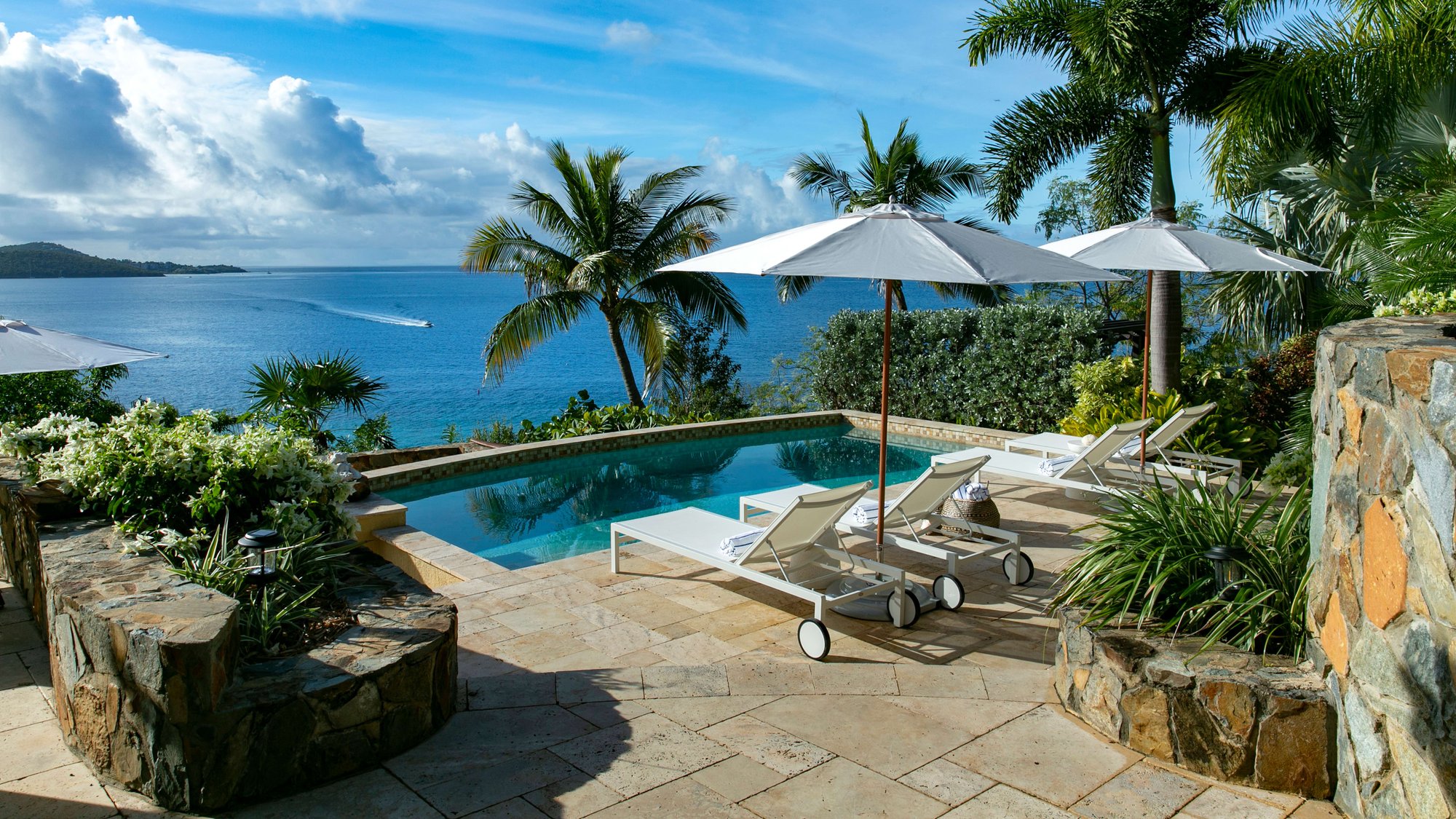
A Private Cay, Deliberately Small
The approach to Lovango Cay by boat sets the register before you've even stepped ashore. The cay sits just off St. John's north coast, separated from the main island by a short water crossing that functions less as an inconvenience and more as a threshold. Caribbean resorts have long used physical remoteness as a design statement, and Lovango works that logic at a smaller scale than most: 29 rooms on a private island, reached by water, with the surrounding reef and forest intact rather than cleared for maximum capacity. That restraint is increasingly the differentiator in this part of the Caribbean, where the boutique era has sorted properties into those that learned from it and those that only adopted its vocabulary.
The resort is family-owned, part of a small company with properties in Nantucket and Martha's Vineyard. That lineage matters in context. Operators with roots in the northeastern US island circuit tend to arrive with an understanding of how to keep a place intimate without making it feel sparse, and how to read a natural setting without overwhelming it. Lovango carries that sensibility: the styling is described in its own positioning as unpretentiously stylish and tastefully luxe, phrases that are easy to reach for but harder to deliver in a region where luxury and scale have so often been treated as synonyms. For a broader sense of how St. John's accommodation options are distributed across price tiers and formats, our full St. John hotels guide maps the field.
Design Logic: What the Space Is Doing
Architecture and design of small Caribbean island resorts have undergone a genuine shift over the past decade. The dominant model through the 2000s was brand-standard luxury, imported aesthetics applied over local geography, with the natural environment as backdrop rather than participant. The newer cohort, of which Lovango is a clear representative, builds the other way: local materials and vernacular references brought forward, the resort footprint kept to what the site can absorb, and the wildness of the surroundings treated as the primary amenity rather than something to be tamed.
At 29 rooms, Lovango operates at a scale where design decisions are visible in individual spaces rather than diluted across hundreds of keys. Properties in this size bracket, comparable in some respects to design-led boutique hotels like Hotel Esencia in Tulum or the similarly nature-embedded approach at Amangiri in Canyon Point, live or die by the coherence of the spatial experience. The difference between a well-executed small resort and a merely expensive one tends to show in exactly those details: how interior and exterior meet, how the property reads at different times of day, whether the materials hold up against the landscape they're meant to complement.
Lovango's positioning as a beach club as well as a resort is also worth noting architecturally. The dual identity implies spaces designed for both resident guests and day visitors, a planning challenge that requires the resort to function at variable occupancy and foot traffic without losing its character. Properties that do this well, like Hotel du Cap-Eden-Roc in Cap d'Antibes, tend to create distinct spatial zones that allow the day-use and overnight experiences to coexist without constant friction.
The Caribbean Context: What Lovango Is Responding To
St. John is a particular kind of Caribbean destination. Around two-thirds of the island falls within the Virgin Islands National Park, which means development has been structurally constrained in ways that distinguish it sharply from more built-out neighbours. That constraint has historically limited the scale of accommodation that can be introduced and pushed serious operators toward smaller, more considered projects. Lovango Cay, as an offshore cay rather than a plot on the main island, operates in a slightly different regulatory and physical context, but the spirit of the setting is consistent: this is Caribbean travel that is defined by what hasn't been built rather than what has.
The US Virgin Islands as a region occupy an interesting position in the Caribbean luxury market. St. Thomas, with its cruise infrastructure and larger hotel inventory including properties like The Ritz-Carlton, St. Thomas, handles a different kind of visitor volume and expectation. St. John has always attracted those willing to trade convenience for quiet, and Lovango extends that logic to its natural conclusion: a property accessible only by water, on an island that is its own destination. For visitors building a wider St. John itinerary, the dining, bar, and activity options on the main island remain relevant, and our full St. John restaurants guide, bars guide, and experiences guide cover the options in detail.
Sustainability and Scale
Small family-owned resorts on private cays exist in a different sustainability conversation than large-footprint branded hotels. The argument isn't simply that smaller is greener, but that properties operating at 29 rooms have structural incentives to protect the environment their commercial model depends on. Reef health, water clarity, and the condition of the surrounding landscape are not peripheral concerns at a resort where those elements are the primary draw. The newer generation of boutique Caribbean properties has generally taken this relationship seriously in operational terms, from water management to construction materials, though the specifics vary significantly by property.
The family ownership structure at Lovango, with its roots in Nantucket and Martha's Vineyard operations, suggests a long-term operational horizon rather than a short-cycle investment model. That distinction matters in how a property is maintained and evolved over time. For comparison, other owner-operated properties with strong design identities, like Casa Maria Luigia in Modena or Castello di Reschio in Lisciano Niccone, demonstrate how family stewardship tends to produce distinctive, coherent properties that retain character across seasons in ways that managed hotel brands often do not.
Planning Your Stay
Access to Lovango is by boat from St. John or St. Thomas, which means arrival logistics require a step of planning that mainland resorts do not. That extra layer filters the guest profile toward those who have specifically chosen the property rather than defaulted to it for convenience. Booking should be arranged directly or through a travel specialist; given the 29-room capacity, availability at peak periods in the Caribbean high season (December through April) will be limited, and advance planning is direct advice rather than a caveat. The beach club component means the property also hosts day visitors, so guests seeking the quieter residential character of the resort may want to factor time of day into their activity schedule. For wineries and broader Virgin Islands context, our St. John wineries guide covers any vinous options in the region.
Frequently Asked Questions
- Is Lovango Resort and Beach Club more low-key or high-energy?
- Lovango sits firmly at the low-key end of the Caribbean resort spectrum. The 29-room capacity and private-cay setting are structural rather than incidental: the resort is designed for guests who want access to a relatively undeveloped stretch of the Virgin Islands without the activity programming and crowd levels of larger properties. The beach club element introduces some daytime energy, but the overall register is relaxed and unhurried.
- What's the leading room type at Lovango Resort and Beach Club?
- With no detailed room-type data available in our current records, we can't make a specific recommendation by category. What the 29-room footprint does imply is that even standard configurations will be relatively intimate compared to larger Caribbean resorts. If the coastal setting and natural surroundings are your primary reasons for choosing Lovango, proximity to the water is worth prioritising when booking. Contact the property directly for current room-type specifics.
- What's the main draw of Lovango Resort and Beach Club?
- The private-cay location is the central argument. Being accessible only by water, with the reef and natural range of the Virgin Islands immediately present, places Lovango in a different category from St. John's land-based accommodation. The family-owned operation and 29-room scale reinforce the sense of a property that has traded volume for character, which is increasingly the relevant trade-off in Caribbean travel at the premium end.
- Is Lovango Resort and Beach Club reservation-only?
- The resort operates with 29 rooms, which makes advance reservations functionally necessary rather than optional, particularly in the Caribbean high season between December and April. The beach club side of the operation may accommodate some walk-in or day-trip traffic by boat, but for overnight stays, booking ahead is the practical approach. Check directly with the property for current booking procedures, as contact details are not listed in our current records.
- How does staying on a private cay like Lovango differ from a standard St. John resort experience?
- The water-access-only model changes the nature of the stay more than any individual amenity. Guests are committed to the property's environment in a way that mainland resorts don't require, which concentrates the experience around what Lovango Cay itself offers: its reef, its natural setting, and the views back toward St. John and the wider Virgin Islands. That separation is the draw for travellers who want the Caribbean to feel genuinely remote, and it places Lovango in a peer set closer to private-island properties than to conventional boutique hotels, despite its relatively accessible location just off St. John's coast.
For broader Caribbean and global hotel comparisons at a similar tier of intimate, design-conscious luxury, properties like Aman Venice, Cheval Blanc Paris, La Réserve Paris, Le Bristol Paris, Hotel Plaza Athénée, Hôtel de Paris Monte-Carlo, Badrutt's Palace Hotel, Hotel Sacher Wien, Hotel Bel-Air, Aman New York, The Fifth Avenue Hotel, Bvlgari Hotel Tokyo, HOTEL THE MITSUI KYOTO, and Cipriani, A Belmond Hotel, Venice sit across very different geographies but share the emphasis on limited keys, considered design, and a guest experience shaped by setting as much as service.
A Quick Peer Check
These are the closest comparables we have in our database for quick context.
| Venue | Cuisine | Price | Awards | Notes |
|---|---|---|---|---|
| Lovango Resort and Beach Club | Price: No rooms available Rooms: 29 Rooms The newest generation of Caribbean r… | This venue | ||
| The Ritz-Carlton, St. Thomas |
Preferential Rates?
Our members enjoy concierge-led booking support and priority upgrades at the world's finest hotels.
Get Exclusive Access