The Port O Call, Port Campbell
On Lord Street in the small coastal town of Port Campbell, The Port O Call sits a short drive from the Twelve Apostles and the broader Great Ocean Road corridor. The venue serves travellers passing through one of Victoria's most-visited stretches of coastline, offering a stop that reflects the unhurried character of the town itself. Practical, unpretentious, and positioned for those moving between major Great Ocean Road landmarks.
Pearl is the En Primeur Club membership app — saves, bookings, and concierge access live there. Same editors, same standards.
- Address
- 35-37 Lord St, Port Campbell VIC 3269, Australia
- Phone
- +61 3 5598 6206
- Website
- theportocall.com.au
- Directions
- Get directions
 Saves & bookings on Pearl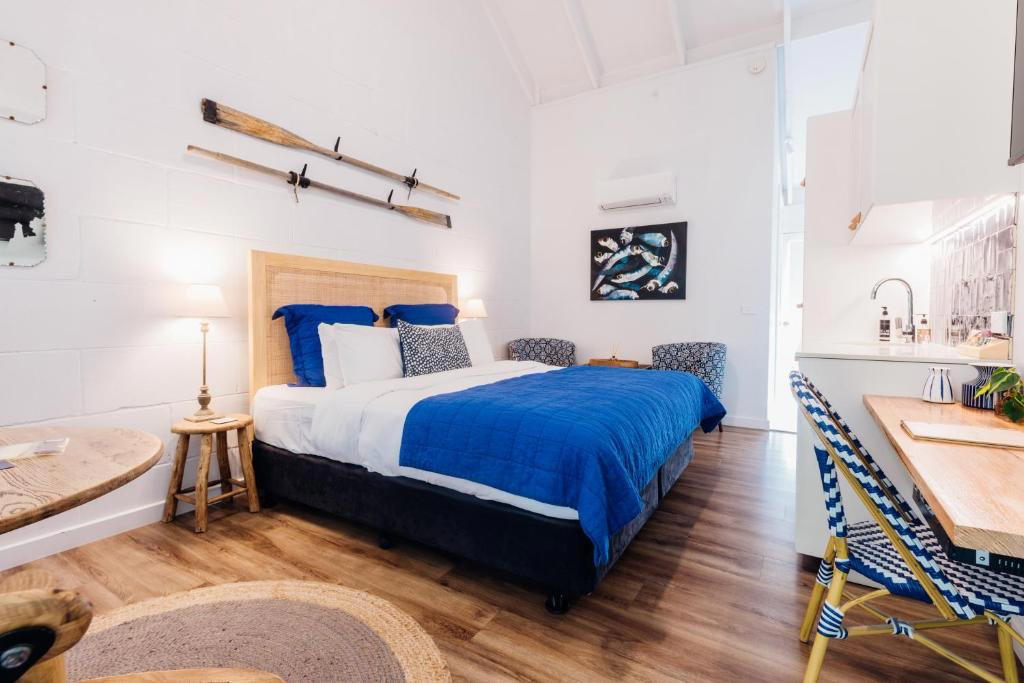
Where the Great Ocean Road Stops and the Coast Takes Over
The Port O Call, Port Campbell is a 4-star hotel at 35-37 Lord St, Port Campbell VIC 3269, Australia, a practical base within easy reach of the Twelve Apostles and the foreshore lookouts above them. In a town that functions primarily as a staging post for one of Australia's most visited stretches of coastline, the accommodation question matters more than it might elsewhere. Travellers are often passing through on a tight timetable, which makes address and accessibility as important as anything inside the building.
The Physical Setting: Low-Key Architecture in a High-Drama Location
Port Campbell's built environment is modest by design. The town has resisted the resort-scale development that has absorbed some other Great Ocean Road stops, and properties along Lord Street reflect that restraint. Buildings here tend toward functional coastal architecture, weatherboard cladding, pitched roofs, covered verandas, that prioritises shelter from the Southern Ocean wind over architectural statement. The Port O Call at 35-37 Lord Street sits within that vernacular. The address spans two lots, suggesting a footprint that is larger than the typical single-fronted accommodation on this strip, and the corner-adjacent position on Lord Street gives it a presence relative to its neighbours.
This kind of low-profile coastal architecture is, in a specific way, well-suited to its context. The drama here belongs to the landscape: the limestone stacks, the gorges, the ocean colour shifting between slate and pale green depending on the weather. Properties that try to compete visually with that tend to look mismatched. The quieter the built envelope, the more the location does the work, and that is an approach that gives visitors staying on Lord Street a practical base without architectural friction.
Travellers who want a reference point for how the higher-investment end of Australian coastal hospitality is currently operating can look at properties like Southern Ocean Lodge in Kingscote, which applies a design-forward, landscape-integrated approach to an analogous Southern Ocean setting. Or, at the luxury end of urban-coastal hospitality, Capella Sydney and The Tasman in Hobart represent the heritage-building conversion model that has become prevalent in Australian cities. Port Campbell operates in a different tier entirely, and The Port O Call reflects the town's character rather than working against it.
Port Campbell as a Base: The Practical Logic
The town is the closest settlement of any size to the Twelve Apostles Marine National Park, with the viewing platforms at the Apostles themselves accessible within a short drive along the B100. Gibson Steps, Loch Ard Gorge, and the Bay of Islands Coastal Park all sit within the same corridor, making Port Campbell the logical overnight stop for visitors who want to see the limestone coast in more than a single rushed afternoon. The light at the Apostles at dawn is categorically different from midday conditions, and staying in town is one direct way to be there early.
The Great Ocean Road from Melbourne is typically driven west to east starting from Torquay, or east to west from Warrnambool, depending on the traveller's direction. Port Campbell sits roughly in the middle of the western section. Warrnambool, 66 kilometres to the west, has a broader service infrastructure and is where most flight connections to the region would route through. Geelong and Melbourne are the other access anchors. Visitors arriving from Melbourne will generally find the drive on the inland Princes Highway faster than the coastal route, using the coastal road only for the scenic sections.
Port Campbell fits that structure: the town exists in service of the coastline, and accommodation there should be assessed on that logic rather than against urban hospitality standards.
The Local Food Context
Port Campbell's dining scene is characteristic of small coastal Victoria: seafood-forward, reliant on regional produce, and limited in scale. The Shipwreck Coast label that tourism bodies use for this stretch of coast is geographically accurate, the Bass Strait and Southern Ocean approaches have a significant maritime history, and the fishing heritage is reflected in what local kitchens tend to work with. Crayfish from the Southern Ocean, abalone harvested from the reef systems along this coast, and dairy from the south-west Victoria pastoral belt are the credible regional ingredients. Visitors should not expect a broad restaurant scene; Port Campbell has a handful of options concentrated along and near Lord Street.
Comparing this to the food infrastructure at other Australian regional destinations puts it in perspective. Properties like Cape Lodge in Wilyabrup, sitting in the Margaret River wine region, operate with a restaurant as a central feature of the stay. Wildman Wilderness Lodge in Marrakai integrates dining into its remote-stay offer. In Port Campbell, the logic is inverted: accommodation supports access to the landscape first, and dining is incidental to that primary function.
Planning Your Stay
Port Campbell operates as a seasonal destination, with the summer months from December through February bringing the highest visitor volumes to the Twelve Apostles viewing platforms. Shoulder season visits in autumn and early winter offer noticeably quieter conditions on the trails and at the lookouts, and the Southern Ocean light in those months has a quality that summer's haze can reduce. Booking accommodation in Port Campbell earlier than you might for a comparable city stay is advisable through the December to January peak.
Travellers adding Port Campbell to a broader Victorian itinerary that includes Melbourne will find properties across the accommodation spectrum in the city: Crown Metropol in Southbank and Four in Hand Hotel in Paddington represent the urban end of that range. For those routing through New South Wales before or after, Harbour Rocks Hotel in The Rocks, InterContinental Sydney Double Bay, and Bondi Beach House cover different Sydney positions. Further afield, The Calile in Brisbane, Crystalbrook Riley in Cairns, and Watsons Bay Hotel complete a range of coastal and city options for an extended Australian circuit. Internationally, travellers with further itineraries in mind can reference Aman New York, The Fifth Avenue Hotel, and Aman Venice for context on how design-led hospitality operates at a global scale.
A Quick Peer Check
Comparable venues nearby, for context on price, style, and recognition.
| Venue | Cuisine | Price | Awards | Notes |
|---|---|---|---|---|
| The Port O Call, Port CampbellThis venue — the venue you are viewing | Charming native garden motel with modern, freshly styled rooms. | $$ | 4-Star | Not listed |
| Punthill Narrabundah | Contemporary apartment-style hotel with Art Deco architectural elements positioned as a relaxed, home-away-from-home base for extended stays. | $$ | 4-Star | Narrabundah |
| Best Western Melbourne City Hotel | Quaint inner-city home away from home in historic European-style building. | $$ | 3-Star | Melbourne |
| Kyah - Boutique Hotel | Mid-century modern Palm Springs-inspired boutique hotel with contemporary design elements and retro motel heritage. | $$$ | 4-Star | Blackheath |
| Little National Hotel Adelaide | Contemporary luxury boutique hotel designed for modern travellers. | $$$$ | 4-Star | North Terrace |
| The Pink Hotel Coolangatta | Retro-modern boutique hotel blending 1960s motel heritage with contemporary luxury and artistic flair. | $$$ | 5-Star | Coolangatta |
At a Glance
- Cozy
- Scenic
- Charming
- Weekend Escape
- Family Vacation
- Garden
- Wi Fi
- Air Conditioning
- Parking
- Garden
- Wi Fi
- Air Conditioning
- Parking
Cozy, chic, and inviting with warm, welcoming decor and immaculate cleanliness.