The Charlie

1 Michelin Key
A Michelin Key-awarded boutique hotel in West Hollywood built around 14 restored English-style bungalows on land once owned by Charlie Chaplin. Rates from $394 per night. The property trades scale for privacy, with cottage-style rooms bearing names tied to the Golden Age stars said to have lived here, and a service approach that keeps guests largely left to their own devices.

Pearl is the En Primeur Club membership app, where members save venues, book tables and use the concierge.
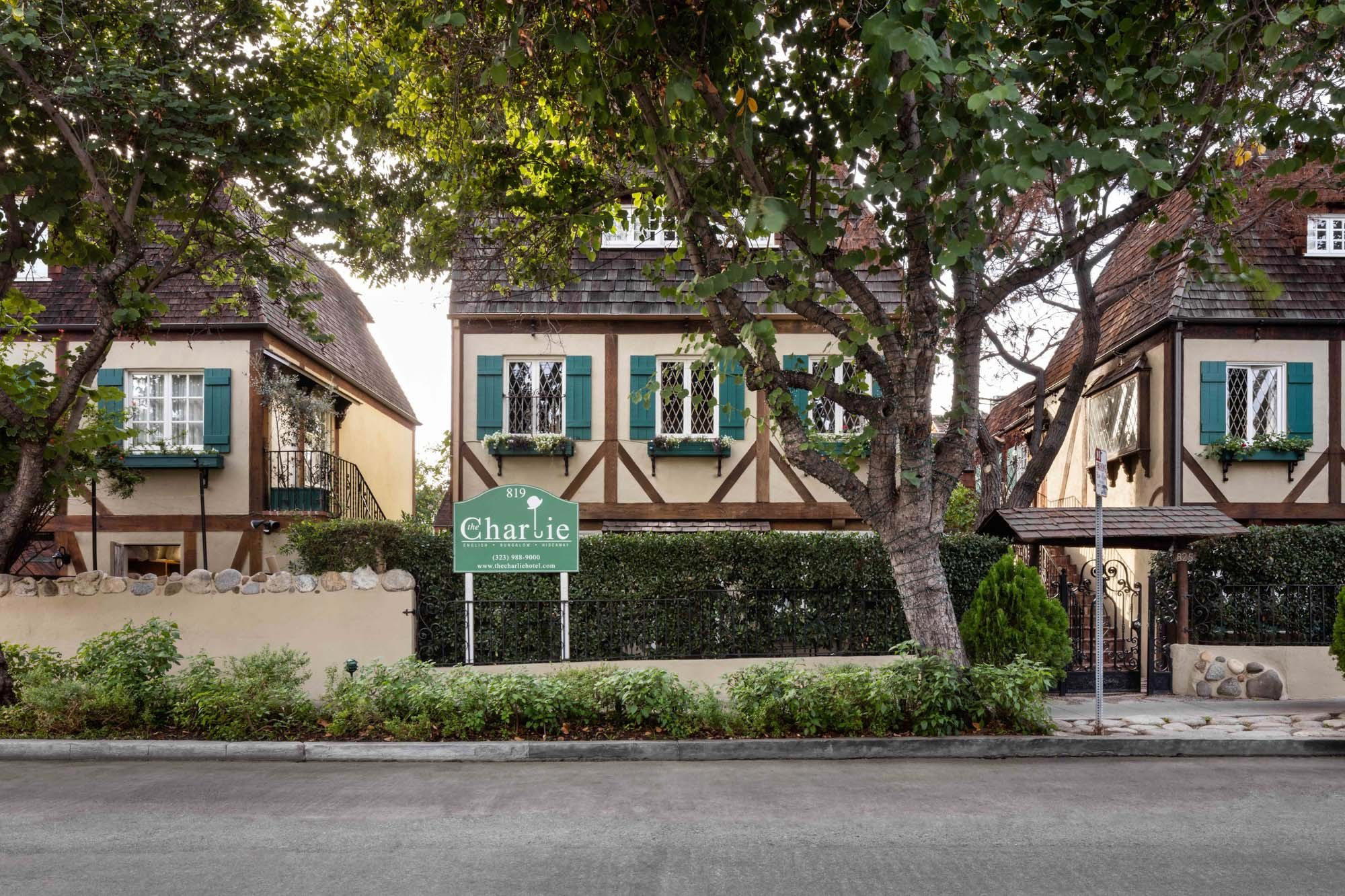
A West Hollywood Address With a Long Memory
West Hollywood's accommodation tier has bifurcated sharply over the past decade. On one side sit the larger flagships, properties like The Sun Rose West Hollywood and, just over the city line, The Beverly Hills Hotel and The Peninsula Beverly Hills, where scale, amenity stacking, and name recognition do the heavy lifting. On the other sit a smaller cohort of boutique properties that trade all of that for something harder to manufacture: genuine character rooted in place. The Charlie sits firmly in the second camp, and its case for being there is stronger than most.
The physical premises are the argument. This cluster of English-style bungalows on North Sweetzer Avenue in West Hollywood predates the modern hotel industry's presence in the neighbourhood by decades. When Charlie Chaplin owned this land, the cottages read as unremarkable domestic architecture for the area, a pastoral holdover in a city still sorting out its identity. That Chaplin left Los Angeles more than sixty years ago and the structures still stand is, as the property itself acknowledges without embarrassment, something of a minor miracle. Most of comparable vintage didn't make it.
What the Cottages Actually Are
The Charlie runs 14 rooms across its bungalow footprint, a scale that immediately defines what kind of stay this is. For context, Chateau Marmont, the neighbourhood's other hotel with genuine Hollywood mythology attached to it, operates at a different register of visibility and social density. The Charlie's version of the same mythology is quieter and more residential in its delivery.
Each cottage carries a single-word name rather than a room number, names that correspond, with deliberate coyness, to Golden Age Hollywood figures said to have spent time on the property during Chaplin's tenure. Charlie, Marlene, Marilyn, Valentino: the blanks are easy enough to fill in, and the property makes no particular effort to stop you filling them. Whether you read this as romantic myth-making or shrewd branding likely says more about you than about the hotel. Los Angeles has always operated in the gap between documented history and well-maintained legend, and The Charlie simply inhabits that gap honestly.
The interiors lean into the English countryside reference without tipping into pastiche. Restored and refurbished, the cottages retain their original architectural character while accommodating the functional requirements of contemporary travel. Kitchens and washer/dryers sit alongside standard hotel suite amenities, a configuration that positions the property closer to a high-end furnished rental than a conventional hotel room, and that suits guests planning multi-night stays around work or extended visits.
Privacy as the Core Proposition
The boutique hotel category in LA has expanded quickly, and not all of it offers a genuinely distinct reason to book. The Charlie's clearest differentiator is the privacy its physical structure provides almost automatically. Individual cottages set apart from one another, a 14-room count that keeps foot traffic low, and a service culture described consistently as hands-off, these are structural features, not marketing positions.
Property received a Michelin Key in 2024, placing it in the recognised tier of Michelin's hotel selection for California. Michelin Keys are awarded on the basis of character, quality of experience, and the coherence of what a property sets out to do, not on room count or amenity lists. The credential is relevant here because it validates what the property is actually trying to be, rather than what it lacks relative to a full-service luxury hotel. At rates from $394 per night for 14 rooms, the positioning is clear: this is not a budget-conscious decision, but it is a character-driven one.
For guests who want the full-service, high-amenity version of LA luxury, Hotel Bel-Air, L'Ermitage Beverly Hills, and The Maybourne Beverly Hills operate in the same price tier with a substantially different offer. For those who find that kind of attentiveness claustrophobic rather than reassuring, The Charlie tends to be the answer.
How the Property Works Across the Day
The structural difference between a conventional hotel stay and a stay at The Charlie becomes most apparent across an ordinary day. The cottage format means guests move between an enclosed private space and the wider neighbourhood rather than through a lobby, pool deck, or restaurant circuit. There is no dense programming of the kind you encounter at larger properties, no poolside service culture, no lobby bar scene generating ambient social pressure. The daytime experience at The Charlie is largely whatever you make of it within the cottage and across the surrounding streets of West Hollywood.
The evening dynamic shifts the equation further. West Hollywood's dining and bar density means that guests at a property like this are effectively treating the neighbourhood as an extended amenity, the hotel provides the private retreat, the streets provide the scene. This model works better from North Sweetzer than it does from many other addresses in the city: the location is walkable to a meaningful cross-section of West Hollywood's food and drink options, and the cottage itself provides a genuinely comfortable base to return to. It's a rhythm more like renting an exceptional short-term property in a functioning city neighbourhood than staying in a conventional hotel, and for guests who respond to that, the 14-room count and cottage layout are features rather than limitations.
For comparison, the small-footprint, privacy-forward model appears in a handful of other North American properties worth knowing. Troutbeck in Amenia applies a similar logic in a completely different landscape context. SingleThread Farm Inn in Healdsburg takes the intimate-rooms model in a more programmatic culinary direction. Post Ranch Inn in Big Sur offers comparable privacy in a dramatically different natural setting. Each represents a different answer to the same question: what does a small, character-driven property do when it chooses depth over breadth?
Planning a Stay
The Charlie is at 819 N Sweetzer Ave, West Hollywood, CA 90069, on a residential corner that reads more like a private address than a hotel entrance, which is, again, rather the point. Rates begin at $394 per night across 14 rooms, and the property's Michelin Key recognition makes it a reasonable benchmark when comparing within the boutique segment. Because the room count is this low, availability can be limited during peak LA periods, and booking lead time is worth considering if dates are fixed. See our full Los Angeles guide for broader neighbourhood and restaurant context, or explore other properties in the city's boutique and full-service range: Downtown LA Proper Hotel offers a comparable design-led sensibility at a different end of the city.
For those building a wider West Coast or US itinerary around properties with similar character credentials, Amangiri in Canyon Point, Kona Village in Kailua Kona, and Little Palm Island in Little Torch Key each occupy a comparable niche, small, specific, and defined by a strong sense of place rather than a long amenity checklist.
A Pricing-First Comparison
Comparable venues nearby, for context on price, style, and recognition.
| Venue | Price | Awards | Notes |
|---|---|---|---|
| The CharlieThis venue (the venue you are viewing) | Not listed | 1 Michelin Key | Not listed |
| Palihouse West Hollywood | Not listed | 1 Michelin Key | Beverly Grove, residential-inspired urban lodge |
| Soho Warehouse DTLA | $300–500 | Michelin Selected · Mr & Mrs Smith Seal of Approval | Wholesale District, Members-only club hotel in a restored 1916 warehouse. |
| The Paramour Estate | Not listed | 1 Michelin Key | Silver Lake, Historic Mediterranean Revival estate reimagined with vintage bungalows and lavish suites |
| Le Petit Pali Brentwood | Not listed | 1 Michelin Key | Brentwood, charming boutique inn with mid-century modern renovations |
| The Prospect Hollywood | Not listed | 1 Michelin Key · Mr & Mrs Smith Seal of Approval | Yucca Corridor, Hollywood Regency-style boutique hotel |
Recognition history
Dated appearances from independent guides and award organizations, with the underlying list record or original source where available.
Michelin 1 Key
Michelin
Full recognition history (3 entries)
Michelin 1 Key
Michelin
Michelin 1 Key
Michelin
Continue exploring
More in Los Angeles
Hotels in Los Angeles
All hotels in Los Angeles →
Bars in Los Angeles
All bars in Los Angeles →
Restaurants in Los Angeles
All restaurants in Los Angeles →
Wineries in Los Angeles
All wineries in Los Angeles →
Details
- Cozy
- Historic
- Intimate
- Charming
- Quiet
- Romantic Getaway
- Weekend Escape
- Garden
- Terrace
- Historic Building
- Wi Fi
- Fitness Center
- Room Service
- Concierge
- Bicycle Rental
- EV Charging
- Step Free Entrance
Peaceful and charming historic atmosphere with lush gardens, cozy firepit, and individually decorated suites praised as a serene retreat.