Santa Teresa Hotel RJ - MGallery Hotel Collection



Occupying a restored 18th-century coffee plantation in Rio's bohemian Santa Teresa district, this 44-room MGallery property sits well above the beach circuit in both elevation and atmosphere. Indigenous hardwoods, Brazilian designer art, and a hillside pool with Guanabara Bay views define the physical experience. At around $556 per night, it positions itself as the neighbourhood's anchor luxury address.
 Discover on Pearl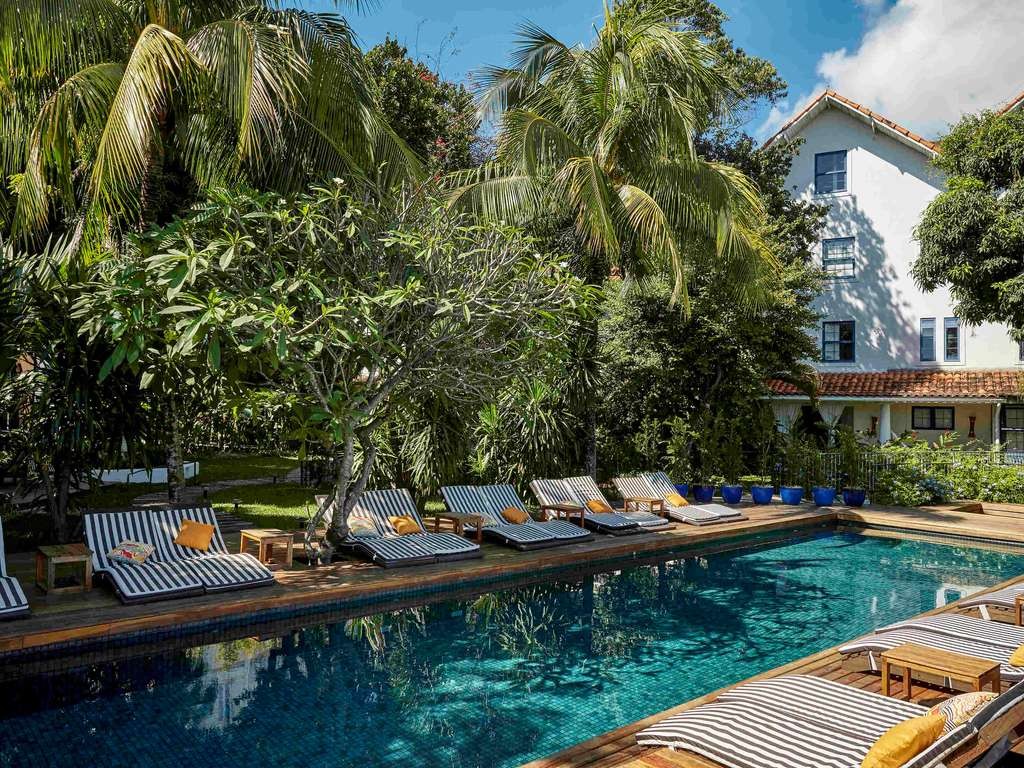
A Different Rio Entirely
Rio de Janeiro's luxury hotel market divides fairly cleanly along geographic lines. The beach-facing corridor from Copacabana to Ipanema holds the grand internationals: Copacabana Palace, A Belmond Hotel, Rio de Janeiro, Fairmont Rio de Janeiro Copacabana, Hotel Fasano Rio de Janeiro, and Emiliano Rio. Santa Teresa Hotel RJ - MGallery Hotel Collection belongs to a different conversation. It sits not on the Zona Sul beachfront but high in the hills of the Santa Teresa neighbourhood, where colonial mansions crowd narrow streets and artists' workshops occupy former plantation outbuildings. The postal address, Rua Almirante Alexandrino 660, places the hotel near the historic centre of a district that has been accumulating creative energy for decades without ever fully converting to mass tourism.
That positioning is not incidental. Brazil's boutique hotel sector has increasingly split between properties that use heritage buildings as scenery and those that treat the building's history as an active part of the guest experience. The Santa Teresa Hotel, housed in what was once an 18th-century coffee plantation mansion, operates in the second category. The 44 rooms occupy reclaimed plantation structures, and the materials throughout — recycled jacaranda, cinnamon, and ipê hardwoods, local golden slate, natural fabrics — are a direct reference to what the building once was rather than a decorative flourish applied over a generic luxury shell.
What the Space Communicates
The approach to the hotel already frames expectations. Santa Teresa's streets are steep, lined with bougainvillea, and interrupted occasionally by views down to the bay. The neighbourhood's characteristic tram line , the bonde , historically connected this refined district to the city below, and the sense of slight remove from the beach circuit remains tangible. Arriving at the property, the grounds include mango and apricot trees, which is not the kind of detail that gets curated into most luxury hotels.
Guestrooms in the reclaimed mansion carry white walls and wood furnishings that read as restrained rather than austere. The design elements , silk drapes, slate showers, shutters that filter coastal light, Brazilian-designer mirrors , work within the building's existing proportions rather than against them. All 44 rooms include fresh orchids, bathrobes, and original art by Brazilian designers, with 46-inch LCD televisions and flip-flops as the concessions to contemporary comfort. Some rooms include king-size beds. The overall effect is of a colonial residence that has been carefully edited rather than comprehensively renovated, which is the more interesting outcome.
The pool area represents the hotel's most theatrical asset. Surrounded by tropical gardens and positioned to face the Guanabara Bay, it holds a view that changes character significantly between afternoon and after dark. The Pool Lounge functions as the natural late-afternoon gathering point, with drinks timed against the shift in light over the bay. That kind of moment , unhurried, atmospheric, anchored by a specific geographic relationship , is what distinguishes a hillside property from its beach-facing counterparts, and the Santa Teresa Hotel is well placed to deliver it.
How the Hotel Attends to Guests
The editorial angle that matters most here is service architecture: specifically, what a small-inventory property with genuine neighbourhood roots can offer that larger beach hotels cannot. At 44 rooms, the hotel operates in a scale bracket where personalisation is structurally possible in ways that a 300-key beachfront tower makes difficult. The MGallery collection, which positions its properties as story-led boutique hotels within the Accor network, uses that small scale as a programmatic asset rather than a limitation.
Activities the hotel can arrange for guests reflect this. A helicopter ride over Rio and rock climbing on Sugarloaf Mountain are not standard hotel-desk referrals; they require coordination, local relationships, and a staff culture oriented toward experience assembly rather than just accommodation management. The spa, Le Spa, works with natural oils and local ingredients, which connects the treatment menu back to the same Brazilian-materials logic visible in the architecture. That continuity , between building material, spa ingredient, and landscape view , suggests deliberate curation rather than coincidental accumulation.
Hotel is approximately 3.5 kilometres from Santos Dumont Airport (a 10-minute transfer) and 20 kilometres from Galeão Airport (approximately 35 minutes). The property arranges transfers at BRL 70 from Santos Dumont and BRL 160 from Galeão, each way. Rates sit at approximately $556 per night, which places the hotel in a mid-to-upper tier relative to the Santa Teresa neighbourhood itself, though comfortably below the peak pricing of the Zona Sul luxury corridor. Wi-Fi is available throughout the property.
How This Property Fits the Broader Brazil Picture
Brazil's premium hotel landscape has developed a strong regional variation over the past decade. Properties like Rosewood São Paulo anchor urban luxury in the financial capital, while nature-led properties , Awasi Santa Catarina, Caiman, Pantanal, and Barracuda Hotel & Villas , address travellers whose primary interest is landscape rather than city. Within Rio specifically, the Santa Teresa Hotel occupies a distinct niche: it offers urban access while delivering the pace and visual character of a hillside retreat. The hotel also contrasts interestingly with destination properties like Hotel das Cataratas, A Belmond Hotel, Iguassu Falls, where the setting is the primary draw rather than the neighbourhood.
Other properties worth considering in this context include Botanique Hotel Experience in Campos do Jordão, Fera Palace Hotel in Salvador, Kenoa Exclusive Beach & Spa Resort, Toca da Coruja, Fasano Boa Vista, NÓR Hotel & Spa, Carmel Taíba Exclusive Resort, Castelo Saint Andrews - Gramado, and Caiman, Pantanal, each of which serves a different Brazilian travel agenda. For those planning beyond Brazil, comparable character-led boutique properties in other markets include Aman New York, The Fifth Avenue Hotel, and Aman Venice.
For broader planning around Rio, see our full Rio de Janeiro hotels guide, our full Rio de Janeiro restaurants guide, our full Rio de Janeiro bars guide, our full Rio de Janeiro experiences guide, and our full Rio de Janeiro wineries guide.
Frequently Asked Questions
Cuisine-First Comparison
A short peer set to help you calibrate price, style, and recognition.
| Venue | Cuisine | Awards | Notes |
|---|---|---|---|
| Santa Teresa Hotel RJ - MGallery Hotel Collection | Rio de Janeiro may be famous for its beach scene, but Santa Teresa Hotel RJ - MG… | This venue | |
| Copacabana Palace, A Belmond Hotel, Rio de Janeiro | World's 50 Best | ||
| Fairmont Rio de Janeiro Copacabana | |||
| Hotel Fasano Rio de Janeiro | |||
| Emiliano Rio |
Preferential Rates?
Our members enjoy concierge-led booking support and priority upgrades at the world's finest hotels.
Get Exclusive Access