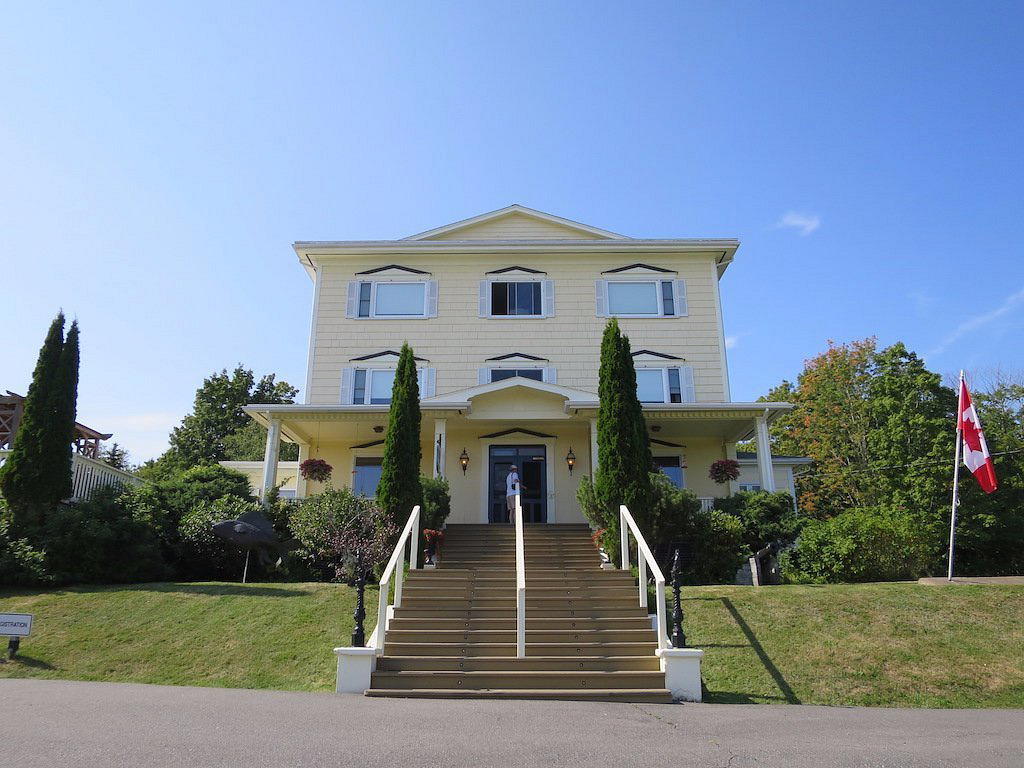
A Victorian-era inn on the shores of Passamaquoddy Bay in St. Andrews, New Brunswick, Rossmount Inn operates in the small but serious tier of Canadian heritage properties where architecture and landscape do as much work as the kitchen. The inn sits on NB-127 outside the town centre, positioning it as a retreat rather than a convenience stop — the kind of property where the building itself is the primary argument for the stay.

Pearl is the En Primeur Club membership app — saves, bookings, and concierge access live there. Same editors, same standards.
- Address
- 4599 NB-127, St. Andrews, NB E5B 3S7, Canada
- Phone
- (506) 529-3351
- Website
- rossmountinn.com
- Directions
- Get directions
A Victorian Property on the Fundy Shore
St. Andrews, New Brunswick occupies a particular niche in Canadian heritage travel: a loyalist-era town on Passamaquoddy Bay where the architecture has been preserved at a scale that rewards slow attention. The region draws comparisons to the more visited Atlantic coastal towns of Nova Scotia and Prince Edward Island, but St. Andrews operates at a quieter register, with fewer resort-scale properties and a visitor profile that trends toward travellers who have already done the obvious Maritime itineraries. Rossmount Inn, set on NB-127 just outside the town centre, fits that context exactly. The property occupies a Scottish Baronial-style manor house dating to the mid-nineteenth century, a building type rare in this part of Canada and one that immediately places the inn in a different architectural conversation from the shingled Cape Cod vernacular that defines most of the Atlantic coast's heritage accommodation.
The Scottish Baronial idiom — characterised by crenellated rooflines, turret forms, and a deliberately imposing stone or rendered facade — was a prestige architectural language imported to the British colonies in the Victorian period, typically by wealthy merchants or landowners seeking to signal continuity with old-world status. In New Brunswick, where loyalist and British colonial heritage is more concentrated than elsewhere in Canada, the style has particular historical logic. At Rossmount, the exterior reads as a set piece against the bay and the surrounding woodland, a configuration that gives the property its visual identity before a guest enters the building. Approaching along NB-127, the manor sits refined above the road, the silhouette working in the inn's favour in all seasons but especially in late autumn and winter when the deciduous canopy thins and the full form of the building becomes legible from a distance.
What the Building Does Inside
Properties of this architectural type face a consistent challenge: the Victorian era's preference for compartmentalised interior space, heavy material palettes, and low natural light requires careful curatorial decisions to avoid tipping from heritage atmosphere into institutional mustiness. The most successful conversions of comparable manor houses in Atlantic Canada, and there are instructive parallels at Manoir Hovey in North Hatley and at Elora Mill in Centre Wellington, thread between authentic period detail and functional comfort without forcing either into inauthenticity. The structural bones of a house like Rossmount: high-ceilinged principal rooms, wide staircases, deep window reveals, fireplaces in the main reception spaces, are assets that newer-build boutique properties cannot replicate, but they require ongoing investment to maintain the argument that staying in the original fabric of the building is preferable to a purpose-built alternative.
Canada's tier of design-led inn properties has expanded significantly over the past decade. Fogo Island Inn in Joe Batt's Arm established an internationally recognised benchmark for remote architecture in Atlantic Canada, and Clayoquot Wilderness Lodge in Tofino demonstrated how non-urban settings can anchor destination-quality stays. Rossmount operates in a different register from both: it is a heritage conversion rather than a designed-from-new property, which changes the nature of what it offers. The guest proposition here is access to a specific historical building in a specific coastal town, not an architectural statement conceived for the contemporary market. That distinction matters when setting expectations, and it also explains why the property competes less with the large-footprint Canadian luxury hotels, the Fairmont Banff Springs in Banff, the Fairmont Chateau Whistler in Whistler, the Fairmont Chateau Lake Louise in Lake Louise, and more directly with smaller, independently operated inn properties across Atlantic Canada and Quebec.
The Setting as a Structural Argument
New Brunswick's Fundy Coast is among the more geographically dramatic settings in eastern Canada. Passamaquoddy Bay, where St. Andrews sits, opens into the Bay of Fundy, which records the highest tidal range on the planet, tides that shift by more than twelve metres at certain points along the bay's length. That tidal drama is not incidental to a stay in St. Andrews; it shapes the light, the shoreline character, and the pace of movement around the town throughout the day. Rossmount's position on NB-127, set back from the immediate waterfront but with bay views and substantial grounds, uses this context without requiring proximity to the water's edge. The grounds themselves, at a property of this age, typically carry mature specimen planting: trees and shrubs planted in the Victorian and Edwardian periods that have grown to a scale no contemporary landscape designer can shortcut.
The summer months, from June through September, define the primary operating season for most St. Andrews properties. The town receives its densest visitor traffic in July and August, when the bay is navigable, the whale-watching season peaks in the upper Fundy, and the lobster and seafood supply from the surrounding waters is at its most active. Travellers arriving in shoulder season, late May or October, encounter a quieter town with better accommodation availability and the particular quality of Maritime light in those transitional months. For a property like Rossmount, shoulder season arguably shows the building and grounds at their most atmospheric, before summer's full leaf canopy obscures the architectural silhouette and after winter's most limiting conditions have passed.
Where Rossmount Sits in the Broader Canadian Inn Conversation
The Canadian boutique and heritage inn category covers a wide geographic and quality range. Quebec's Eastern Townships produce properties like Manoir Hovey in North Hatley and Hôtel Quintessence in Mont-Tremblant, which have built reputations on kitchen quality and wine programs alongside their physical settings. Ontario's inn circuit, represented by properties like The Royal Hotel in Picton and Deerhurst Resort in Huntsville, draws from a larger urban feeder market in Toronto. New Brunswick's heritage properties operate with a smaller and more dispersed visitor base, which creates both a quieter guest experience and a more limited competitive set against which to benchmark. For travellers coming from urban Canada, Four Seasons Hotel Toronto in Toronto, the Rosewood Hotel Georgia in Vancouver, the transition to a property like Rossmount requires accepting that scale and service infrastructure will be fundamentally different. That is not a shortcoming; it is the condition of the category.
Travellers who have found comparable satisfaction at Le Germain Charlevoix Hotel and Spa in Baie-St-Paul or Hôtel Quintessence in Mont-Tremblant will find the Atlantic Canada coastal inn format legible, if geographically distinct. The Fundy shore operates on different rhythms from the St. Lawrence valley: the tidal cycle, the fog patterns, the fishing-community character of the surrounding towns are specific to this corner of the country and do not translate directly from Quebec or Ontario experience.
Planning the Stay
St. Andrews is accessible by road via NB-127 from the Trans-Canada Highway (NB-1) near St. Stephen, a drive of roughly thirty kilometres. The nearest commercial airport with regular service is Saint John, approximately one hour's drive east. Fredericton International Airport offers an alternative for travellers connecting through central New Brunswick. There is no rail service to St. Andrews. Given the inn's position outside the immediate town centre and the absence of walkable dining alternatives in the immediate vicinity, most guests will require a vehicle for the duration of their stay, a practical constraint worth factoring against the accommodation decision.
At-a-Glance Comparison
| Venue | Price | Awards |
|---|---|---|
| Rossmount InnThis venue — the venue you are viewing | Not listed | Not listed |
| The Ballantyne, A Luxury Collection Hotel | $300–500 | Forbes Recommended |
| The Ritz-Carlton, Charlotte | Not listed | Forbes Recommended |
| The Ivey's Hotel | Not listed | 1 Michelin Key · Forbes 4-Star |
Continue exploring
More in Charlotte
Bars in Charlotte
Browse all →
Details
- Romantic
- Scenic
- Cozy
- Elegant
- Rustic
- Romantic Getaway
- Anniversary
- Weekend Escape
- Waterfront
- Garden
- Historic Building
- Panoramic View
- Wi Fi
- Pool
- Restaurant
- Waterfront
Elegant restored manor with beautiful grounds, cozy library, and serene poolside atmosphere.