Trout Point Lodge of Nova Scotia

World Travel Awards
Nova Scotia's 2025 World Travel Awards winner for Leading Boutique Hotel, Trout Point Lodge sits deep in the Tobeatic Wilderness on the banks of its namesake river, offering a low-key-count retreat built around log and timber construction. The property positions itself within a narrow tier of Canadian wilderness lodges where design, ecological setting, and deliberate remoteness matter more than resort-scale amenities.

Pearl is the En Primeur Club membership app, where members save venues, book tables and use the concierge.
Where the Tobeatic Begins
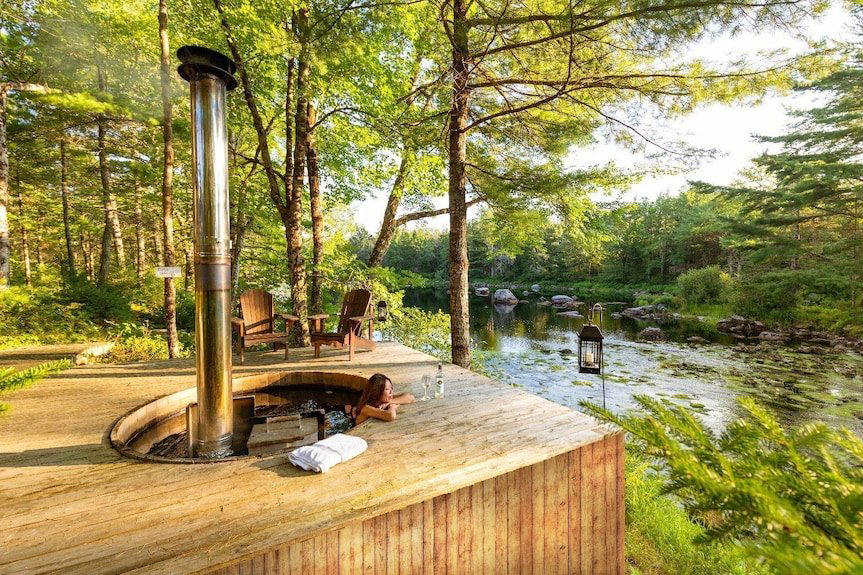
The approach to Trout Point Lodge sets the terms for the stay before you arrive at the door. The drive from the nearest town dissolves gradually into forest, the road narrowing as the Tobeatic Wilderness Area closes in on either side. By the time Trout Point Road delivers you to the property, you have already left behind whatever version of connectivity you brought from the city. This is not incidental atmosphere. It is the design premise. The lodge is built at a point where the Tobeatic river system creates a natural clearing, and the structures read as extensions of that clearing rather than impositions on it. Log and timber construction dominates, with materials that blend the building envelope into the surrounding spruce and hardwood. This category of wilderness architecture, where the primary design challenge is knowing what not to add, has found strong expression in Atlantic Canada, and Trout Point is one of its more committed examples in Nova Scotia.
The Architecture of Deliberate Restraint
Canadian wilderness lodge design has historically split between two approaches: the grand civic-scale timber halls modelled on national park lodges, where scale itself signals prestige, and the smaller, site-specific builds where architecture defers to landscape. Properties like Fairmont Chateau Whistler in Whistler or Fairmont Banff Springs in Banff belong firmly to the first tradition: landmark buildings that shape their landscapes as much as they respond to them. Trout Point operates in the second register. The structure is low-profile against the treeline, favouring horizontal spread over vertical statement. The log construction technique in this region draws on maritime timber traditions, where the density and straightness of Nova Scotia timber gave craftsmen material suited to long horizontal runs rather than the cathedral-pitched rooflines more common in western Canadian lodge architecture.
At Fogo Island, that relationship is rendered in a maximalist, architecturally assertive way; at Trout Point, the resolution is quieter, more absorbed into the setting. Neither approach is wrong. They represent different theories about what a building owes its landscape.
A Boutique Property in a Competitive Canadian Field
The World Travel Awards named Trout Point Lodge as Nova Scotia's Leading Boutique Hotel for 2025, a designation that places it at the head of the province's small-scale accommodation sector. That sector has grown in the Atlantic provinces as travellers increasingly look past the major urban centres, where properties like Hotel Le Germain Montreal in Montreal or Rosewood Hotel Georgia in Vancouver define the upper end of city-based luxury, toward wilderness-anchored alternatives where the land itself is the primary draw.
The boutique hotel category in Canada's wilderness regions is smaller and more contested than in urban markets. Properties like Manoir Hovey in North Hatley, Hôtel Quintessence in Mont-Tremblant, or Elora Mill in Centre Wellington each occupy a specific regional niche where proximity to landscape, low key counts, and design integrity are the differentiating factors. Trout Point operates in that framework within Atlantic Canada, drawing a traveller profile distinct from those seeking Langdon Hall Country House Hotel and Spa in Cambridge's manicured estate model or the national-park grandeur of Fairmont Chateau Lake Louise in Lake Louise.
The Tobeatic as Context, Not Backdrop
Tobeatic Wilderness Area is the largest intact wilderness in the Maritime provinces, covering roughly 1,000 square kilometres of old-growth forest, wetlands, and river systems. For a property sitting at its edge, this is not a scenic backdrop in the resort-marketing sense. It is the reason the property exists where it does, and it shapes the experience in practical terms: the wildlife corridor means encounters with species that have retreated from more developed parts of the Maritimes, the river system creates fishing and paddling conditions that draw visitors with specific outdoor interests, and the low ambient light pollution produces night skies that are increasingly rare on the Eastern Seaboard. Atlantic Canada's wilderness lodges generally benefit from the region's low population density outside Halifax and the Annapolis Valley corridor, and Trout Point sits in one of the more isolated pockets of that already-sparse geography. Booking ahead is advisable, particularly for summer and early autumn when the Tobeatic's deciduous component turns and river conditions are at their most active. For those exploring the broader region, our full East Kemptville guide covers the surrounding area in more detail.
Where Trout Point Sits Among Canada's Wilderness Properties
Placing Trout Point in Canada's wider wilderness lodge conversation is useful for understanding what it does and does not offer. Clayoquot Wilderness Lodge in Tofino operates in a remote-access model with fly-in and boat options, which sets a different logistical register. Deer Lodge and Deerhurst Resort in Huntsville sit on the resort spectrum where amenity breadth rather than site intimacy is the primary offer. Trout Point's position is closer to the intimate end: a low key count, a single river location, and an architectural approach that keeps the property from feeling like a scaled-up facility dropped into a wild setting. For Canadian travellers building a circuit of design-conscious small properties, it fits alongside Le Germain Charlevoix Hotel and Spa in Baie-St-Paul and The Royal Hotel in Picton as Atlantic and eastern Canadian alternatives to the well-documented western mountain lodge circuit.
Planning Your Stay
East Kemptville is most practically accessed by road from Yarmouth or Bridgewater, with the lodge sitting approximately midway between Nova Scotia's southwestern tip and the province's central corridor. The property's remote position means there is no meaningful walkable infrastructure nearby; the stay is self-contained by design. Visitors travelling from outside Atlantic Canada typically fly into Halifax Stanfield International Airport and drive south and west, with the journey taking roughly two to two and a half hours depending on the approach route chosen. Given the World Travel Awards recognition and the property's limited scale, advance booking is not optional for peak season travel: the summer months from late June through September and the October foliage window fill well ahead. For international visitors building a Canadian East Coast itinerary, the lodge pairs logically with Halifax's urban properties or, for those extending westward, with the Quebec properties that define the country's other major French-inflected boutique hotel cluster. Travellers who have experienced the urban polish of Four Seasons Hotel Toronto or the New York reference points of Aman New York will find Trout Point's register deliberately and completely different. That difference is the point.
At-a-Glance Comparison
Comparable venues nearby, for context on price, style, and recognition.
| Venue | Cuisine | Price | Awards | Notes |
|---|---|---|---|---|
| Trout Point Lodge of Nova ScotiaThis venue (the venue you are viewing) | Haute rustic wilderness lodge inspired by early 20th-century Great Camps | $500–750 | World Travel Awards | Not listed |
| The Clayfield | contemporary wine-country retreat | Not listed | Not listed | Old Town Historic District |
| Hastings House | Luxury country-house resort with historic manor-house character. | Not listed | Not listed | Ganges |
| Nobu Hotel & Restaurant Toronto | Intimate luxury urban sanctuary perched atop a mixed-use tower, combining Nobu’s lifestyle brand energy with a residential, retreat-like feel. | $500–750 | Michelin Selected · Virtuoso Luxury Hotel Partner | Entertainment District |
| Hôtel Place d'Armes | Luxury boutique hotel in a restored historic building ensemble | $100–200 | 1 Michelin Key | Old Montreal |
| Sofitel Montreal Golden Mile | Refined French luxury in historic Golden Square Mile setting | Not listed | Michelin Selected | Golden Square Mile |
Recognition history
Dated appearances from independent guides and award organizations, with the underlying list record or original source where available.
World Travel Awards
World Travel Awards
Details
- Rustic
- Romantic
- Scenic
- Cozy
- Quiet
- Intimate
- Romantic Getaway
- Honeymoon
- Anniversary
- Wellness Retreat
- Weekend Escape
- Waterfront
- Panoramic View
- Wi Fi
- Hot Tub
- Sauna
- Massage
- Bicycle Rental
- Waterfront
Rustic luxury with log walls, stone fireplaces, candlelit dining, and a serene forest riverside atmosphere promoting deep relaxation.