Rosewood Cape Kidnappers




Rosewood Cape Kidnappers sits on the clifftop headlands of Hawke's Bay, where 22 suites and a four-bedroom Owner's Cottage look out over the Pacific across a working sheep and cattle station. Ranked among the leading two hotels in New Zealand and Australia by Travel + Leisure and within the top 20 globally by Condé Nast Traveller, it pairs a Tom Doak-designed golf course with wildlife sanctuary access at rates from NZD $2,064 per night.
Pearl is the En Primeur Club membership app — saves, bookings, and concierge access live there. Same editors, same standards.
- Address
- 446 Clifton Road, Te Awanga 4180
- Phone
- +64 6 875 1900
- Website
- rosewoodhotels.com
- Directions
- Get directions
 Saves & bookings on Pearl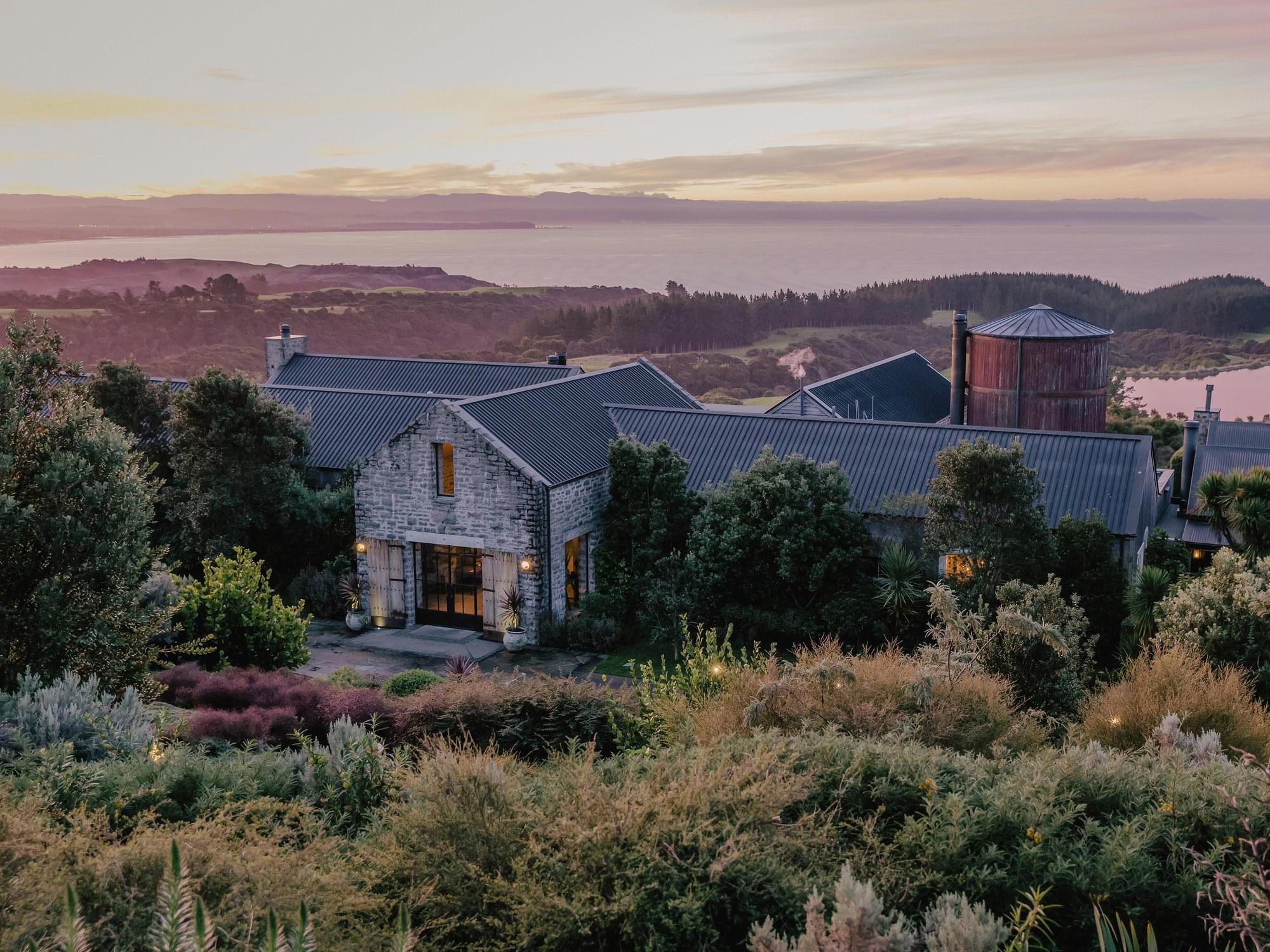
Where Farmland Meets the Pacific
New Zealand's lodge tradition has always worked a particular tension: serious wilderness on one side, serious comfort on the other. What separates the properties that hold this balance from those that merely claim it is usually a matter of site. Rosewood Cape Kidnappers has a notable one. The lodge sits on clifftop headlands at the eastern edge of Hawke's Bay wine country, where rolling farmland drops to rugged coastal bluffs and the Pacific stretches uninterrupted to the horizon. The address, 446 Clifton Road in Te Awanga, places it well outside the district's main hospitality corridor, which is precisely the point. Arrival here involves a drive through working agricultural land before the lodge building resolves into view, and that sequence matters. It resets expectations before a guest ever steps inside. For more on what the wider region offers, see our full Te Awanga restaurants guide.
The Architecture of Controlled Restraint
New Zealand's premium lodge tier has produced two broad design responses to landscape: properties that compete with their surroundings through architectural statement, and those that defer to the view and invest instead in material quality and spatial comfort. Cape Kidnappers takes the second approach deliberately. The main lodge building reads as a modern rural structure, its form close enough to vernacular farmhouse vocabulary to feel grounded in its setting while its interiors are anything but agricultural in finish. The balance is precise enough to avoid both the trap of resort pastiche and the opposite risk of self-conscious minimalism.
All 22 accommodations are configured as suites rather than rooms, each with a private balcony, a separate sitting area within the bedroom, walk-in wardrobes, and a full luxury bathroom. The spatial logic prioritises usable volume over decorative density. Fireplaces, flatscreen televisions, and the period detail of working farm views from every outlook complete a package that sits firmly in New Zealand's highest lodge category. The four-bedroom Owner's Cottage operates as a self-contained property within the estate and represents the leading accommodation format on site, suited to groups or families wanting compound-style privacy without sacrificing lodge services. Comparable design-led rural properties in the New Zealand market include Blanket Bay in Glenorchy, Hapuku Lodge in Kaikoura, and Wharekauhau Country Estate in Featherston, each of which uses a working-land setting as a design anchor rather than a backdrop.
The Golf Course as Landscape Architecture
Among the property's most discussed features is the golf course, designed by Tom Doak, whose reputation in course architecture rests on a commitment to naturalistic routing and minimal earthworks. Doak courses tend to use existing terrain rather than reshape it, which at Cape Kidnappers produces holes that play along and across clifftop ridges with direct sea exposure. The course functions architecturally as an extension of the property's broader design logic: the landscape is the material, and intervention is kept to what serves the game rather than what impresses from a distance. For guests who do not play golf, the course still defines the visual character of the estate when viewed from the lodge and suites, framing the Pacific outlook through a sequence of fairways and headland drops that few managed landscapes can match.
Working Farm, Wildlife Sanctuary, and Guest Experience
Cape Kidnappers operates simultaneously as a working sheep and cattle station and as a conservation sanctuary for native New Zealand flora and fauna, including access to the Cape Kidnappers gannet colony, one of the largest mainland gannet colonies in the world. This combination places it in a small category of luxury properties where agricultural and ecological systems are not decorative props but functional parts of the estate. The Can-Am Exploration, Kiwi Discovery Walk, and gannet colony visit are structured guest experiences rather than optional add-ons, and they reinforce the property's claim to offer something beyond the standard lodge-spa-dining circuit. Similar rural-ecological programming at a comparable tier can be found at Poronui Lodge in Taharua and Eagles Nest in Russell, though the gannet colony access at Cape Kidnappers is specific to this site's geography.
Dining and the Main Lodge
The main lodge houses the guest lounge, library, wine cellar, and snug alongside multiple dining locations, which gives the property a social infrastructure more varied than the single-dining-room model common to smaller lodges. Dining at this level of New Zealand lodge hospitality follows a consistent format: locally sourced produce, refined preparation, and an expectation of formality calibrated to the rural setting. A jacket at dinner is not an unusual requirement in this category. The wine cellar carries particular relevance given the property's location on the eastern edge of Hawke's Bay, one of New Zealand's primary red wine regions, where Bordeaux varieties and Syrah have established strong critical ground over the past two decades.
Recognition and Competitive Position
Cape Kidnappers holds two significant editorial rankings: Travel + Leisure places it among the leading two hotels in New Zealand and Australia, and Condé Nast Traveller ranks it within the global top 20. La Liste's 2026 hotel assessment awarded it 94 points. These are not interchangeable signals: Travel + Leisure rankings tend to reflect experiential breadth and guest satisfaction across a wide readership, while La Liste's scoring system draws on a synthesis of global restaurant and hospitality guides. Together they place Cape Kidnappers at the upper end of the Australasian lodge market rather than merely within it. Rates from NZD $2,064 per night position it above the entry point of the New Zealand lodge category and in direct competition with properties like Huka Lodge, Otahuna Lodge in Tai Tapu, and Helena Bay Lodge. Other properties in the Rosewood portfolio worth comparing include Rosewood Kauri Cliffs in Matauri Bay, which shares the brand's New Zealand lodge model. Further afield in the premium rural New Zealand category, Fiordland Lodge in Te Anau, Annandale Villas in Pigeon Bay, Minaret Station Alpine Lodge in Wānaka, Solitaire Lodge in Rotorua, and Lakestone Lodge in Twizel each occupy distinct landscape registers that attract different guest priorities. Those considering New Zealand's South Island alternatives might also look at Bay of Many Coves in Queen Charlotte Sound or Carnmore Chateau Marlborough in Blenheim. For a lodge-style experience on Waiheke Island, Omana offers a smaller-scale counterpoint. Urban alternatives in Auckland include Hotel DeBrett. For those benchmarking against international city properties of similar editorial standing, Aman New York and Aman Venice operate in a comparable tier by recognition, though the format and context differ entirely. Pompolona Lodge in Fiordland National Park and Mt Cook Lakeside Retreat at Lake Pukaki serve the adventure-adjacent segment of the same market. The The Fifth Avenue Hotel in New York City and Hotel St Moritz Queenstown round out the peer-set picture for travellers weighing options across formats.
Planning a Stay
Cape Kidnappers is reached via Te Awanga on the Hawke's Bay coast, accessible from Napier and Hastings, both of which have domestic air connections from Auckland and Wellington. Given the property's size (22 suites plus the Owner's Cottage), availability at peak periods requires advance planning, particularly during the New Zealand summer months from December through February when the gannet colony is most active. The combination of lodge dining, structured guest experiences, and golf means multi-night stays are the norm rather than the exception here. Guests visiting primarily for Hawke's Bay wine country access should factor in that the lodge's eastern clifftop location places it at a distance from the main winery corridor around Havelock North and the Tuki Tuki Valley, making transport logistics worth considering.
In Context: Similar Options
Comparable venues nearby, for context on price, style, and recognition.
| Venue | Cuisine | Price | Awards | Notes |
|---|---|---|---|---|
| Rosewood Cape KidnappersThis venue — the venue you are viewing | Contemporary luxury lodge on a working farm | $$$$ | Michelin 2 Key | Not listed |
| Wharekauhau Country Estate | Edwardian country mansion with freestanding cottages | $$$$ | Michelin 2 Key | Palliser Bay |
| Otahuna Lodge | Historic Queen Anne mansion on a country estate | $$$$ | Michelin 2 Key | Tai Tapu |
| The Hotel Britomart | Contemporary sustainable luxury in a repurposed waterfront precinct | $$$$ | Michelin 1 Key | Auckland Central |
| Rosewood Kauri Cliffs | Upscale country manor with Hamptons-inspired main lodge and contemporary classic cottages; refined seclusion blending luxury with natural landscape. | $$$$ | Michelin 2 Key | Matauri Bay, Northland Region |
| Blanket Bay | Grand alpine lodge blending colonial New Zealand architecture with modern luxury; native timber and stone construction with contemporary comforts. | $$$$ | Michelin 2 Key | Glenorchy |
Recognition history
Dated appearances from independent guides and award organizations, with the underlying list record or original source where available.
Forbes 4-Star
Forbes
La Liste Top Hotels
La Liste
Virtuoso Luxury Hotel Partner
Virtuoso
Michelin 2 Keys
Michelin
Continue exploring
More in Te Awanga
Restaurants in Te Awanga
Browse all →
Wineries in Te Awanga
Browse all →
At a Glance
- Elegant
- Sophisticated
- Scenic
- Quiet
- Ornate
- Honeymoon
- Romantic Getaway
- Wellness Retreat
- Anniversary
- Weekend Escape
- Golf Course
- Infinity Pool
- Panoramic View
- Private Villa
- Spa
- Pool
- Fitness Center
- Room Service
- Concierge
- Wi Fi
- Golf Course
- Business Center
- Valet Parking
- Waterfront
- Vineyard
- Spa
- Pool
- Fitness Center
- Room Service
- Concierge
- Wi Fi
- Golf Course
- Business Center
- Valet Parking
Serene and elegant with natural light from expansive ocean vistas, cozy fireplaces in suites, and a peaceful hilltop setting.