Eagles Nest



Perched above the Bay of Islands on a 75-acre private estate, Eagles Nest offers four architect-designed villas for a maximum of 22 guests at any one time. The 2025 World Travel Awards named it Oceania's Leading Villa Resort. Access requires a short car ferry crossing to the Russell peninsula, placing it at genuine remove from the Northland mainland.
Pearl is the En Primeur Club membership app — saves, bookings, and concierge access live there. Same editors, same standards.
- Address
- 60 Tapeka Road, Russell 0242
- Phone
- +64 9 403 8333
- Website
- eaglesnest.co.nz
- Directions
- Get directions
 Saves & bookings on Pearl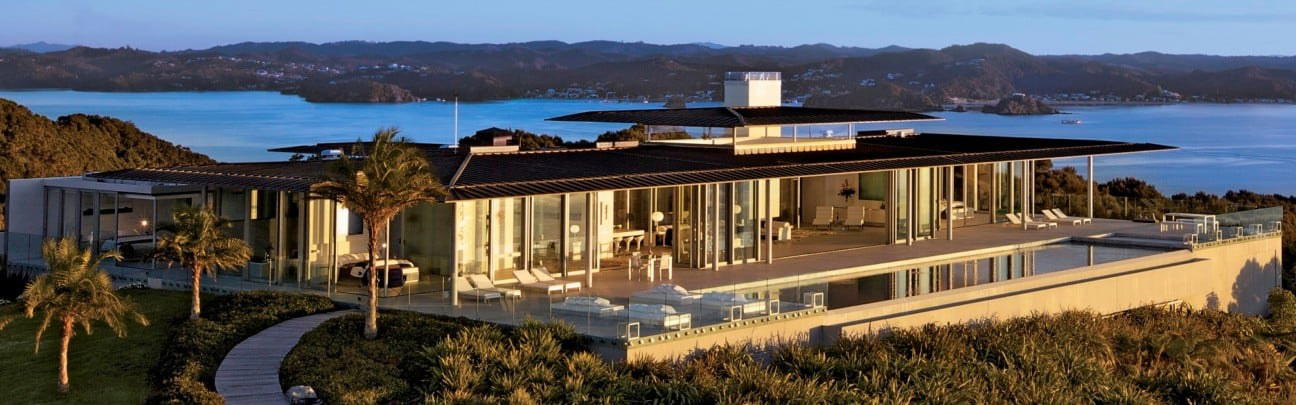
The Physical Logic of Eagles Nest
Approaching Russell by road from the south means crossing the Opua car ferry, a five-minute passage across the narrow channel. The interruption is deliberate in effect if not design: by the time guests reach Tapeka Road, the mainland feels genuinely distant. Eagles Nest sits on 75 acres of headland above one of New Zealand's most complex coastlines, a waterway dense with peninsulas, inlets, and island profiles that accumulate into something the name "Bay of Islands" undersells considerably. The estate's architecture is built to respond to that geography rather than dominate it, using massing, orientation, and glazing to pull the outside in at every turn.
That orientation strategy is the central design argument across all four villas. Each structure reads as a viewing instrument as much as a dwelling: floor-to-ceiling glass frames ocean and island panoramas that shift with the light and season, while the material palette, brushed metals, contemporary stone, polished concrete, keeps the interior register cool enough not to compete with what's outside. The landscape treatment works on similar principles, with native trees, ferns, flaxes, and grasses used to integrate the buildings into the hillside rather than clear it for lawns. Subtropical exotics fill the warmer pockets of the garden, a reminder that Northland's latitude sits meaningfully north of Auckland.
Four Villas, One Design Register
New Zealand's lodge market has polarised in recent years between large-format country house properties and small villa retreats where the unit of accommodation is a private residence rather than a hotel room. Eagles Nest belongs firmly to the latter category. With four villas and a hard ceiling of 22 guests on the property at any one time, it operates in a comparable set closer to Annandale Villas in Pigeon Bay or Omana on Waiheke Island than to properties like Huka Lodge or Rosewood Kauri Cliffs, which operate at higher guest volumes and offer more communal infrastructure.
First Light Villa is the smallest configuration, one bedroom with floor-to-ceiling windows oriented toward the Bay, a private jacuzzi set into the bush, and an outdoor fireplace on the balcony. It functions as the property's most intimate footprint, drawing couples who want privacy without the scale of a full house. The Eyrie Villa steps up to three bedrooms, with a heated lap pool and a large outdoor BBQ deck suited to small groups. Eagle Spirit Villa also runs three bedrooms and adds a heated infinity pool, jacuzzi, and ocean views that track across open water rather than harbour. Sacred Space Villa goes to four bedrooms across a two-storey open-plan structure, with a 20-metre heated infinity pool, jacuzzi, and sauna set into the surrounding planting.
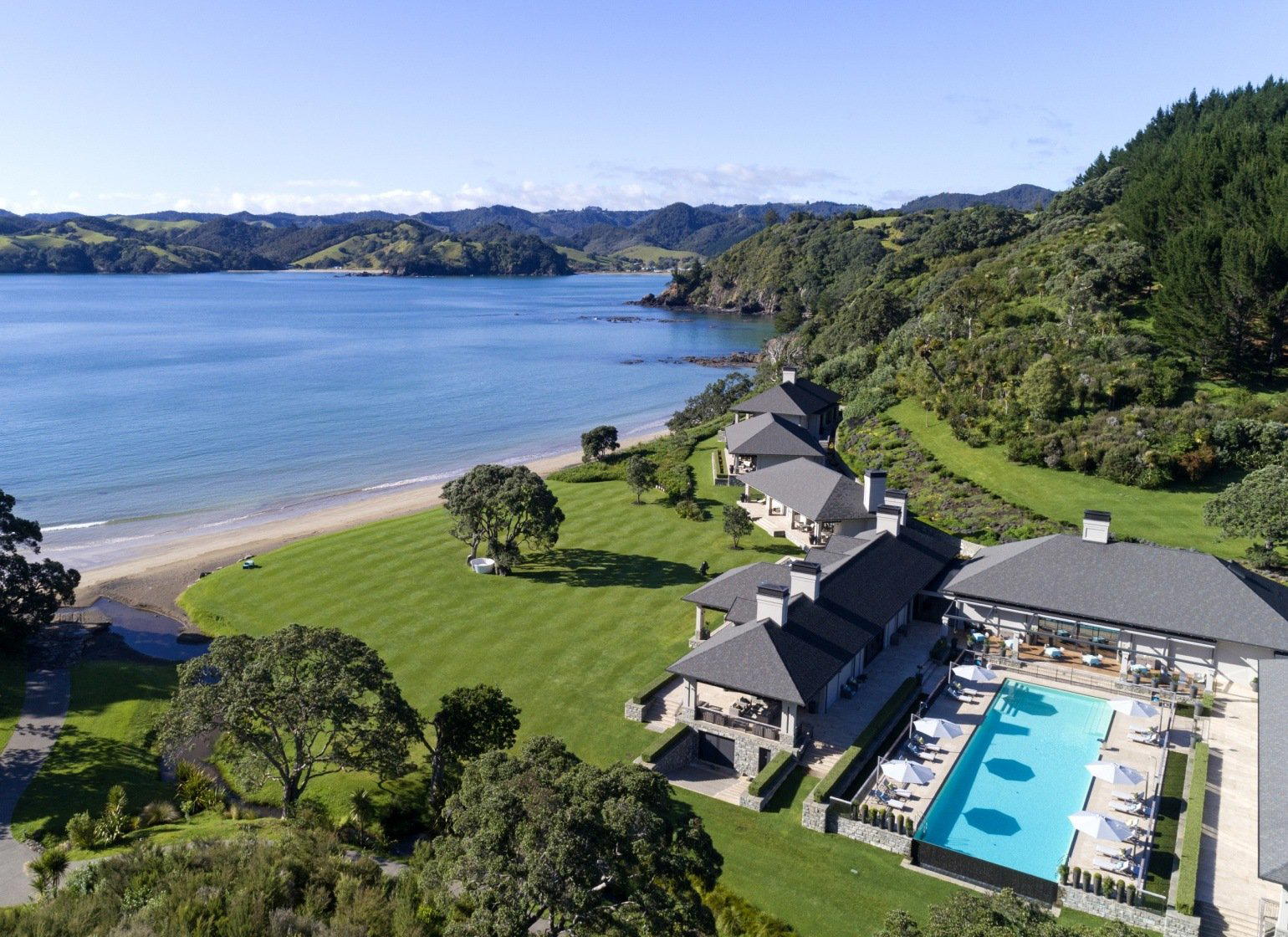
Rahimoana sits above all of these in scale and ambition. The villa occupies 44 acres of private headland with its own beach, delivering 320-degree views across ocean and islands from four bedroom suites. The 25-metre infinity pool, gym, sauna, and jacuzzi are the expected amenities at this tier; the private beach and headland extent are less replicable. As a point of comparison, few villa retreats in the southern hemisphere offer this combination of coastal acreage and finished residential design within a single-property booking. The 2025 World Travel Awards recognised Eagles Nest as Oceania's Leading Villa Resort.
Context: The Russell Location
Russell is the oldest European settlement in New Zealand, and its character as a small historic village is central to the hotel proposition. The property is within walking distance of the village, which means access to a cluster of cafes and the Pompallier Mission on foot. The car ferry connection to Paihia keeps the wider Northland circuit accessible without requiring guests to base themselves in a busier town. Kerikeri Airport sits approximately 45 minutes away by car, including the ferry crossing, making the property reachable from Auckland without a full-day transit. For guests arriving from further afield, Auckland International Airport is the standard routing point before the drive or domestic flight north.
The Bay of Islands as a location provides its own activity architecture. Sailing, deep-sea fishing, and island exploration by tender are the dominant draws on the water, while the Waitangi Treaty Grounds and the broader historical record of the region provide cultural context for guests prepared to engage with it. The hotel keeps activity options open rather than prescribing an itinerary, with the property's design specifically avoiding shared public spaces in favour of villa-contained living. For guests who want structured itineraries or wider-ranging lodge experiences in the North Island, Poronui Lodge and Solitaire Lodge represent the fishing-and-nature end of the same market, while Helena Bay Lodge offers comparable seclusion further down the Northland coast.
Dining and Self-Sufficiency
The accommodation format here is residential rather than hotel-standard, which shapes the dining model accordingly. Each villa comes with a full kitchen and brushed-metal appliances, and self-catering is a genuine option rather than a token one. The property also offers access to a personal chef, giving guests the ability to calibrate the experience along a spectrum from full privacy and self-sufficiency to catered meals within their villa. Russell's restaurant scene provides an external option for guests who want to eat out;
How Eagles Nest Sits in New Zealand's Lodge Market
New Zealand's premium lodge sector is well-developed relative to the country's size, with strong competition from properties like Otahuna Lodge in Canterbury, Wharekauhau Country Estate, Fiordland Lodge, and Rosewood Cape Kidnappers across both islands. The hotel occupies a specific position within that field: its villa format, its Northland geography, and its hard limit on guest numbers make it a different proposition from lodge-format properties that operate shared dining rooms and activity programmes. The design register is also distinct. Where properties like Hapuku Lodge or Lakestone Lodge lean into vernacular or landscape-referencing architecture, the hotel reads as international contemporary, with the natural setting providing the warmth rather than the material palette. That positions it closer, philosophically, to villa-format properties in Southeast Asia or the Indian Ocean than to the classic New Zealand country lodge.
For those extending a New Zealand itinerary across both islands or comparing options in the South Island premium tier, Carnmore Chateau Marlborough, Hotel St Moritz Queenstown, and Mt Cook Lakeside Retreat represent different points on the same premium spectrum.
Planning Your Stay
Getting to the hotel involves flying into Kerikeri Airport (approximately 45 minutes from the property) or driving from Auckland, the latter a journey of roughly three to four hours depending on traffic through Northland. The Opua-Okiato ferry crossing adds five minutes to the final approach and runs continuously throughout the day. Room availability across the four villas is limited by design; the property carries a maximum of 22 guests at any one time, which means forward planning is essential, particularly during the New Zealand summer season from December through February when Bay of Islands demand peaks. The property operates a personal chef arrangement rather than a central restaurant, with self-catering available in all villas as an alternative.
Fast Comparison
Comparable venues nearby, for context on price, style, and recognition.
| Venue | Cuisine | Price | Awards | Notes |
|---|---|---|---|---|
| Eagles NestThis venue — the venue you are viewing | Exclusive private villa retreat on a clifftop estate | $$$$ | Michelin 1 Key | Not listed |
| Delamore Lodge | Secluded clifftop luxury lodge | $$$$ | Michelin 1 Key | Oneroa |
| Bay of Many Coves | luxury waterfront resort | $$$$ | Michelin 1 Key | Queen Charlotte Sound |
| The Hotel Britomart | Contemporary sustainable luxury in a repurposed waterfront precinct | $$$$ | Michelin 1 Key | Auckland Central |
| Hotel Fitzroy by Luminous | Restored historic villa with modern annex | $$$$ | Michelin 1 Key | Grey Lynn |
| Park Hyatt Auckland | Contemporary luxury waterfront residence with Māori-inspired design accents and sophisticated modern furnishings. | $$$$ | Michelin 1 Key | Auckland Central |
Recognition history
Dated appearances from independent guides and award organizations, with the underlying list record or original source where available.
Mr & Mrs Smith Smith Seal of Approval
Mr & Mrs Smith
Virtuoso Luxury Hotel Partner
Virtuoso
Michelin 1 Key
Michelin
World Travel Awards
World Travel Awards
Continue exploring
More in Russell

At a Glance
- Romantic
- Scenic
- Elegant
- Intimate
- Sophisticated
- Honeymoon
- Romantic Getaway
- Anniversary
- Weekend Escape
- Panoramic View
- Infinity Pool
- Pool
- Spa
- Hot Tub
- Wi Fi
- Massage
- Waterfront
- Pool
- Spa
- Hot Tub
- Wi Fi
- Massage
Serene and luxurious with dramatic clifftop views, cozy fireplaces, relaxing hot tubs, and a zen-like peaceful atmosphere praised in guest reviews.