
Pulso Hotel Faria Lima occupies 57 rooms in Pinheiros, designed by architect Arthur Casas around an upcycled material aesthetic that runs continuously from spa to dining to guest floor. The property operates at a scale where design coherence is structurally maintainable, placing it in São Paulo's smaller, architecture-led luxury tier rather than with the city's large international flagships. Terrace rooms extend that contrast between interior restraint and the São Paulo skyline outside.
 Discover on Pearl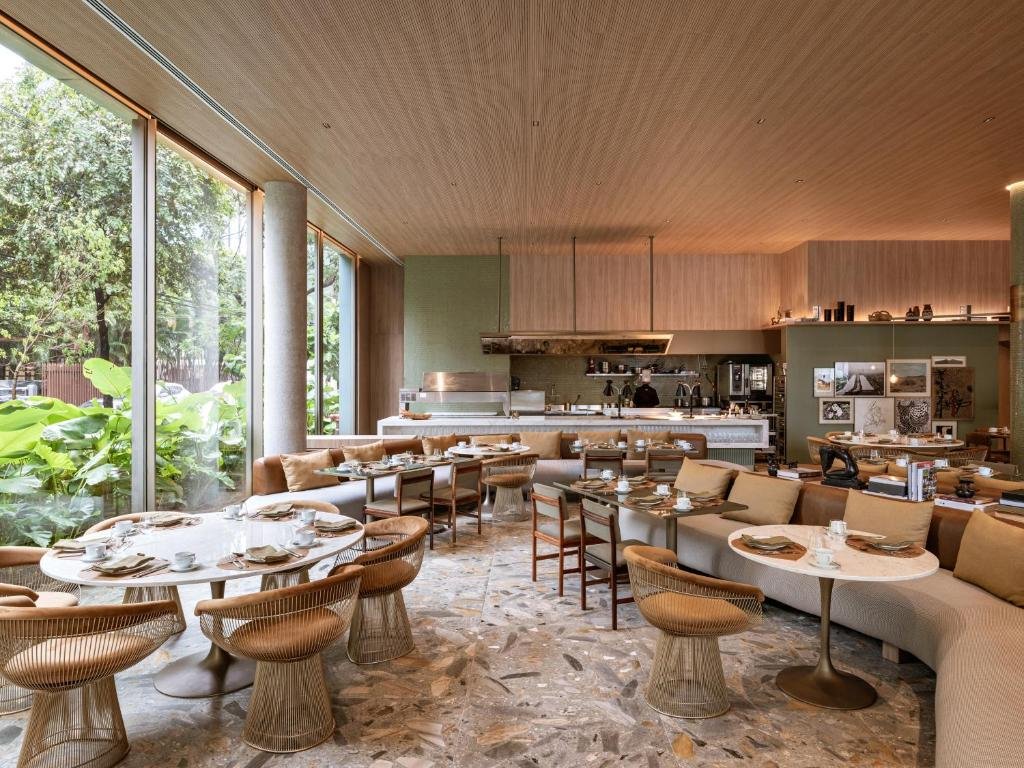
Where Pinheiros Meets Its Quieter Self
Faria Lima's financial corridor is one of São Paulo's most relentless stretches: glass towers, constant traffic, the particular energy of a city that treats ambition as a resting state. Arriving at Pulso Hotel Faria Lima on Rua Henrique Monteiro, in the Pinheiros pocket just west of the avenue's main axis, you step into something calibrated in deliberate opposition to that intensity. The building, designed by architect Arthur Casas, communicates through restraint rather than spectacle. Upcycled materials, a coherent aesthetic that runs from the lobby through corridors and into the rooms, and a layout that makes it genuinely possible to move between spa, dining, and bed without the property's logic ever breaking.
São Paulo's premium hotel market has historically divided between large international flagships anchored near Paulista or Itaim — places like the Grand Hyatt São Paulo, the JW Marriott Hotel São Paulo, or the address-conscious Hotel Fasano Sao Paulo Itaim — and smaller, design-led properties that compete on atmosphere and specificity rather than scale. Pulso belongs firmly to the second category. With 57 rooms, it operates at a size where individual attention is structurally possible rather than a marketing claim.
The shortlist, unlocked.
Hard-to-book tables, cellar releases, and concierge-planned trips.
Get Exclusive Access →Arthur Casas and the Upcycled Aesthetic
Brazilian architecture has a long tradition of treating ecological concern as a formal principle rather than an afterthought. Casas, one of the more influential figures in contemporary São Paulo design, carries that tradition into Pulso's interior logic. The upcycled aesthetic is not incidental branding , it structures the experience of moving through the property. Materials are chosen for a second life; the visual language is one of considered reuse rather than pristine newness.
This positions Pulso in a growing tier of urban hotels that treat sustainability not as a certification plaque near the reception desk but as a spatial condition. The guest does not have to seek out the environmental commitment; it is present in what the building looks and feels like. That approach is more demanding than a recycling programme and, when executed with Casas-level rigour, more convincing. Comparable design seriousness in São Paulo tends to appear at properties like Hotel Unique, where architectural identity is the product's primary argument. Pulso makes a similar bet, on a smaller footprint and with a different material vocabulary.
Across Brazil, properties that have built sustainability into their architectural DNA rather than layering it onto existing structures have found a distinct guest profile. The Cristalino Lodge in Alta Floresta does this in an Amazonian context; Botanique Hotel Experience in Campos do Jordão takes the same structural commitment into mountain terrain. Pulso translates that discipline to a dense urban address , arguably the harder task, where the temptation to default to standard luxury finishes is strongest.
The Room Configuration and the Terrace Advantage
The 57-room count keeps the property in a bracket where operational choices remain visible to guests , staffing ratios, morning quietness, the absence of convention-group corridors. Within the room inventory, terrace rooms carry a specific editorial argument: the contrast between Casas's contained, sculptural interior and the São Paulo skyline pressing in from outside is part of what makes the property coherent as an experience. You do not come to Pulso to be insulated from the city; you come to have a vantage point on it that the city itself cannot provide.
The hotel's own description invokes the image of sleeping in an abstract treehouse inside a modern art museum , which is the kind of claim that either lands or reads as overclaiming depending entirely on how well the architecture delivers. Based on the Casas track record and the property's positioning, the treehouse logic holds: elevation, visual remove, and a surrounding aesthetic that operates by its own rules.
Guests weighing Pulso against São Paulo's larger luxury addresses should understand the trade-off clearly. The Rosewood São Paulo and Emiliano São Paulo offer a different proposition: broader amenity sets, higher room counts, and the kind of brand assurance that operates internationally. Palácio Tangará offers park-facing seclusion. Pulso's argument is neither scale nor seclusion , it is design coherence and neighbourhood specificity in one of the city's most active residential and commercial zones.
Spa, Dining, and the Integrated Property Logic
One of the structural claims Pulso makes is that its layout allows movement between spa, dining, conference, and bedroom without the property's aesthetic logic interrupting. This is a more specific claim than simply having multiple amenities on site. It implies that the design was conceived as a single system rather than a collection of functions bolted together , which is consistent with Casas's practice and with the upcycled material continuity that presumably runs across the property's zones.
For a 57-room hotel with this kind of conceptual ambition, the wellness offer and dining programme are likely calibrated to the same guest who chose the property for the design , which means both will reward guests who engage with them rather than treating them as generic hotel add-ons. Guests planning extended stays in São Paulo should factor this into timing: check-in during the week to access the property's meeting and conference facilities without weekend-event congestion, and plan spa access for late afternoon, when the Faria Lima professional crowd transitions out of the day.
Pinheiros and What the Neighbourhood Adds
Staying in Pinheiros rather than in Itaim or Jardins changes the São Paulo itinerary meaningfully. The neighbourhood runs younger and less corporate than the Faria Lima tower corridor two blocks away. Its restaurant and bar scene draws from across the city; its streets are walkable in a way that few São Paulo districts genuinely are. For guests using the hotel as a base for the wider city, the full São Paulo restaurants guide covers what the surrounding area , and the city broadly , offers across cuisines and price points.
Brazil's wider hotel spectrum is worth mapping for guests building a multi-destination itinerary. For Rio, the Copacabana Palace, A Belmond Hotel, Rio de Janeiro operates at a different scale and historical register. For nature-anchored travel, Caiman, Pantanal in Miranda and the Atlantica Jungle Lodge in Vila Do Abraao each offer ecological immersion that complements a design-led urban stay. For coastal transitions, Barracuda Hotel & Villas in Itacaré, Carmel Charme Resort in Ceará, and Carmel Taíba Exclusive Resort in Taíba hold the northern coastline options. In the south, Casas Brancas Boutique Hotel & Spa in Armacao de Buzios, Buona Vitta Gramado in Gramado, and Castelo Saint Andrews in Vale do Bosque serve different preferences in the Serra Gaúcha. Awasi Santa Catarina brings the Awasi group's ecological attentiveness to the Brazilian south. And for those extending to Iguassu, Hotel das Cataratas, A Belmond Hotel, Iguassu Falls remains the reference address at the falls.
Planning Your Stay
Pulso Hotel Faria Lima sits on Rua Henrique Monteiro, 154, in Pinheiros , a ten-to-fifteen minute drive from Congonhas Airport depending on traffic, and accessible from Guarulhos in forty-five to sixty minutes outside peak hours. São Paulo's traffic patterns make arrival timing genuinely consequential; the hotel's location slightly off the main Faria Lima axis helps, but the city's peak congestion runs from roughly 07:00 to 09:30 and 17:30 to 20:00. The property's 57 rooms mean availability, particularly for terrace categories, tightens around major São Paulo business events and during high season months from October through March. Booking two to four weeks ahead is a reasonable minimum for standard rooms; terrace rooms warrant earlier action. For international itineraries pairing Pulso with other design-led hotels, the Aman New York and The Fifth Avenue Hotel in New York City represent comparable commitments to architectural specificity in dense urban settings, as does Aman Venice for European extensions.
The shortlist, unlocked.
Hard-to-book tables, cellar releases, and concierge-planned trips.
Get Exclusive Access →Frequently Asked Questions
Price and Positioning
A short peer set to help you calibrate price, style, and recognition.
| Venue | Price | Awards | Notes |
|---|---|---|---|
| Pulso Hotel Faria Lima | This venue | ||
| Rosewood São Paulo | World's 50 Best | ||
| JW Marriott Hotel São Paulo | |||
| Emiliano São Paulo | |||
| Hotel Fasano São Paulo | |||
| Hotel Unique |
Preferential Rates?
Our members enjoy concierge-led booking support and priority upgrades at the world's finest hotels.
Get Exclusive AccessThe shortlist, unlocked.
Hard-to-book tables, cellar releases, and concierge-planned trips.
Get Exclusive Access →