Cristalino Lodge


Virtuoso Luxury Hotel Partner
Set within a private natural heritage reserve of more than 11,000 hectares in the southern Brazilian Amazon, Cristalino Lodge positions itself at the intersection of ecological seriousness and considered design. Expert naturalist guides lead immersive wildlife observations through one of the Amazon's most species-rich corridors, while à la carte Amazonian cuisine by Chef Fábio Vieira grounds the experience in regional identity. Access is straightforward via Alta Floresta Airport, with connecting flights from Brazil's major state capitals.

Pearl is the En Primeur Club membership app, where members save venues, book tables and use the concierge.
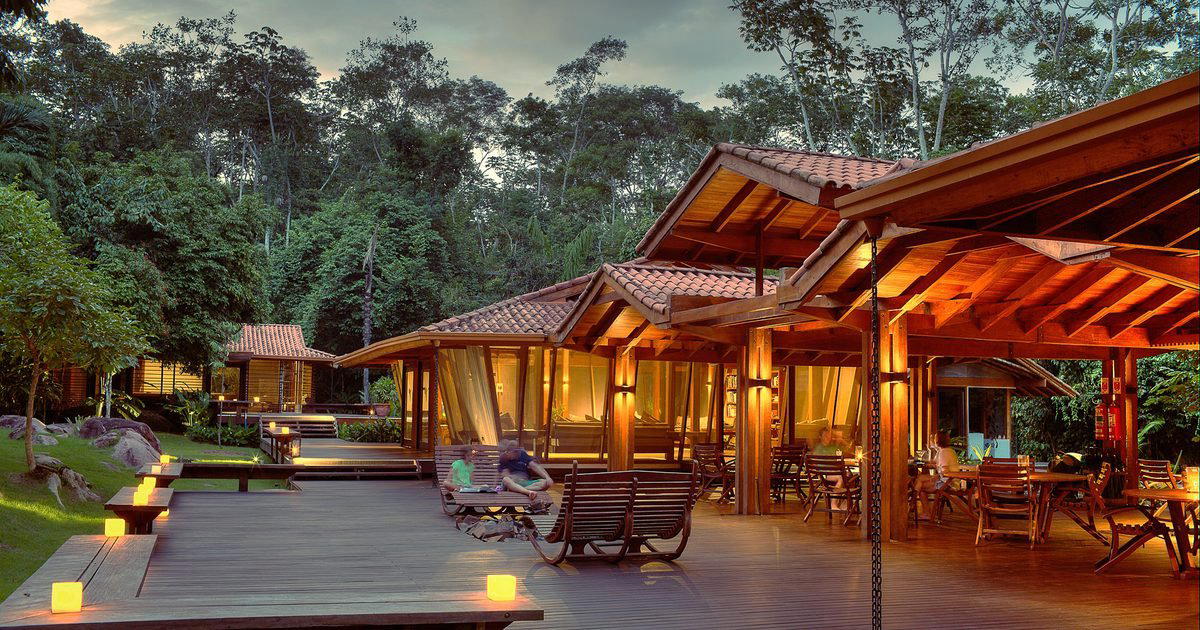
Where the Amazon Announces Itself
The approach to Cristalino Lodge does not ease you in gently. From Alta Floresta Airport, a 40-minute road transfer gives way to a boat journey along the Teles Pires and Cristalino rivers, a deliberate sequence that strips away the ambient noise of the outside world and replaces it with something older: the layered canopy of the southern Amazon, bird calls carrying across open water, and the particular quality of light that filters through 11,000 hectares of unbroken rainforest. By the time the lodge appears on the riverbank, the transition is complete. You are inside the forest, not adjacent to it.
That physical immersion is not accidental. The lodge sits within the Cristalino Private Natural Heritage Reserve, a protected area spanning more than 11,000 hectares in Mato Grosso state, a footprint roughly twice the size of Manhattan. In an Amazon context where private reserves of this scale are increasingly rare, that land holding is the primary design decision. Everything else, the accommodations, the guiding operation, the dining program, exists in service of the reserve's ecology rather than the other way around.
The Architecture of Restraint
Premium eco-lodges in Brazil have split across two broad approaches over the past decade. One favours architectural spectacle: cantilevered structures, infinity edges, imported materials that signal luxury through contrast with the surroundings. The other approach treats the forest as the primary experience and builds accordingly, low-profile structures, local materials, design decisions oriented around sightlines into canopy rather than away from it. Cristalino Lodge belongs firmly to the second school.
The accommodations are designed to recede. refined walkways connect the main areas of the lodge to individual rooms, keeping ground disturbance minimal and allowing wildlife movement beneath the structures, a choice that reflects genuine conservation thinking rather than decorative rusticity. The Cristalino region carries serious ornithological credentials: it is widely regarded among naturalists as one of the most productive areas in the entire Amazon for wildlife observation, a reputation built on the confluence of multiple forest types within the reserve's boundaries. The lodge's design philosophy defers to that ecology at every turn.
For travellers accustomed to the design-led properties that have proliferated across Brazil's coastal destinations, from the considered minimalism of Fasano Boa Vista in Porto Feliz to the coastal luxury of Hotel Fasano Trancoso, Cristalino represents a different kind of premium entirely. The measure of quality here is not thread count or architectural provenance but the calibre of naturalist guiding, the density of wildlife encounters, and the integrity of the protected landscape itself.
A Reserve, Not a Resort
The distinction matters. Brazil's premium accommodation market ranges from the grand urban hotels, Copacabana Palace and Rosewood São Paulo operating as city-centre institutions, to nature-led retreats where the surrounding environment is the core product. Within that nature-led category, there is a further distinction between properties that sit adjacent to protected land and properties that occupy it directly. Cristalino sits in the latter position. Guests are not visiting the Amazon from a comfortable buffer zone; they are sleeping inside a working natural reserve, guided through it each day by specialists whose expertise shapes the entire experience.
The naturalist guides represent the lodge's most consequential operational asset. In wildlife-focused properties across South America, from the Pantanal lodges, including Caiman, Pantanal in Miranda, to Patagonian retreats, the quality of the guiding team is the single most reliable predictor of guest satisfaction. At Cristalino, that guiding program operates within a reserve whose ecological diversity is recognised among ornithologists and naturalists as exceptional by any measure applicable to the Brazilian Amazon.
Cuisine Drawn from the Region
Dining program operates on à la carte terms rather than a fixed menu, with a kitchen led by Chef Fábio Vieira working through Amazonian ingredients and culinary traditions. In the broader context of Brazilian gastronomy, this kind of regionally-anchored Amazon cuisine remains relatively rare at the premium end of the market, most high-end Brazilian hotels lean toward European-inflected cooking or mainstream Brazilian fare, particularly outside the major urban centres. A kitchen at this latitude, working with ingredients sourced from the region's biodiversity, occupies a niche position within the country's hospitality landscape.
À la carte format also signals a different relationship with guests than the all-inclusive or set-menu structures common at comparable international eco-lodges. It allows the kitchen to respond to availability and seasonality while giving guests some agency over their meals, a structure that suits the longer-stay pattern typical of serious wildlife travellers, for whom predictable fixed menus become repetitive over multiple days.
Getting There
Cristalino Lodge positions itself as one of the more accessible lodges in the Brazilian Amazon, and the infrastructure supports that claim. Alta Floresta Airport (AFL) connects to leading state capitals across Brazil, making the lodge reachable without the multi-leg bush-plane transfers that characterise some deeper Amazon destinations. From AFL, the lodge's own team handles the transfer: a 40-minute road journey followed by a river boat transfer along the Teles Pires and Cristalino rivers. That final river approach is operationally necessary but also functions as the transition point, the moment the forest takes over from the infrastructure of the outside world.
For travellers building a wider Brazil itinerary that combines urban centres with nature destinations, Cristalino fits logically into a route that might include Hotel das Cataratas at Iguassu Falls or coastal properties such as Barracuda Hotel and Villas in Itacaré and Kenoa Exclusive Beach and Spa Resort in Barra de São Miguel. Bookings should be arranged directly with the lodge well in advance; the reserve's protected status and the lodge's limited capacity mean availability during peak wildlife observation periods fills considerably ahead of travel dates. Guests looking for comparable nature-led experiences in Brazil should also consider Atlantica Jungle Lodge in Vila do Abraão.
For more on what Alta Floresta offers as a base for Amazon exploration, see our full Alta Floresta guide.
How Cristalino Sits in the Premium Nature-Lodge Tier
Brazil's nature-led premium segment has grown but remains stratified. At the leading sits a small group of properties where the combination of reserve quality, guiding depth, and accommodation standard creates a genuinely differentiated experience, properties that compete less on price and more on the specificity of what they offer. The relevant comparisons are not other Brazilian hotels but specialist wildlife lodges operating on large private land holdings elsewhere in South America and Africa.
For travellers whose primary measure of a lodge is what they will see and learn rather than what they will eat or how the bathroom is finished, Cristalino's offer is clear. The design recedes so the forest can advance. That is a considered position, and it is the right one for this location. Other Brazil properties worth considering for different styles of premium travel include Awasi Santa Catarina, Botanique Hotel Experience in Campos do Jordão, and NÓR Hotel and Spa in São Roque for those seeking design-led properties with strong natural settings but a different emphasis than deep-forest immersion.
Fast Comparison
Comparable venues nearby, for context on price, style, and recognition.
| Venue | Cuisine | Price | Awards | Notes |
|---|---|---|---|---|
| Cristalino LodgeThis venue (the venue you are viewing) | rustic luxury eco-jungle lodge | Not listed | Virtuoso Luxury Hotel Partner | Not listed |
| Vila Kalango | Eco-friendly beachfront pousada with stilt houses and bungalows. | $100–200 | Michelin Selected | Jericoacoara |
| Nobu Hotel São Paulo | Luxury lifestyle hotel and residences with a restaurant-led mixed-use concept. | Not listed | Not listed | Wall Street district |
| Hotel das Cataratas, A Belmond Hotel, Iguassu Falls | Restored 1950s hacienda with Portuguese colonial elegance | $500–750 | 3 Michelin Keys · World's 50 Best #77 | Iguassu National Park |
| Vila d’este | Contemporary classic boutique hotel with Mediterranean influences and rustic antique-chic design elements; small luxury property emphasizing privacy and intimacy. | $300–500 | Michelin Selected | Alto do Humaitá, Centro |
| Aventora Resort Baía Formosa, Minor Reserve Collection | Luxury eco‑resort and branded residence enclave positioned as a landmark destination in northeastern Brazil’s Baía Formosa region. | Not listed | Not listed | Baía Formosa |
Recognition history
Dated appearances from independent guides and award organizations, with the underlying list record or original source where available.
Robb Report The 50 Greatest Luxury Hotels on Earth
Robb Report · 2026 Robb Report The 50 Greatest Luxury Hotels on Earth
Virtuoso Luxury Hotel Partner
Virtuoso
Details
- Scenic
- Quiet
- Rustic
- Intimate
- Family Vacation
- Wellness Retreat
- Weekend Escape
- Group Retreat
- Garden
- Waterfront
- Terrace
- Panoramic View
- Restaurant
- Bar
- Concierge
- Waterfront
- Garden
Immersive, quiet rainforest setting with a close-to-nature, low-impact atmosphere; guests describe it as a pristine jungle retreat with harmonious, understated elegance.