Post House

Post House Charleston transforms an 1896 Mount Pleasant landmark into an intimate seven-room boutique inn where British tavern tradition meets Lowcountry sophistication. Located in the historic Old Village just minutes from downtown Charleston, this design-driven retreat combines individually styled suites with farm-to-table dining and relationship-focused hospitality.
 Discover on Pearl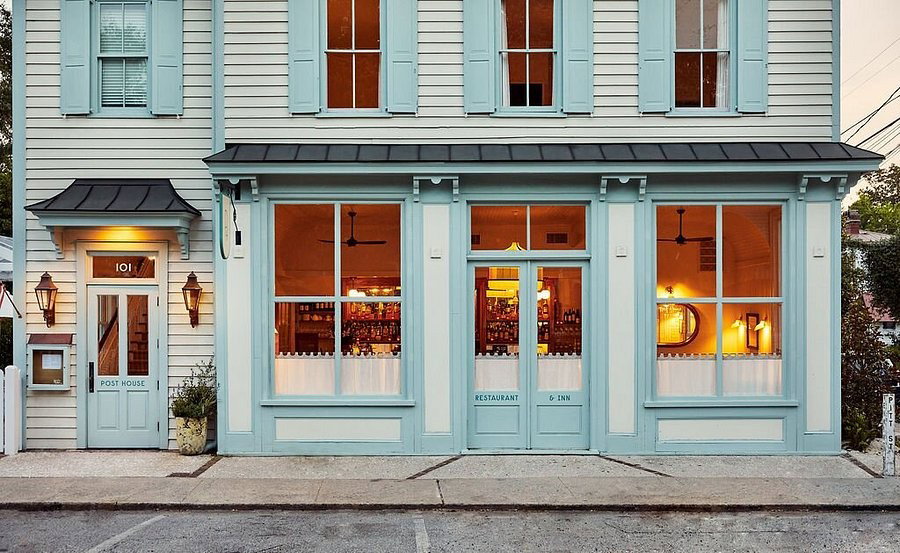
Where Mount Pleasant Slows Down
Across the Ravenel Bridge from Charleston proper, Mount Pleasant operates on a quieter frequency. The streets around Pitt Street retain a residential scale that downtown's increasingly trafficked corridors have long since lost, and it is in this context that Post House makes its most coherent argument. Arriving at the property, a well-preserved 19th-century structure on 101 Pitt Street, the visual register is one of unhurried Southern domesticity rather than hotel theatrics. There is no porte-cochère, no lobby designed to announce itself. What greets you instead is the kind of architectural restraint that signals a considered retreat from spectacle.
That framing matters for understanding what Post House actually is. The boutique inn format, now common enough across both Charleston and comparable mid-size American cities with strong preservation cultures, tends to split between properties that lean hard on period costuming and those that treat historic fabric as a foundation for something more contemporary in sensibility. Post House sits clearly in the second camp. The interiors work with, rather than perform, the 19th-century bones of the building, and the result avoids the costumed-antebellum trap that catches a number of its regional peers.
Seven Rooms and the Logic of Small-Scale Hospitality
The small-scale retreat format has become one of the more interesting pressure points in American boutique hospitality. At seven rooms, Post House operates in a tier where the economics force genuine curation: there is no revenue buffer of a 60-room floor to absorb a careless staffing decision or an underperforming design choice. Properties of this size succeed or fail on the quality of each individual room and on the coherence of the overall experience. The Michelin Key recognition Post House received in 2024 places it within a peer set that includes HarbourView Inn and Hotel Bennett Charleston at the one-Key level, while The Loutrel and The Pinch Charleston occupy the two-Key tier above it.
What the seven-room scale enables, practically, is a degree of quiet that larger properties structurally cannot offer. The retreat logic here is spatial: fewer guests means fewer corridors of foot traffic, fewer competing schedules at breakfast, and a pace that reads less like a hotel and more like occupying a well-appointed private residence for the duration of your stay. For travellers arriving from high-density urban contexts, that shift in register is the primary draw, operating well before any specific amenity enters the calculation.
The Restaurant as Anchor
Post House is perhaps most accurately understood as a fine restaurant with a small number of beautifully appointed guest rooms attached, rather than the other way around. This model, where the dining operation carries the identity and reputation of the property, has precedent in some of the more considered small American inns. It places the food and beverage program at the center of the guest experience in a way that distinguishes Post House from hotels where the restaurant is secondary infrastructure.
The broader Charleston dining scene, which has moved steadily toward national recognition over the past decade, provides useful context here. The city's culinary reputation now operates well beyond regional interest, and properties in the metropolitan area that invest seriously in their food programs benefit from that refined baseline. For a more complete picture of where dining in the city stands right now, our full Charleston restaurants guide covers the range from counter-service to tasting-menu formats.
Retreat Conditions: What Mount Pleasant Actually Offers
The wellness and retreat case for Post House is not built on a spa menu or a fitness programming schedule. It is built on conditions: a residential neighbourhood at human scale, a seven-room property that operates without the ambient noise of a full-service hotel, and a dining operation serious enough that meals anchor rather than merely fuel the day. For travellers whose understanding of rest involves deceleration rather than programmed activity, that combination is more directly useful than an infrared sauna and a class timetable.
This positions Post House differently from dedicated wellness properties like Canyon Ranch Tucson or landscape-driven retreats such as Amangiri in Canyon Point, where the program is the product. Post House offers the retreat condition through subtraction rather than addition: fewer rooms, a quieter neighbourhood, a domestic architectural register, and a dining room that rewards lingering.
The comparison also holds when placed against larger-footprint Charleston properties. The Dewberry, Hotel Bennett Charleston, and Market Pavilion Hotel each offer a more conventional full-service hotel experience within Charleston proper. Post House trades that breadth of amenity for specificity of atmosphere, and the trade is a coherent one for the right traveller.
Mount Pleasant's Position in the Charleston Orbit
Mount Pleasant is the largest municipality in South Carolina by area, a fact that surprises most visitors who encounter it as a quieter alternative to Charleston's historic peninsula. The Pitt Street corridor, where Post House sits, is among its older residential zones, with a neighbourhood character that predates the suburban expansion that defines much of the town's modern footprint. Access to downtown Charleston is direct via the Ravenel Bridge, putting the peninsula's concentration of restaurants, bars, and cultural sites within fifteen to twenty minutes by car.
For guests who want to move between the retreat conditions of Mount Pleasant and the denser programming available downtown, that proximity is a practical advantage. Our full Charleston bars guide and our full Charleston experiences guide map the range of what's available on the peninsula side, while our full Charleston hotels guide covers the full accommodation spectrum for those still weighing neighbourhood options.
Properties like The Spectator Hotel, 86 Cannon Charleston, and HarbourView Inn place guests within the historic district's walking radius, which is a meaningfully different base of operations than Mount Pleasant. The choice between them is ultimately a question of what kind of stay architecture works for a given trip.
Planning Your Stay
Post House operates at seven rooms and rates begin at $250 USD per night, though pricing is confirmed on a per-inquiry basis rather than through a public booking engine. That model reflects the property's approach to hospitality: reservations are handled through EP Club's customer service team, who gather additional information to confirm the stay. Given the limited room count, lead time matters, particularly during Charleston's peak spring and fall travel windows when demand across the city's boutique tier runs high. Properties of this scale do not absorb last-minute demand in the way that larger hotels can.
For those building a longer regional itinerary, Post House pairs logically with a run of days in downtown Charleston or with excursions toward the ACE Basin and Lowcountry coast. The Charleston wineries guide covers options for those extending their time in the broader region. Travellers comparing the small-retreat format across American markets may also find useful context in how similar properties position themselves: Little Palm Island Resort & Spa in Little Torch Key and Kona Village, A Rosewood Resort in Kailua-Kona represent the destination-island end of the low-key-count luxury spectrum, while Auberge du Soleil in Napa offers a comparable restaurant-anchored inn model in a different regional context. At the urban end of that comparison, Aman New York and The Fifth Avenue Hotel in New York City show how the small-footprint luxury format translates into major metropolitan markets, while Hotel Bel-Air in Los Angeles and Four Seasons at The Surf Club in Surfside provide coastal American benchmarks. Internationally, Aman Venice and Badrutt's Palace Hotel in St. Moritz sit at the higher end of the historic-property-as-retreat model, and Raffles Boston represents the grand-hotel alternative for travellers who want scale alongside heritage.
Frequently Asked Questions
Recognition, Side-by-Side
A quick peer reference to anchor this venue in its category.
| Venue | Awards | Cuisine | Notes |
|---|---|---|---|
| Post House | Michelin 1 Key | This venue | |
| Zero George | |||
| The Loutrel | Michelin 2 Key | Michelin 2 Keys | |
| The Pinch Charleston | Michelin 2 Key | Michelin 2 Keys | |
| HarbourView Inn | Michelin 1 Key | Michelin 1 Key | |
| Hotel Bennett Charleston | Michelin 1 Key | Michelin 1 Key |
Preferential Rates?
Our members enjoy concierge-led booking support and priority upgrades at the world's finest hotels.
Get Exclusive Access