Zero George


Five restored 1804 brick residences at the corner of George Street and East Bay form one of Charleston's most private small hotels. Zero George occupies a different register than the Peninsula's larger properties: crushed oystershell garden paths, flickering lanterns, and a labyrinthine interior courtyard that reads more like a personal residence than a commercial lodging. Part of the Easton Porter Group, the property has held a 4.8-star rating across more than 900 Google reviews since opening in 2013.
 Discover on Pearl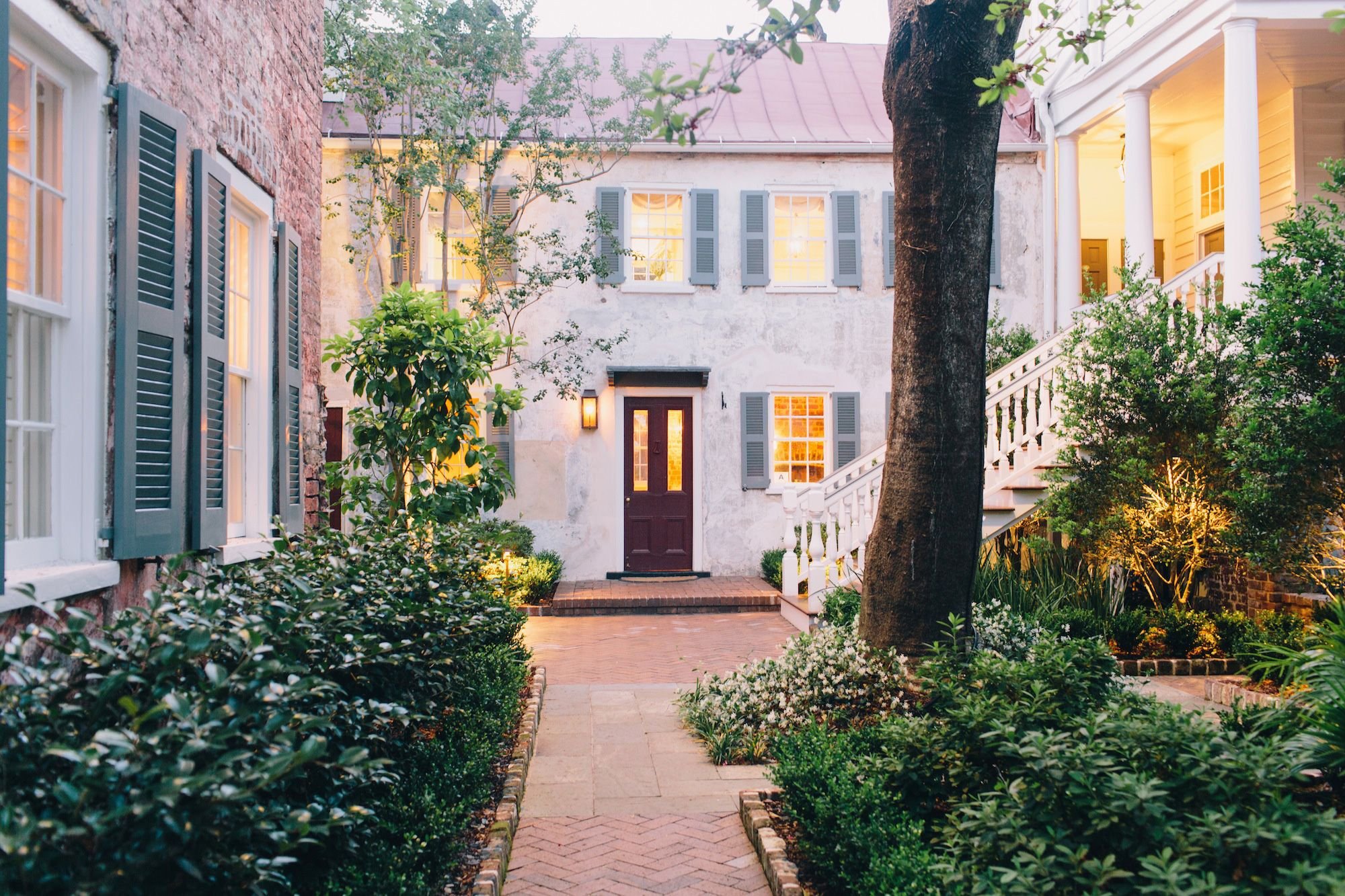
What Charleston's Historic District Asks of Its Hotels
Charleston's Peninsula places particular constraints on premium hospitality. The city's historic preservation standards mean that any property operating within the original street grid must work with existing structures rather than against them — no new-build towers, no imported luxury signatures grafted onto blank sites. The result is a hotel category defined by adaptive reuse: antebellum townhouses, carriage houses, and merchant residences converted into lodging that carries the material weight of the nineteenth century into a contemporary service context.
That constraint, more than any design philosophy, is what shapes the upper tier of the Charleston hotel market. Properties like The Loutrel and The Pinch Charleston — both holding Michelin 2 Keys recognition , operate within this same framework, converting narrow townhouse lots into intimate, low-key-count lodging. The premium proposition is not scale or spectacle; it is depth of material authenticity and the kind of privacy that only a small-room-count building can offer.
Five Buildings, One Interior World
At the corner of George Street and East Bay, five brick residences dating to 1804 present the kind of façade that reads as ordinary in Charleston's historic district: statuesque, warm-toned, with column-studded verandas and lantern light at the entrance. The architecture signals nothing unusual from the street. That restraint is, in part, the point.
What Zero George is doing architecturally sits within a broader pattern visible across premium small hotels in American historic cities: the hotel as private compound, where the guest experience depends entirely on what opens up once you pass the threshold. The five structures , residences and carriage homes , have been connected through a garden courtyard threaded with crushed oystershell pathways and fountains. The compound operates as a single organism with distinct nodes rather than a single-building property with corridors. This format places Zero George closer, in structural terms, to compound-style retreats like Amangiri in Canyon Point or Hotel Bel-Air in Los Angeles than to the full-service tower hotels that define other American city markets.
The Easton Porter Group, the hospitality company behind the property, brought Zero George to market in 2013 under founders Dean Porter Andrews and Lynn Easton. Their approach across the portfolio has leaned toward properties where architectural context and editorial restraint carry more weight than amenity volume , a model that has proved durable in cities where authenticity of place is the primary draw for high-end travelers. The property's 4.8-star rating across more than 900 Google reviews, accumulated over more than a decade of operation, reflects that sustained positioning.
The Guest Experience as Spatial Sequence
Small compound hotels operate on a logic that differs from full-service urban properties. The sequence of arrival matters more when scale is limited: what you encounter in what order, and what the property withholds until you are already inside, shapes the overall register of the stay. The oystershell garden paths and courtyard fountains at Zero George function as a transition mechanism , from the public street life of the lower Peninsula to a contained, relatively quiet interior world. This is not a property oriented toward lobby programming or public-facing social energy of the kind that defines a place like Hotel Bennett Charleston or The Dewberry. The proposition here is withdrawal and privacy within a densely urban historic block.
That orientation aligns with a segment of the premium hotel market that has been gaining ground in American cities over the past decade. Travelers who have stayed at Aman New York or Little Palm Island Resort & Spa , properties where the central feature is controlled access and contained space rather than programmatic richness , will recognize the format. Zero George applies it at a neighborhood scale, in a city where the street itself already carries enormous historical and atmospheric charge.
Where Zero George Sits in the Charleston Peer Set
Charleston's premium accommodation market has a clear hierarchy when assessed by recognition signals. At the upper tier, The Loutrel and The Pinch Charleston carry Michelin 2 Keys. The next band includes HarbourView Inn, Hotel Bennett Charleston, and Post House, each holding Michelin 1 Key. Zero George competes within this field on different terms , the property's sustained guest satisfaction score and its compound format position it as a privacy-first alternative to the properties with larger public programming and higher room counts.
For context outside the Charleston market: the compound-hotel format at this scale is relatively rare in American cities. Properties like Raffles Boston or The Fifth Avenue Hotel in New York City operate at a different volume and service architecture. Within Europe, the closest analog is perhaps the private-palazzo model exemplified by Aman Venice , a large historic structure converted to minimal-key lodging with a premium on discretion over spectacle. Zero George works within those same instincts at a more accessible scale and price point.
Practical Notes
Zero George sits at the corner of George Street and East Bay in the lower Peninsula, within walking distance of the French Quarter, the City Market, and the primary restaurant and bar corridor that runs from Broad Street north through Harleston Village. The address places guests close to the dining density that makes Charleston one of the more serious food cities in the American South , a subject covered in depth in our full Charleston restaurants guide. Bar programming on and around King Street is within easy reach; our full Charleston bars guide maps the options. For broader accommodation comparison across the Peninsula and its surrounding neighborhoods, our full Charleston hotels guide covers the full range of options, including properties in the Ansonborough and Cannonborough-Elliotborough corridors such as 86 Cannon Charleston and The Spectator Hotel.
The property opened in 2013 under the Easton Porter Group and has operated continuously since. For wine and experience programming in the wider Charleston area, see our full Charleston wineries guide and our full Charleston experiences guide.
Frequently Asked Questions
Side-by-Side Snapshot
A compact peer snapshot based on similar venues we track.
| Venue | Cuisine | Price | Awards | Notes |
|---|---|---|---|---|
| Zero George | To the naked eye, the five beautifully restored 1804 residences and carriage hom… | This venue | ||
| The Loutrel | Michelin 2 Key | Michelin 2 Keys | ||
| The Pinch Charleston | Michelin 2 Key | Michelin 2 Keys | ||
| HarbourView Inn | Michelin 1 Key | Michelin 1 Key | ||
| Hotel Bennett Charleston | Michelin 1 Key | Michelin 1 Key | ||
| Post House | Michelin 1 Key | Michelin 1 Key |
Preferential Rates?
Our members enjoy concierge-led booking support and priority upgrades at the world's finest hotels.
Get Exclusive Access