
A Michelin Selected hotel occupying a restored Dominican priory on Predikherenstraat, Martin's Klooster places guests inside one of Leuven's most architecturally significant medieval structures. The conversion preserves cloister galleries, vaulted ceilings, and stone corridors while meeting contemporary hotel standards. For travellers prioritising historic fabric over modern-build amenities, it sits at a distinct point in Leuven's accommodation tier.
Pearl is the En Primeur Club membership app — saves, bookings, and concierge access live there. Same editors, same standards.
- Address
- Onze-Lieve-Vrouwstraat 18, 3000 Leuven, Belgium
- Phone
- +32 16 21 31 41
- Website
- martinshotels.com
- Directions
- Get directions
 Saves & bookings on Pearl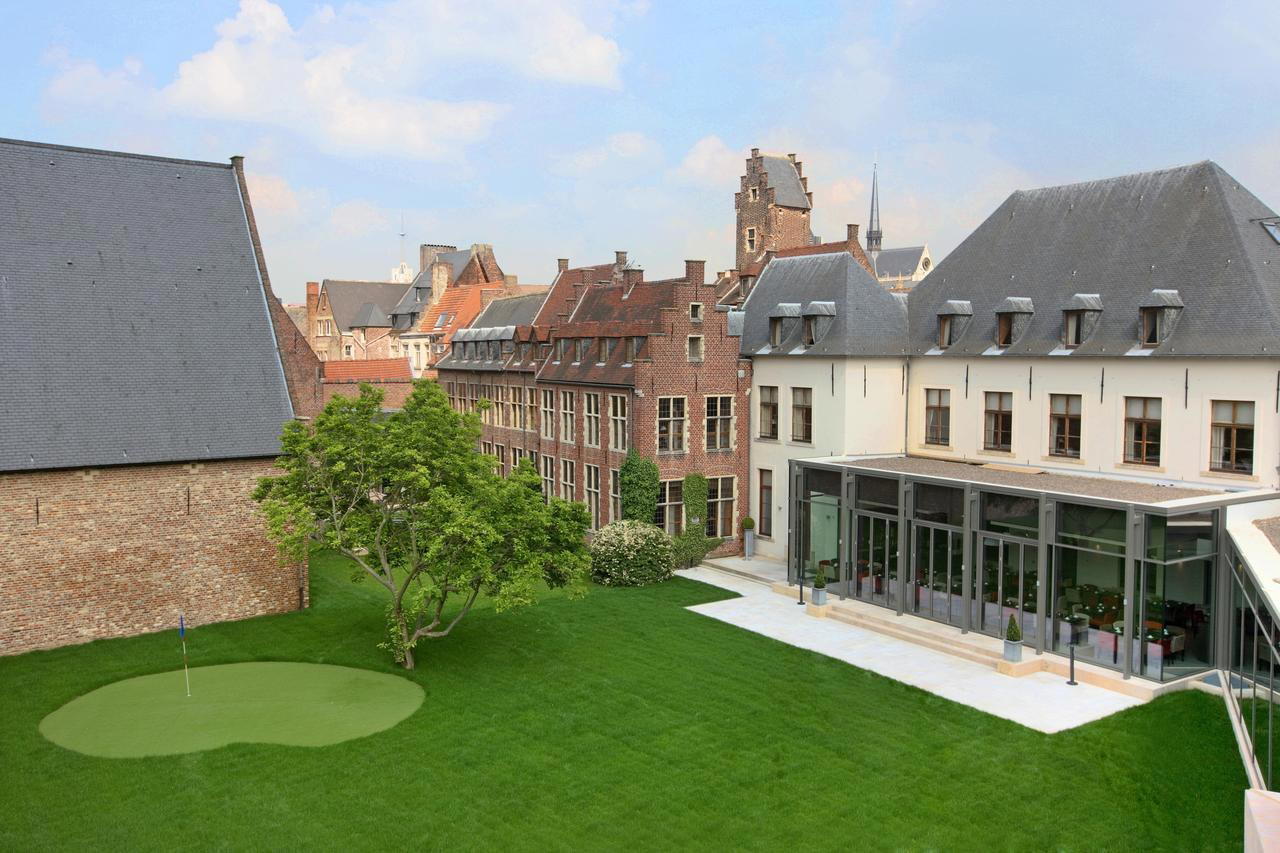
Stone Walls, Living Hotel: The Architecture of Martin's Klooster
Leuven's old city centre contains an unusually dense concentration of Gothic and Baroque religious architecture, most of it still structurally intact. The city's university history, the KU Leuven was founded in 1425, meant that monastic buildings were frequently repurposed rather than demolished, giving Leuven a stock of adaptive-reuse heritage that few Belgian cities of its size can match. Martin's Klooster, at Predikherenstraat 22, occupies one of the more substantial examples: a former Dominican priory whose stone bones remain visible throughout the building. Walking toward the entrance, the scale reads as ecclesiastical before it reads as hospitality. The cloister arcade, the proportions of the windows, the weight of the masonry, these are not reproduced details but original fabric, which places the hotel in a different category from period-inspired design projects elsewhere in Belgium.
That distinction matters when comparing Leuven's accommodation options. The city has a small but considered set of hotels operating in heritage structures, and the quality of the conversion, how honestly the original architecture is engaged rather than cosmeticised, separates the better properties from those that use age as decoration. At Martin's Klooster, the medieval cloister walkways function as circulation space, meaning guests move through genuine 15th-century stonework as part of their daily hotel experience rather than viewing it from behind a rope. For context among comparable properties around Belgium, the approach shares something with the philosophy behind Botanic Sanctuary Antwerp, another selected property that has chosen to work within significant historic fabric rather than smooth it away.
Michelin Recognition and Where It Sits in Leuven's Accommodation Tier
The hotel carries a MICHELIN Selected distinction in the 2025 Michelin Hotels guide, which functions as an entry-level quality endorsement from the guide's hotel editorial team rather than a starred restaurant distinction. In practice, Michelin Selected signals that the property meets a threshold of quality and character that the guide's inspectors consider worth directing travellers toward, it appears alongside other Belgian properties such as Hotel De Orangerie in Bruges, Manoir de Lébioles in Liège, and Villa Copis in Borgloon, a comparable set that skews toward properties with a strong sense of physical identity and local character.
Within Leuven specifically, the hotel occupies a tier above the standard business and chain accommodation that fills much of the city's supply during the academic year. Its closest direct competitor for the heritage-conversion position in Leuven is Tafelrond - The Fourth, also operating in a historic structure in the city centre. The two properties offer different interpretations of Leuven's architectural past, and travellers who care about the physical character of where they sleep have a genuine choice to make between them. The hotel is accessible as a base for exploring Leuven and the wider Flemish Brabant region.
The Physical Experience: Moving Through the Priory
The spatial logic of a converted priory differs fundamentally from purpose-built hotels. Rooms are distributed around a cloister courtyard rather than along a standard double-loaded corridor, which means sightlines, sound transmission, and the sense of enclosure all behave differently. The courtyard itself acts as a pressure valve, a quiet interior space buffered from Predikherenstraat by the building's mass. In a city as active as Leuven, particularly during term time and on weekends when the beer culture draws visitors to the Oude Markt, that acoustic separation is a practical advantage rather than just an aesthetic one.
Vaulted ceilings in communal areas and stone detailing in the corridors are the kind of features that appear in heritage hotel marketing copy everywhere, but here they are structural realities rather than applied finishes. The thickness of the walls, the uneven surfaces, the proportions inherited from a building designed for contemplative religious life rather than commercial hospitality, these things register physically in a way that photographs undersell. Belgium has a number of castle and manor conversions that compete for a similar traveller, including Château Beausaint in La Roche-en-Ardenne, Le Sanglier des Ardennes in Durbuy, and Kasteelhoeve de Kerckhem in Wijer, but an urban Dominican priory in active use as a hotel is a structurally different proposition from a rural château. The city presses up against the building on all sides, and the contrast between the animated street life of central Leuven and the cloister's internal calm is part of what the property offers.
Planning a Stay
Leuven's academic calendar shapes the rhythm of hotel demand in ways that visitors from outside Belgium sometimes underestimate. Term periods and graduation weeks drive occupancy sharply upward, and the city's beer tourism, Leuven is home to AB InBev's global headquarters and a deeply embedded brewing culture, adds weekend pressure year-round. For travellers with flexibility, weeknight stays outside term peaks may be easier. Predikherenstraat is walkable to the main cultural attractions, including the Gothic town hall and the university library, without requiring transport.
Room-category selection can benefit from direct communication about specific physical characteristics, ceiling height, and courtyard-facing or street-facing position. Travellers building a wider Belgian itinerary might also consider properties such as Ganda Rooms & Suites in Ghent, NE5T Hotel & Spa in Namur, or La Réserve in Knokke-Heist to build out a route that holds to a consistent quality standard across regions.
Comparison Snapshot
Comparable venues nearby, for context on price, style, and recognition.
| Venue | Cuisine | Price | Awards | Notes |
|---|---|---|---|---|
| Martin's KloosterThis venue — the venue you are viewing | Historic heritage hotel blending 16th-century monastery architecture with contemporary luxury and modern amenities in a city-center location. | $$$ | 4-Star | Not listed |
| Tafelrond - The Fourth | Historic luxury hotel in neogothic building with modern additions | $$$ | 4-Star | Grote Markt |
| Martin's Patershof | Contemporary classic luxury hotel housed in a restored 19th-century Franciscan monastery with modern amenities integrated into historic architecture. | $$$ | 4-Star | Historical Mechelen City Center |
| August | Minimalist design hotel in a converted historic convent with contemporary pared-back interiors and bespoke finishings. | $$$$ | 4-Star | Green District |
| Main Street Hotel | Quirky boutique hotel with individually themed rooms and curated curiosities; positioned as a charming alternative to standard accommodations. | $$$ | 4-Star | Ypres city center |
| Hotel De Orangerie | Restored 15th-century monastery blending historic elegance with modern comforts | $$$ | 4-Star | Historic Center |
Recognition history
Dated appearances from independent guides and award organizations, with the underlying list record or original source where available.
Michelin Selected
Michelin
Continue exploring
More in Leuven
Hotels in Leuven
Browse all →
Bars in Leuven
Browse all →
Restaurants in Leuven
Browse all →
Wineries in Leuven
Browse all →
At a Glance
- Classic
- Quiet
- Elegant
- Romantic
- Cozy
- Romantic Getaway
- Weekend Escape
- Business Trip
- Historic Building
- Garden
- Terrace
- Design Destination
- Wi Fi
- Bar
- Restaurant
- Business Center
- Concierge
- Room Service
- Bicycle Rental
- Laundry Service
- 24 Hour Front Desk
- Garden
- Wi Fi
- Bar
- Restaurant
- Business Center
- Concierge
- Room Service
- Bicycle Rental
- Laundry Service
- 24 Hour Front Desk
Warm, calming, and refined with brown-and-beige palettes, cozy common spaces filled with cushioned seating, natural light, and a peaceful garden retreat (The Orangery) creating a tranquil urban sanctuary.