Maroon
In a city where Ottoman-era texture meets Austro-Hungarian geometry, Maroon occupies a particular position in Sarajevo's evolving dining scene. The name signals something deliberate about colour, warmth, and register, placing it at a remove from the capital's more casual čevapi counters and tourist-facing kafanas. For travellers working through our full Sarajevo restaurants guide, Maroon is worth understanding on its own terms.
Pearl is the En Primeur Club membership app — saves, bookings, and concierge access live there. Same editors, same standards.
- Address
- 71000 Sarajevo
- Directions
- Get directions
 Saves & bookings on Pearl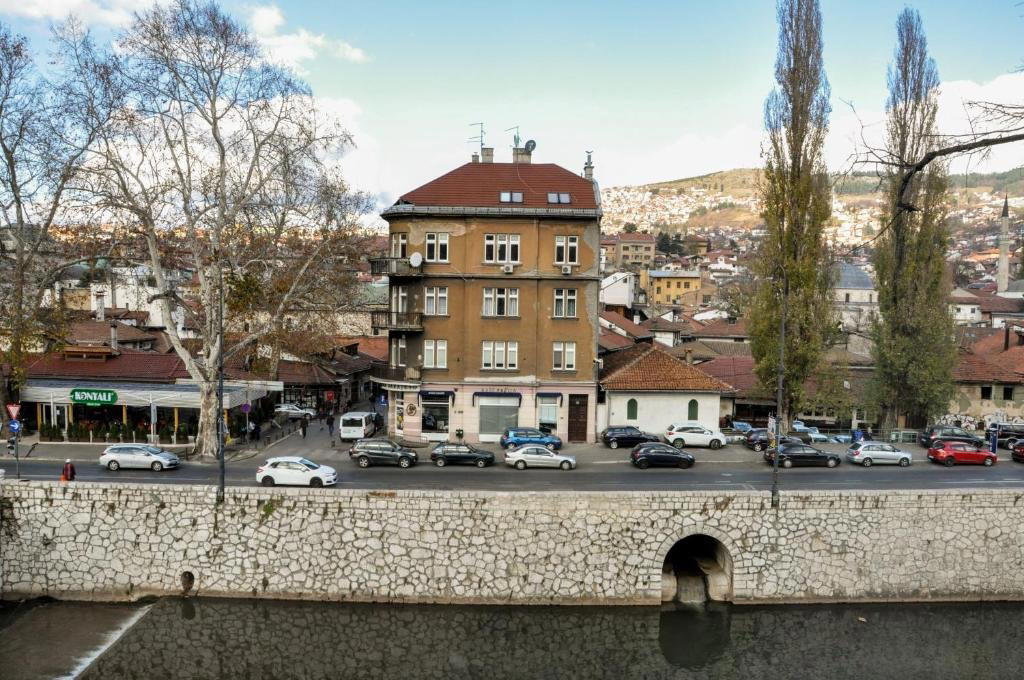
What Sarajevo's Dining Scene Asks of a Place Called Maroon
Sarajevo is one of those cities where the built environment does most of the editorial work. Walk the transition from Baščaršija's Ottoman bazaar quarter into the Austro-Hungarian grid of Ferhadija Street and you have, in about four hundred metres, a compressed history of competing empires, each leaving its own spatial logic on the city. Restaurants here exist inside that layering whether they intend to or not. The question for any serious dining address in Sarajevo is how deliberately it engages with that context, and how honestly its physical space communicates its ambitions.
Maroon, a 4-star hotel in Sarajevo at 71000, sits in a city that has developed a more considered hospitality register over the past decade. The capital's dining scene has moved, at its upper end, away from the purely traditional format, where grilled meats and copper-pot stews define the entire offer, toward spaces that hold tradition and contemporary sensibility in tension. That tension, when it works, is what distinguishes Sarajevo from more homogenised Balkan capitals.
The Architecture of Atmosphere: What a Name Communicates
A venue named for a colour is making a spatial argument before a guest arrives. Maroon as a shade sits between the warmth of terracotta and the depth of burgundy: it suggests interior light rather than daylight, candlelit surfaces rather than exposed concrete, weight rather than minimalism. In cities with strong design-led dining cultures, a name like this functions as a promise about the room. Sarajevo has a tradition of interiors that absorb rather than perform, with the wooden-latticed architecture of the old bazaar quarter and the high-ceilinged Habsburg rooms of the city centre both prioritising enclosure and warmth over spectacle.
That inheritance matters for reading what Maroon might be doing spatially. Across European cities with similarly layered histories, Prague, Budapest, Vienna, the dining addresses that hold long-term authority tend to be those that reference the local architectural vernacular rather than importing a generic contemporary language. The difference between a room that feels placed in its city and one that could be anywhere is usually found in material choices: the presence or absence of aged wood, the quality of light sources, whether textiles carry regional craft traditions. For visitors arriving from high-design hotel environments such as Hotel Sacher Wien in Vienna or Cheval Blanc Paris, the appeal of a Sarajevo room is precisely that it cannot be replicated elsewhere.
Sarajevo's Position in the Regional Dining Conversation
Bosnia and Herzegovina remains among the least covered Balkan destinations in international food media, which means that Sarajevo's better addresses operate without the critical infrastructure that would, in a city like Belgrade or Ljubljana, quickly establish a competitive hierarchy. That absence cuts both ways: it removes a benchmark that would help position Sarajevo's upper tier internationally, but it also means that the local dining scene develops on its own logic rather than chasing external validation.
For the traveller calibrated to institutional recognition, as they might seek at Bvlgari Hotel Tokyo or in the starred restaurant environments around Le Bristol Paris, Sarajevo requires a different frame. Authority here comes from longevity, from a consistent local following, and from the quality of sourcing in a country where lamb, dairy, and produce from the surrounding valleys remain genuinely distinctive. The Bosnian table has one of the more coherent regional identities in the former Yugoslav space, grounded in Ottoman culinary inheritance, central European pastry and coffee culture, and a mountain agriculture that produces specific ingredients unavailable elsewhere.
Maroon's address within that context, is best understood through the lens of what Sarajevo's current dining moment rewards: consistency, spatial intelligence, and a legible relationship to local material culture.
Planning a Visit: What the Sarajevo Context Requires
Sarajevo is a city that rewards physical movement between neighbourhoods rather than anchoring to a single district. Baščaršija is the logical starting point, dense with copper workshops, the Gazi Husrev-beg Mosque, and the original Ottoman commercial street pattern. From there, the Habsburg centre and its coffee-house tradition is a short walk north and west. Maroon's central postcode places it within reach of both zones, which is to say within the core area where most visitors to the capital will already be spending time.
Visitors travelling into Bosnia more broadly, through Jajce to the north where Uno Apartman Jajce offers a base near the waterfall town, or south toward the Drina Valley and Pension Jelena in Višegrad, will find Sarajevo a natural anchor for the trip. The capital has direct connections to Vienna, Istanbul, and Frankfurt by air, and an improving bus network into the wider Western Balkans.
Reservations are recommended.
Travellers who structure trips around design-led and architecturally considered stays, whether at properties like Amangiri in Canyon Point, Castello di Reschio in Lisciano Niccone, or Aman Venice, will recognise in Sarajevo a city that rewards the same kind of spatial attention. The layers here are denser and less curated than in those environments, which is part of the point.
Continue exploring
More in Sarajevo
Hotels in Sarajevo
Browse all →

At a Glance
- Modern
- Cozy
- Weekend Escape
- Historic Building
- Wi Fi
- Air Conditioning
- Free Parking
- Airport Transfer
- Laundry Service
- Street Scene
- Wi Fi
- Air Conditioning
- Free Parking
- Airport Transfer
- Laundry Service
Soundproofed, air-conditioned apartments with modern comforts in a quiet, allergy-free setting amid Sarajevo's lively old town.